Author: Amanda Smith

  • Operational and Strategic Management for Your Farm or Ranch Business

    Operational and Strategic Management for Your Farm or Ranch Business

    Imagine you scouted one of your fields yesterday and an insect pest reached the threshold number for spraying. Today, you bring the tractor and sprayer to the field to minimize the potential damage to yield that could occur from the insect pest if it was left untreated. This is just one of dozens of operational management decisions and activities you do each day.

    Obviously, these operational management decisions are critical for keeping your farm running as efficiently as possible. However, it is just as important for you, as a farm or ranch business manager, to spend time thinking beyond the current growing season and focus on management decisions that may affect your farm in the future. These long-term management decisions are considered strategic management.

    Both operational and strategic management are necessary for the success of the farm or ranch business. Operational management is straight forward. If it hasn’t rained, you decide to irrigate. If it is time to apply a mid-season fertilizer, you apply fertilizer. If one of your calves gets sick, you quarantine her from the herd and treat her symptoms. Strategic management involves planning and making decisions for the farm or ranch business that will impact it in the next five years or longer. Strategic management answers the questions: “Where do I want to be?” and “What do I need to do to get there?”

    Strategic management is identifying the vision and purpose of your farm or ranch business, setting goals for the near- and long-term, analyzing your farm’s strengths and weaknesses, evaluating opportunities and threats outside of the farm, and making decisions that steer you toward a desired goal or outcome. Those might include:  goals for net worth or profit, goals for your operation to reach a certain size, a vision for your ideal way of life, or plans for retirement. The path to those outcomes may include decisions such as expanding the operation by acquiring more land or breeding livestock, adopting new technology, diversifying enterprises, entering new markets, hiring employees, or positioning the farm and the next generation for a successful transition.

    In addition to your day-to-day operational management, you should set aside time to think strategically about the future. However, setting aside time when you are busy with operational management is easier said than done. Scheduling a set time to plan strategically is necessary. It will require you to block out several hours of your day a couple of times a month or more depending upon your goals. It may be easier for you to prioritize strategic management if you get away from the farm or ranch. A couple days away will enable you to focus entirely on planning for the future. It would be most beneficial if this occurs after you have compiled your financial data from the most recent year.  Be sure to include any important partners or family members who are instrumental to the future of your farm. 

     There are many resources available to help you with this process. Several Land Grant Universities offer programs in strategic management through their Cooperative Extension Service. There are also numerous podcasts, case studies, and textbooks written on strategic management. Building a Sustainable Business, is a useful guide to business planning and strategic management from Sustainable Agriculture Research and Education. It is downloadable for free online or available for purchase in print.

    Strategic management is critical to the long-term success of your farm or ranch business. It is easy to get caught up in the daily operational management decisions, but when you incorporate strategic management, you will be better prepared for opportunities and challenges that may arise.


    Recommended citation format: Smith, Amanda R. “Operational and Strategic Management for Your Farm or Ranch Business.” Southern Ag Today 6(28.1). July 6, 2026. Permalink
  • Estimating Cost of Production and Breakeven Prices with Enterprise Budgets

    Estimating Cost of Production and Breakeven Prices with Enterprise Budgets

    Knowing how much it costs to produce your product is one of the most important pieces of information for a farmer, rancher, or agribusiness manager. The cost of production provides the foundation for calculating breakeven prices, which impact marketing plans and sales decisions. One effective tool for these calculations is the enterprise budget.

    Enterprise budgets are detailed plans that estimate the costs of producing a specific agricultural product or service. An enterprise budget can be created for each crop, livestock, or service that a grower plans to produce during the year. Examples include corn, cotton, peanuts, feeder calves, hay, blueberries, tomatoes, cabbage, and many others. An enterprise budget is typically created on a per-acre, per-head, per-pound, or per-service basis. They are also created for one growing season or production cycle.

    One of the first steps in creating an enterprise budget is to estimate costs. There are two types of costs, variable and fixed. Variable costs are use-related and will vary based on the level of production and the amount of input a grower plans to use. Variable costs can include seed, fertilizer, fuel, repairs & maintenance on machinery, labor, pesticides, or feed, depending upon the enterprise being evaluated. Fixed costs are time-based and do not change regardless of the production level. Fixed costs include land ownership costs, interest, depreciation on machinery and equipment, insurance, and taxes.

    Once variable and fixed costs are estimated, a grower can calculate their breakeven price. The breakeven price is the price at which costs are covered, and profit is zero. Breakeven price equals total cost (variable + fixed costs) divided by expected yield, as shown in the equation below. The expected yield tends to come from historical data for that farm. Growers can also calculate a breakeven price that covers only their variable costs, the only difference being that you would use variable cost in the equation below instead of total cost.. 

    Growers who estimate their breakeven price know the minimum price they need to get for their product to cover their costs. It is advised that growers lock in prices above breakeven as part of their marketing plan and sales decisions to give them a higher chance of making a profit.

    The land-grant universities throughout our coverage area have enterprise budgets that can be used as a template for growers. These enterprise budgets are representative of the region where they were developed, and individual farm numbers will vary. Producers are highly encouraged to use the budgets as a template and adjust the numbers to reflect their production plans for the upcoming season. This will provide a more accurate estimate of their own cost of production and breakeven prices.


    Smith, Amanda. “Estimating Cost of Production and Breakeven Prices with Enterprise Budgets.” Southern Ag Today 6(3.1). January 12, 2026. Permalink

  • Risk Management

    Risk Management

    I was at a field day showcasing research conducted at one of our university’s research and education centers a couple of weeks ago. Land grant universities across the U.S. have similar research and education centers, where field research is conducted and results are shared with producers and industry stakeholders. These centers enable experts to conduct unbiased, scientific research that gets disseminated to future adopters of the production practices or technologies being studied. If you have a chance to attend a field day at a local university research and education center, you won’t regret the experience. At the end of this field day, we gathered in the air-conditioned conference room for a debrief. We asked producers and stakeholders about their thoughts and needs for future research and education. When the topic of agricultural economics came up, one producer mentioned the continued need for risk management education.

    So how do producers manage their risk?  What follows are a few thoughts on the five main areas of risk in agriculture: production, marketing, financial, legal, and human. 

    Production risk impacts the ability to produce livestock, poultry, or crops. The weather is unpredictable and impossible to control, but producers can diversify by growing a variety of crops or meat animals throughout the year. Appropriate crop rotations and nutrient management plans can ensure fertilizers are used efficiently. Integrated pest management programs can help reduce the risk of damage from insects, diseases, and weeds. The use of irrigation management systems can improve water use efficiency. Another way to manage production risk is with insurance, which can help cover losses that may occur from an unpredictable event that impacts production. 

    Marketing risk impacts the sale of products and the prices at which they are sold. Producers who know their cost of production can forward contract their products at prices above their costs to lock in their potential for profit. Creating a marketing plan takes out the indecision and emotional component that may occur when prices are changing. Producers may also use futures or options to hedge the cash price of the livestock or crops in production. Futures and options can help establish price floors or ceilings for products. Another way to manage marketing risk is through selling directly to consumers or joining a marketing cooperative to sell products with other producers. Crop insurance, with revenue protection, is also a tool that can be used to manage marketing risk.

    Financial risk impacts the business side of the farm or ranch. First and foremost, producers can manage financial risk through excellent recordkeeping and up-to-date financial statements. The use of financial recordkeeping software enables producers to monitor and manage financial performance measures like working capital, liquidity, return on investment, and profitability. Financial software can also be used to look at cash flow and see what times of year operating capital will be needed and when it can be paid off. Keeping an eye on family living withdrawals from the farm business is also important, as well as determining if off-farm income is needed to support the family.

    Legal risk impacts the farm business in terms of liabilities and compliance with regulations. The organizational structure of the farm business can be an important strategy to protect farm business owners from personal liability. Sole proprietorships, although easy to form, leave the owner personally liable for any debt of the farm business. Other forms of legal organizational structures include partnerships, limited partnerships, corporations, and limited liability companies. States may vary in the licensing and paperwork required to form different organizational structures, so producers are encouraged to seek advice from their accountant or an attorney. Managing legal risk also means being aware of laws and regulations that impact the farm business and complying with them at the local, state, and federal levels.

    Human risk impacts the people in the farm business, from owners and managers to heirs and employees. One way to manage risk between owners and heirs is to have an estate plan in place to help ease the transition of the farm business to heirs. Open communication is important within the family to ensure all members know their role in the farm business. Communication is also important with employees. There should be clearly written job descriptions with clear expectations on performance, and employees should receive appropriate training for their jobs. Managing human risk includes knowing and following all local, state, and federal labor laws that govern occupational safety and agricultural worker protections. 

    When risks are managed well, producers can minimize loss and increase their probability of profit. When you get a chance, attend the next field day at your local research and education center so you can learn how best to manage risk.


    Smith, Amanda R. “Risk Management.” Southern Ag Today 5(38.1). September 15, 2025. Permalink

  • Cropland Rents

    Cropland Rents

    Agricultural economists receive requests for a variety of data from our clientele. One common question we receive during this time of year is about the going rate on cash land rents. The U. S. Department of Agriculture National Agricultural Statistics Service (USDA NASS)  conducts an annual survey on cash land rental rates and publishes the results on its website by early August of each year.

    Producers often rent a portion of the total land they farm. Part of this is because acquiring land is difficult due to scarcity, and the other part is because it takes significant capital to buy land. Farming on more acres by renting enables producers to more efficiently utilize their assets and achieve economies of scale through increased production while spreading their costs across more acres.

    Producers can rent either irrigated or non-irrigated cropland. If the landowner has an established irrigation system in place, the rent on irrigated land is higher than the rent on non-irrigated land. In some instances, a producer can place temporary irrigation on the land they are renting. Since the producer owns and pays for the irrigation system, the rent expense is usually comparable to that of non-irrigated land. A variety of agreements can be made between the landowner and producer to accommodate their needs.

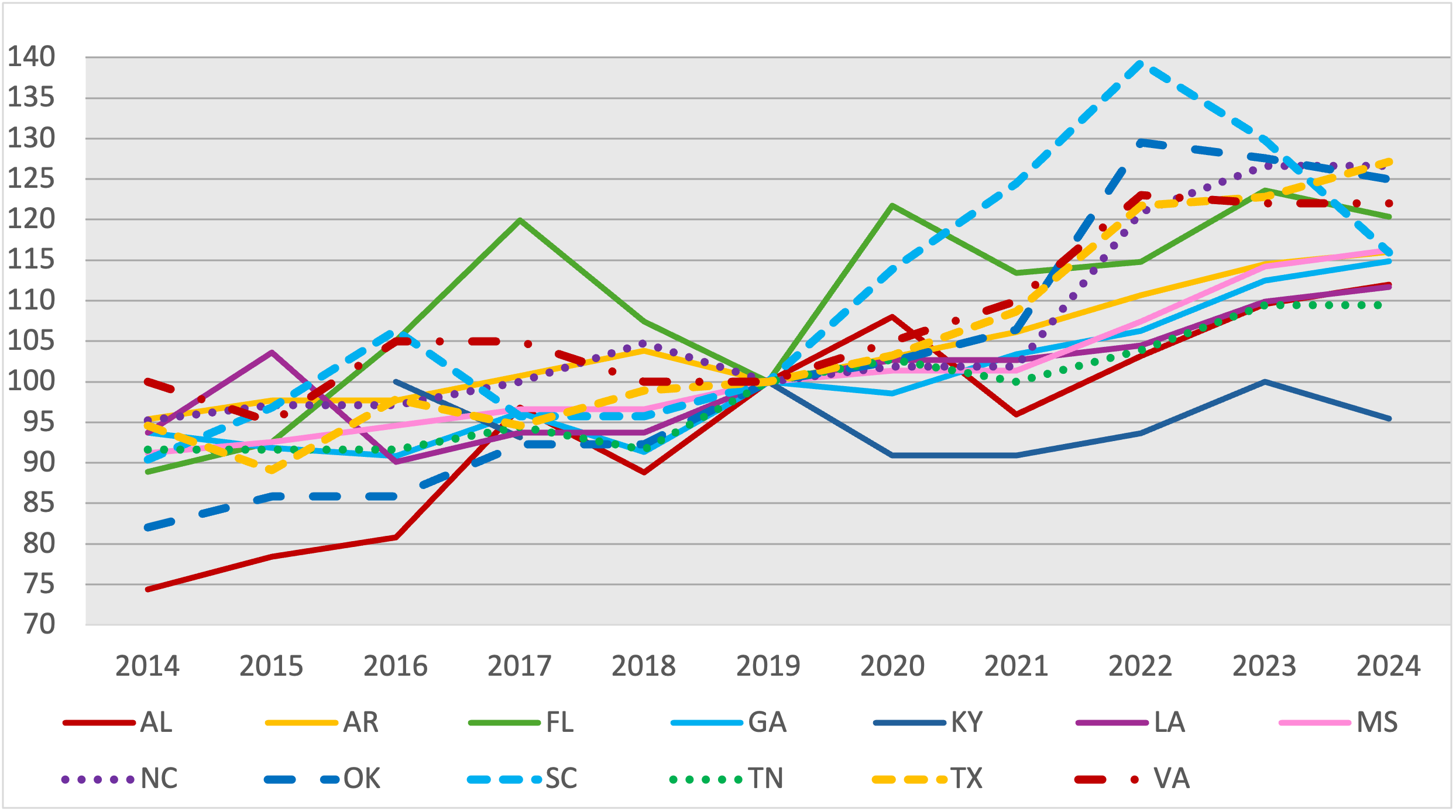
    The following 2 figures show indices of average annual cash rents for the five years before and after the COVID-19 pandemic for irrigated (Figure 1) and non-irrigated (Figure 2) cropland. Land rents can vary significantly from parcel to parcel and state to state. An index was chosen instead of the actual value of cash rents per acre to allow for relative comparison between states. The year 2019 was chosen as the base year of the index because the rent values, published in August 2019, were not impacted by the pandemic. The scale of the y-axis on the irrigated and non-irrigated charts are the same with an index range from 70 to 140, although there is a much narrower range in observed non-irrigated land rents over the 11-year period from 2014 through 2024 than the observed range on irrigated.

    Figure 1 shows a larger increase in average annual cash land rents on irrigated cropland during the 5-year period following the pandemic compared to the 5-years prior. South Carolina, Oklahoma, and Virginia saw a peak in average annual irrigated cash land rents in 2022, while North Carolina and Florida saw peaks in 2023. In 2024, these five states saw land rents come down slightly or stay about the same as their peak rates. The other states (Texas, Arkansas, Mississippi, Georgia, Alabama, and Louisiana) have seen rental rates continue to increase through 2024. Only Kentucky saw land rents below the 2019 average annual rate, except during 2023, when it was the same.

    Figure 2 also shows a larger increase in average annual cash land rents on non-irrigated cropland during the 5-year period following the pandemic. However, the rate of increase is smaller than that of irrigated cropland. Alabama, Georgia, Kentucky, Louisiana, Mississippi, North Carolina, Oklahoma, Tennessee, and Texas saw their highest average annual cash land rents on non-irrigated cropland in 2024. South Carolina and Virginia saw a peak in 2023 and a slight decline in 2024. Florida saw a peak in 2020, with rents on non-irrigated cropland below the rate in 2019 for the other years after the pandemic. The only state to see land rents on non-irrigated cropland peak prior to the pandemic was Arkansas in 2015.

    Figure 1. Index of Average Annual Cash Rents, Irrigated Cropland in the Southeastern U.S. (2019 = 100).

    Source: Author created index with data from the USDA NASS, Cash Rents Survey, August 2024

    Figure 2. Index of Average Annual Cash Rents, Non-irrigated Cropland in the Southeastern U.S. (2019 = 100).

    Data Source: Author created index with data from the USDA NASS, Cash Rents Survey, August 2024.

    Land rental agreements between landowners and producers will vary. There are fixed cash rent agreements where an agreed upon annual rate is paid by the producer to the landowner. There are flexible cash rent agreements where some of the burden of risk is taken upon by the landowner if production costs and revenues fluctuate. In a flexible cash rent agreement, the annual rate can differ from year to year, depending upon the state of the local farm economy. There are also share agreements that exist where a portion of the production from the rented land is shared between the landowner and producer. Landowners and producers should work to find the ideal agreement that is best for both parties.

    References: 

    U.S. Department of Agriculture (USDA) National Agricultural Statistics Service, Cash Rents Survey, August 2024. https://quickstats.nass.usda.gov/results/E0F5EB36-3313-3D7B-9E7F-E56A3365CF2B#9A9F55D7-E267-38C6-ACB9-DF106291B5A7


    Smith, Amanda. “Cropland Rents.” Southern Ag Today 5(16.1). April 14, 2025. Permalink

  • Liquidity and Working Capital a Priority

    Liquidity and Working Capital a Priority

    Agricultural lenders listed liquidity and working capital as their top concern for producers this crop year, according to a survey conducted by the American Bankers Association and Farmer Mac last August. This is likely an indicator that lenders are seeing the outlook for lower commodity prices while at the same time retaining elevated input costs, including interest rates on operating notes. Because of the nature of agriculture, where there are months when cash outflows exceed inflows during the growing season, liquidity and working capital should be a priority every year, regardless of market outlook.

    Liquidity is a producer’s ability to meet their cash financial obligations as they become due. Working capital is a measure of liquidity that measures how much current assets exceed current liabilities. 

    Current assets and current liabilities are found on the balance sheet. Current assets include cash and other assets that can be converted to cash relatively quickly, while current liabilities include any debts that are due within a year or less. Some examples of current assets include cash, inventories of crops, market livestock, livestock products and supplies, accounts receivables, prepaid expenses, marketable stocks and bonds, and the cash value of life insurance. All of these can be quickly converted to cash to pay any debts that come due. Current liabilities are debts or obligations that must be paid within a year’s time or less, including accounts payable to merchants and suppliers, current notes payable and the current payments required on long-term notes payable to lending institutions.

    Liquidity, by definition, is related to cash flow. In agriculture, a pro forma cash flow statement is a great tool to estimate cash flows and working capital balances for the upcoming crop year, providing an idea of the approximate timing and size of inflows and outflows. Of course, it is difficult to truly predict the future. As a result, producers need to have an appropriate amount of working capital on hand to provide flexibility in meeting uncertain cash flows. 

    An example of this occurred during the planting season this year. The weather was unusually wet in some areas this past month, leading to saturated soils that caused seedling damage. Some producers had to make the decision to replant some of their fields. Those who had the working capital available were able to afford this unexpected cash outflow. Liquid reserves, by means of working capital, are necessary for the sustainable operation of the farm business every year.


    Sources/Resources:

    Fall 2023 Agricultural Lender Survey Results. (Nov 6, 2023). The American Bankers Association and Farmer Mac survey conducted August 2023. https://www.aba.com/-/media/documents/reference-and-guides/2023-ag-lending-survey-report.pdf Obtained online Jun 10, 2024.


    Smith, Amanda R. “Liquidity and Working Capital a Priority.” Southern Ag Today 4(26.3). June 26, 2024. Permalink