Author: Steven Richards

  • Can Cooperatives Help Reverse the Decline in Rural Grocery Stores?

    Can Cooperatives Help Reverse the Decline in Rural Grocery Stores?

    Independent rural grocery stores have been in decline due to factors such as competition from newer, smaller-footprint rivals, buying-power disadvantages relative to larger chains, rural population loss, and the aging out of independent grocery store owners. This decline is leading some small towns to explore starting cooperatively owned grocery stores, as history shows that many cooperatives were formed to serve rural areas where private investment failed. Examples include farmers’ cooperatives, rural electric and telephone cooperatives, and the Farm Credit System.

    Recently, the South Carolina Center for Cooperative Development surveyed a small town to assess interest in a cooperatively owned grocery store and found interesting results.

    The Positive Findings

    In general, the survey found substantial enthusiasm for a grocery store. The survey drew 773 complete responses from a population center of about 9,000 people. Most participants (84%) either lived in the city center or were within a 20-minute drive. Participants’ shopping habits showed that they use a variety of food outlets, with many respondents (~80%) shopping at major grocery chains and discount stores. Average monthly grocery spending ranged from $200 to $800, with a median of $400–$599.

    When choosing where to shop, respondents ranked product quality first (80.7%), followed by price or value (62.7%) and product availability, selection, and variety (48.9%). When asked which product offerings were the most important, fresh produce was ranked highest, followed by meat and seafood, dairy products, organic or natural foods, and prepared foods. Locally sourced products seemed to matter more than organically sourced products for most participants: 88.6% rated local sourcing at least moderately important, while 65.7% rated organic sourcing at least moderately important.

    Respondents also viewed the store as more important than a typical retail outlet, like an “anchor store” that drives foot traffic for a struggling main street. A deli or café was the most desired additional service, followed by online ordering and pickup, cooking demonstrations, community events, delivery, and nutritional education. Respondents also emphasized accessibility, parking, operating hours, professional management, and a welcoming atmosphere.

    The Lukewarm Findings

    Familiarity with the cooperative concept was limited. Sixty-nine percent said they were either only slightly familiar or not familiar at all with the model. Membership interest was more measured. About 61% were somewhat or very interested in becoming member-owners. Of those asked about investing, roughly three-quarters considered a one-time stock purchase of less than $300 reasonable. Engagement interest was limited, with interest in serving on a board or committee split evenly at 50% “yes” and 50% “no.”

    The sample was also comparatively affluent, with about 70% reporting household incomes of $100,000 or more, suggesting that the findings may not fully reflect all income groups in the wider community.

    Next Steps and Sources for Assistance

    Cooperative groceries can work, though they typically do not resemble traditional grocery stores. While the survey findings point to a potentially promising market, long-term success depends on clear education (and engagement) with the cooperative model, and thoughtful collaboration with existing farmers, farm markets, and other local businesses. Potential cooperative “owners-as-customers” must also be realistic about the variety of products offered, as grocery store margins are low and inventory costs high.

    The South Carolina Center for Cooperative and Enterprise Development is an example of how most states have resources to help rural towns with this issue. If you are looking to start a cooperative, many land-grant universities have extension personnel and cooperative specialists who can help with these items.  Also, there are national organizations available to help cooperative grocery stores, once a cooperative has been established.

    For more information:

    Food Co-op Initiative  https://fci.coop

    National Co-op Grocers  https://www.ncg.coop


    Recommended citation format: Richards, Steve. “Can Cooperatives Help Reverse the Decline in Rural Grocery Stores?Southern Ag Today 6(37.5). September 11, 2026. Permalink

  • Cultivating Successful Business Partnerships

    Cultivating Successful Business Partnerships

    Many farms are involved in business arrangements, whether through a partnership (or multi-member LLC), a joint venture, a contractual agreement, or a handshake deal. Farm transition plans often include a business partnership between the generations as an in-between step.

    Sometimes, business partnerships just happen, such as a farm family deciding to file a partnership tax return to save on taxes or reduce certain payment limitations. In any case, farm partners are stuck with each other for a while, so how does one cultivate a successful business partnership?  

    Choosing the Right Soil

    The Southern Ag Today article “Before Doing Business Together” outlined considerations to keep in mind before entering a joint business arrangement with someone else. If the business arrangement is intentional, ensure an attorney prepares a legal agreement that spells out everything, especially how decisions are made, how money is handled, and how to unwind the partnership. 

    Amending the Soil

    If things are going well, it is easy to forget that other people are involved in managing your business. But relationships change over time: expectations change, people change, and not always for the better. Sometimes one can inherit a new business partner due to the retirement or death of a previous business partner.

    Expectations for a business partner’s performance may have been clearly stated in the past, but a reset may be needed. Ideally, this would involve revisiting and amending the business agreement. At a minimum, a farm business meeting should be held on a routine schedule (at least annually) to discuss expectations and performance among the group.

    Getting Rid of the Weeds

    Unresolved conflicts, no matter how small, are like weeds choking a business. Unchecked negative feelings can seriously affect business and family relationships. The only way to eradicate these infestations is by resolving the conflict. The responsibility for resolving conflict weighs equally on both parties, the one responsible as well as the one who is upset. Many times, the “offender” doesn’t even know that they have done anything wrong. 

    Regular business meetings are a great way to stay on top of expectations and resolve conflicts. If neither party can discuss the problem, it may be necessary to use a neutral third-party facilitator to get things out on the table.

    Protecting from Diseases and Pests

    Protect against further conflict by improving communication and planning techniques between business partners. An old friend, Dr. George Conneman, often spoke about the 7 Cs for family business success: communication, commitment, common objectives, compromise, cooperation, contribution, and consultation.

    Knowing When to Replant

    All business partnerships end at some point.  It is best to have a plan for how this will happen. A properly documented exit plan will ease partnership dissolutions, minimizing the potential for conflict, hard feelings, and courtroom battles.

    Resources

    If you need personal assistance, Cooperative Extension agricultural agents and specialists have experience, resources, and referrals to help farm families discuss the topics mentioned above. If you would like to learn more about joint business arrangements, download this free workbook

  • Cooperative Involvement in Rural Food Systems

    Cooperative Involvement in Rural Food Systems

    Cooperative Involvement in Rural Food Systems

    Rural food systems[1], including the local foods movement, have been a popular topic over the last twenty years and gained even more popularity during the COVID-19 pandemic.  Did this movement also encourage more cooperatives?  To hone in on this, a survey of twenty-two CooperationWorks![2] members was performed in 2025, representing every state except for Nevada, Arizona, and Utah.  

    Cooperative Involvement in Rural Food Systems by Purpose and Activity

    Survey results hint at the prevalence of cooperatives in rural food systems and the purposes and activities they represent[3].  Figure 1 shows that cooperatives are mentioned more often in relation to local, specialty, and niche-based foods. In contrast, other organizations, such as non-profit organizations and NGOs, are more often mentioned in relation to efforts to address nutrition and food insecurity. Figure 2 shows the mentions of cooperative involvement by specific rural food system activities. Food production and distribution are the most frequently mentioned activities, followed by rural grocery stores, food processing, and multi-stakeholder firms[4].

    The Importance of Cooperatives in Rural Food Systems

    While this survey does not measure the magnitude of cooperative involvement in rural food systems, it suggests that cooperatives are an important ingredient. Open-ended survey responses suggest that cooperatives involved in rural food systems tend to be newer and smaller, unlike older and larger “legacy” commodity cooperatives.  This makes sense, as many aspects of rural food systems, such as local food systems, are also small and new, accounting for about 3.2% of our nation’s food supply (USDA NASS, 2024).

    Figure 1: Cooperatives Mentioned in Rural Food Systems by Purpose

    Figure 2: Cooperatives Mentioned in Rural Food Systems by Activity

    The Cooperative Advantage

    Many survey respondents expressed concerns about the continued availability of grant funding for rural food system efforts, as some have vanished amid shifting priorities away from COVID-era initiatives (e.g., LFPA grants). Cooperatives may have an advantage here, as cooperative members contribute equity to their organizations, potentially insulating them from changes in public funding priorities. 

    If you are part of a cooperative, stay engaged by attending meetings, voting in elections, and serving on the board.  If you are looking to start a cooperative, CooperationWorks! and many land-grant universities have extension personnel and cooperative specialists available to assist.


    [1] Rural food systems are largely synonymous with local and regional food systems: networks connecting food production, processing, distribution, and consumption within a specific region.  

    [2] CooperationWorks! is a national network of cooperative development organizations in the US. https://cooperationworks.coop/

    [3] The survey questions record the number of responses that mention cooperatives being involved in these activities and purposes.  These percentages should not be considered the number or percentage of cooperatives involved in these activities or with these purposes. This survey is simply a barometer of whether cooperatives are involved in rural food systems. 

    [4] Multi-stakeholder firms are those with multiple membership types (e.g., producers and consumers), voting and investment options.  Some states allow cooperatives to have these features, and some do not. 


    Richards, Steven. “Cooperative Involvement in Rural Food Systems.Southern Ag Today 6(19.5). May 8, 2026. Permalink

  • Before Doing Business Together

    Before Doing Business Together

    Joint business agreements, whether a general partnership, an LLC, or a multi-generational business, all require two or more independently minded farmers to work together. A farmer recently told me that partnerships were “the darndest ship you’ll ever ride on.” I like this quote because it reminds us that partnerships and other jointly held businesses can sail through both smooth and rough “seas.” If you are in the early stages of forming a joint business arrangement, what should you consider before signing the paperwork?  

    Consideration #1: Is a joint business arrangement the best solution?

    In general, a joint business arrangement increases the likelihood of success when potential partners understand the problem for which the arrangement is seen as a possible solution. Sometimes a simple contract, such as a lease agreement, may be the best solution.

    Consideration #2: Choosing the right business partners

    Even if you are contracting with another farm, your business arrangement will need to rely on good communication and trust.  Enforcing a contract in court should be a last resort. Keep in mind the traits you are looking for in a business partner, and make your decision rationally, based on facts, rather than making a hurried decision. 

    Consideration #3: Pre-evaluate yourself and your prospective business partners

    Personal relationships are significant to the success of joint business arrangements. The following questions will help you and your potential partners identify and discuss strengths, weaknesses, and expectations before creating any new business arrangement.  

    • Do you prefer to work and make decisions with someone else or work alone?
    • Are you open to change, or would you prefer to “do it like you always have done it?”
    • Can you make suggestions and recommendations instead of giving orders?
    • Are you willing to listen to and accept ideas and suggestions from others with less experience, less training, or less education?  This is especially important when working with the next generation.
    • Are you willing to give others credit for things well done and accept responsibility for your own mistakes?
    • Can you discuss business issues with your potential business partner without getting angry?
    • Are you willing to attend regular business meetings with your partners?
    • Are you willing to develop a written business agreement and update it when necessary?

    Consideration #4: Your Land Grant University Cooperative Extension Service

    If you need personal assistance, Cooperative Extension agricultural agents have experience helping farmers discuss the topics mentioned above and can serve as neutral, third-party facilitators in the business agreement process. If you would like to learn more about doing business together and the numerous options available, please visit https://coopcentersc.org/existing-business/  to download a free “Doing Business Together” workbook. 

    For existing businesses, Cooperative Extension has resources and referrals to help resolve conflicts. The current economic headwinds are making for difficult financial times, straining business relationships. It is an important time to work together and keep that business partner “ship” sailing through choppy seas.


    Richards, Steven. “Before Doing Business Together.” Southern Ag Today 6(12.1). March 16, 2026. Permalink

  • Agricultural Cooperatives in the United States: How Does the South Stack Up?

    Agricultural Cooperatives in the United States: How Does the South Stack Up?

    Good Reasons to Cooperate

    Southern Ag Today has recently published several articles on why producers should consider joining, starting, or becoming more involved with a cooperative in their state. An annual publication from the US Department of Agriculture’s Rural Development[i] (USDA RD) offers solid financial reasons to do the same.  How does a return on investment (allocated equity in the case of a cooperative) of 11.3% to 45.2% sound? It appears that cooperatives offer a distinct advantage to farmers in their state.  

    How Does the South Stack Up?

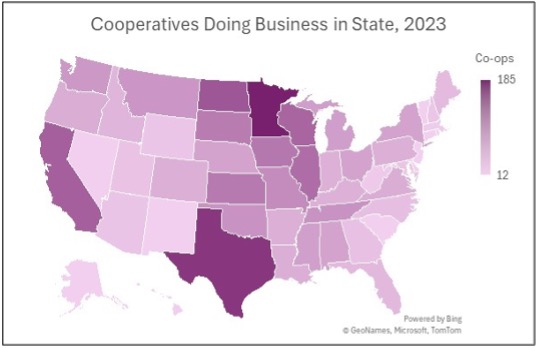
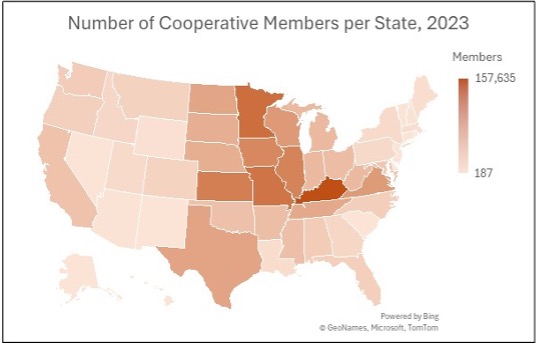
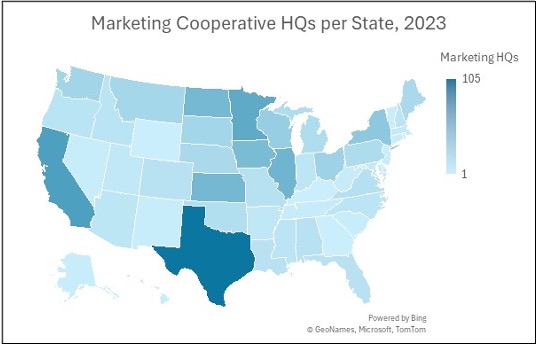
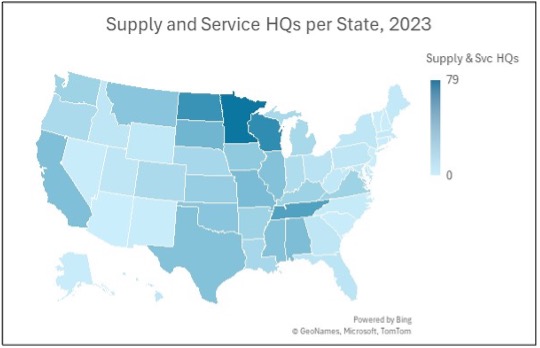
    The readership might be interested in a little competition (or some light post-holiday reading) – how does the US Southern Region[ii] stack up with the rest of the US?  Table 12 in the report cited above provides information on cooperatives represented in each state, which are illustrated with the heat map graphics below and ranked[iii].

    Cooperatives Doing Business in Each State

    Texas (#2) pulls its weight, ranking behind Minnesota in the number of cooperatives doing business in the state.  Oklahoma (#11), Tennessee (12th), Mississippi (16th), and Alabama (17Th) also make the top 20.  

    Number of Cooperative Members in Each State

    Kentucky comes in first place!  Virginia (#8), Texas (#9), Tennessee (#11), Arkansas (#18), Mississippi (#19), and Oklahoma (#20) combine forces to propel the Southern US into just over one-third of the top 20 placements. 

    Marketing Cooperatives Headquartered in Each State

    Marketing cooperatives generate their revenue from the sale of members’ products. Texas again takes the #1 spot, but only Virginia in the Southern Region makes the top 20 at #19. These results, however, may not reflect next-generation cooperatives and cooperatives organized as LLCs (i.e., peanut cooperatives in Georgia)[iv].

    Supply and Service Cooperatives Headquartered in Each State

    Supply and service cooperatives provide farmer members with what their name suggests. Southern states claim nine of the top 20 spots, with Tennessee (#4), Alabama (#6), Mississippi (#9), Texas (tied for #9), Oklahoma (#12), Arkansas (#16), Kentucky (tied for #16), Virginia (tied for #16), and Louisiana (#20). 

    And the Winner Is….

    Honestly, anyone who is a member of a well-functioning cooperative! In terms of sheer numbers, the North Central Region is first, followed by the Southern Region in second.  However, the presence of more cooperatives, their members, and specific types of cooperatives in various regions of the US is largely influenced by the types of commodities grown and the number of different commodities that can be cultivated in each region.  Farm size and the density of farming operations in each location also play a role.  Finally, farmers’ willingness to collaborate with other farmers seems basic, but refers to the willingness of farmers from two or three generations in the past.  Many cooperatives have been around for a long time, with 78% of all cooperatives operating for more than 50 years[1].

    The “well-functioning” part of a cooperative is largely due to the engagement of its members. If your farm is part of a cooperative, strive to be engaged with it by attending meetings, voting in elections, serving as a board member, and encouraging the next generation to do the same.

    If you are looking to start a cooperative or improve a cooperative’s performance, many land-grant universities have specialists who help cooperatives succeed by training and developing cooperative board members and staff. 


    [i] Service Report 87.  USDA Rural Development Rural-Business Cooperative Service.  November 2024 [Unpublished Report]. https://www.rd.usda.gov/publication-cooperatives/sr-87-agricultural-cooperative-statistics-2023

    [ii] The US Southern Region, as defined by the Southern Risk Management Education Center, comprises 13 states, which account for approximately 26% of the US states (and a larger proportion of the land mass). The other regions are also defined, based on the types of crops grown in each region. 

    [iii]  To keep things simple, this article just compares the number of states each region has in the Top 20, as the acres of farmland, number of farmers, and the volume of business through each cooperative in each region may vary significantly.  

    [iv] The report excludes cooperatives that deviate from the one-member, one-vote model, as well as those that handle more than 50% of their volume from non-members.  


    Richards, Steve. “Agricultural Cooperatives in the United States: How Does the South Stack Up?Southern Ag Today 6(1.5). January 2, 2026. Permalink