Author: Susmitha Kalli

  • Peanut Crop Insurance: Differences in Sales Closing Dates and Cancellation Dates Across Regions 

    Peanut Crop Insurance: Differences in Sales Closing Dates and Cancellation Dates Across Regions 

    Authors: Susmitha Kalli, Graduate Student, Department of Agricultural and Applied Economics, University of Georgia; Yangxuan Liu, Associate Professor, Department of Agricultural and Applied Economics, University of Georgia; Hunter D. Biram, Assistant Professor, Department of Agricultural Economics and Agribusiness, University of Arkansas; Fayu Chong, Graduate Student, Department of Forest Resources and Environmental Conservation, Virginia Tech University

    Federal crop insurance remains a vital risk management tool for peanut producers across the United States. In our previous Southern Ag Today article, we discussed the various crop insurance policies available for peanuts. As with other crops, securing and maintaining insurance coverage for peanuts requires close attention to key administrative deadlines set by the U.S. Department of Agriculture’s Risk Management Agency (USDA RMA). Two of the most important are the sales closing date and the cancellation date, which determine eligibility and the continuation of coverage for each crop year.

    The sales closing date is the final day producers can apply for insurance or make changes to an existing policy. This includes selecting the type and coverage level. The cancellation date is the deadline for producers to notify their insurance provider in writing if they choose not to renew their policy. Policies not canceled by this date are automatically renewed under existing terms. For peanuts, the sales closing date and the cancellation date are the same for a given location and are uniform across all available crop insurance policies.

    While these dates remain consistent year to year, their timing varies by state and county. Notably, USDA RMA divides Texas into three distinct regions, each with different deadline dates, whereas other peanut-producing states follow a uniform date statewide, as shown in Table 1 and Figure 1.

    These deadlines are especially important for producers who contract with a sheller. Although insurance coverage is available for all insurable peanut acreage, regardless of whether the crop is grown under contract, the valuation of indemnities may differ depending on contract status. Specifically:

    • Contracted peanuts: When the crop is grown under a qualifying sheller contract, the contract’s base price may be used to calculate coverage, subject to USDA RMA guidelines.
    • Non-contracted peanuts: When the crop is not contracted, indemnities are based on a price election determined by USDA RMA.
    • Mixed production: For producers growing both contracted and non-contracted peanuts, coverage can be divided accordingly, provided that all sheller contracts are submitted by the acreage reporting date.

    To avoid missing critical deadlines or encountering coverage limitations, producers are strongly encouraged to verify their county-specific requirements using the USDA RMA Actuarial Information Browser. A certified crop insurance agent can also assist in clarifying enrollment options, contract documentation requirements, and eligibility based on production practices. The  USDA RMA Agent Locator Tool provides a searchable database that helps producers connect with authorized crop insurance representatives in their state. 

    Table 1. Peanut Crop Insurance Policies’ Sales Closing Dates and Cancellation Dates by State and County

    RegionStates and Counties CoveredDates
    South Texas CountiesIncludes Jackson, Victoria, Goliad, Bee, Live Oak, McMullen, La Salle, Dimmit, and all Texas counties lying south of this lineJan 31
    Central/Eastern Texas and Most Other StatesCovers Alabama, Arkansas, Florida, Georgia, Louisiana, Mississippi, North Carolina, South Carolina, and parts of Texas including El Paso, Hudspeth, Culberson, Reeves, Loving, Winkler, Ector, Upton, Reagan, Sterling, Coke, Tom Green, Concho, McCulloch, San Saba, Mills, Hamilton, Bosque, Johnson, Tarrant, Wise, and Cooke, as well as all Texas counties lying south and east of this boundaryFeb 28
    Remaining AreasIncludes all other Texas counties not listed above, along with New Mexico, Oklahoma, and VirginiaMar 15
    Source: Summary of Changes for the Peanut Crop Provisions (07075), U.S. Department of Agriculture

    Figure 1. Regional Differences in Sales Closing Dates and Cancelation and Termination Dates Runner-Type Peanut Crop Insurance*
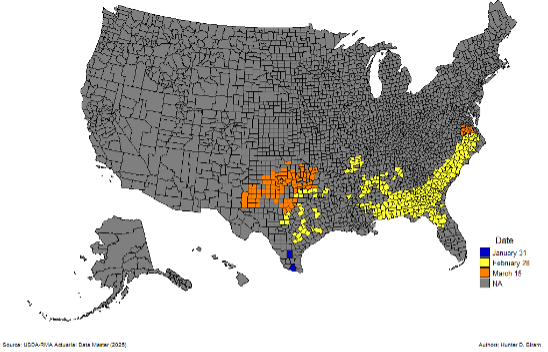
    Source: Summary of Changes for the Peanut Crop Provisions (07075), U.S. Department of Agriculture *Insurance availability for other peanut types (Spanish, Valencia, and Virginia) differs by county, but the sales closing dates are the same as shown in this map. To check details for your county, visit: https://public-rma.fpac.usda.gov/apps/MapViewer/dates.html

    References

    USDA Risk Management Agency (USDA RMA). Peanut Crop Provisions 20-PT-075. Available at: https://www.rma.usda.gov/policy-procedure/crop-policies/peanut-crop-provisions-20-pt-075

    USDA Risk Management Agency. Actuarial Information Browser. Accessed April 2025. https://webapp.rma.usda.gov/apps/ActuarialInformationBrowser/

    USDA Risk Management Agency. Agent Locator Tool. Accessed April 2025. https://public-rma.fpac.usda.gov/apps/AgentLocator/#!/


    Kalli, Susmitha, Yangxuan Liu, Hunter D. Biram, Fayu Chong. “Peanut Crop Insurance: Differences in Sales Closing Dates and Cancellation Dates Across Regions.Southern Ag Today 5(50.1). December 8, 2025. Permalink

  • Peanut Crop Insurance: What’s Available and What’s New Under the OBBB Act

    Peanut Crop Insurance: What’s Available and What’s New Under the OBBB Act

    The One Big Beautiful Bill (OBBB) Act, signed into law on July 4, 2025, introduces new opportunities for U.S. peanut producers to manage risk. This article explores the current crop insurance options available to peanut farmers and highlights how the new law expands these choices beginning crop year 2026. Under the OBBB, peanut producers continue to have access to traditional deep-loss and shallow-loss programs, while also gaining access to a new combination of income protection tools: the Supplemental Coverage Option (SCO) and Agriculture Risk Coverage – County (ARC-CO). These programs are designed to help farmers safeguard their income against unexpected losses. This article provides a detailed look at these options and how they can benefit peanut producers.

    Deep Loss Programs protect against significant losses, including complete crop losses. The Federal Crop Insurance Program (FCIP) for peanuts offers three farm-level insurance plans that fall into this category. These plans form the foundation of a peanut producer’s risk management strategy. They are also referred to as the underlying policy that peanut producers can purchase to protect against potential losses. (1) Yield Protection (YP) insures against losses when yield falls below a selected coverage level due to natural disasters or other covered events. (2) Revenue Protection (RP) safeguards revenue when it falls below the selected revenue coverage level, either due to low yields, declining prices, or both. (3) Revenue Protection with Harvest Price Exclusion (RP-HPE) functions similarly to RP but does not increase the revenue guarantee if harvest prices rise above the projected price. This typically results in lower premium costs for producers. 

    Shallow Loss Programs provide additional coverage for smaller, more frequent losses that can impact a farmer’s income. For peanut producers, shallow loss insurance options include SCO and the Enhanced Coverage Option (ECO). These are add-ons, not standalone policies, and must be paired with an underlying policy, such as YP, RP, or RP-HPE. By layering SCO and/or ECO onto their base policy, producers can often achieve higher overall coverage at a lower combined premium than by raising the base policy’s coverage level alone. This layered approach, which combines shallow-loss and deep-loss tools, is explored here by Biram and Connor (2023), who demonstrate that strategic combinations can enhance overall risk protection. 

    Unlike deep loss programs, which provide protection at the farm level, shallow loss programs do not cover complete crop failures. SCO and ECO are both area-based programs, triggered by county-level yield or revenue outcomes depending on the underlying policy. They help fill the “deductible gap”, covering losses that fall between the individual coverage level of the underlying policy and the higher coverage level selected for SCO or ECO. Biram (2024) discusses how ECO may provide meaningful protection in years when county yields are strong, but market prices declineoffering producers an effective tool to manage upside yield risk and downside price exposure.

    Beginning crop year 2026, under the OBBB, producers can now purchase SCO regardless of whether their base acres are enrolled in ARC-CO, removing a major restriction from previous farm bills. This means that the same acres can now be enrolled in both the ARC-CO and SCO programs. Additionally, the maximum SCO coverage level was increased to 90%, and its premium subsidy rate was raised to 80% (Biram & Maples, 2025). RMA has issued guidance on implementing the legislative changes. Under this new guidance[1], the 80% higher premium subsidy rate will also extend to the Enhanced Coverage Option (ECO) and the Hurricane Insurance Protection–Wind Index (HIP-WI).

    Additional Program: In addition to the deep and shallow loss programs, peanut producers can also purchase Hurricane Insurance Protection – Wind Index (HIP-WI). This endorsement helps cover part of the deductible from the primary crop insurance policy when sustained hurricane-force winds impact the county or a neighboring one. HIP-WI can be combined with SCO and ECO, but only if the acreage is already insured under an underlying policy (YP, RP, or RP-HPE). HIP-WI has gained popularity, particularly in regions prone to hurricanes and tropical storms. 

    Understanding these insurance options empowers farmers to develop customized risk management strategies. By combining standalone policies with supplemental options and endorsements, producers can strengthen their financial resilience against both major and minor losses. For more information, producers are encouraged to visit the U.S. Department of Agriculture’s Risk Management Agency website and use the Agent Locator Tool to connect with a certified crop insurance professional.

    Table 1. Individual and Area Crop Insurance Products with Associated Indemnity Triggers and Standalone Status for Peanuts


    ProductTypeTriggerStandalone
    Deep Loss Programs
    Yield Protection (YP)IndividualFarm YieldYes
    Revenue Protection (RP)IndividualFarm RevenueYes
    Revenue Protection, Harvest Price Exclusion (RP-HPE)IndividualFarm RevenueYes
    Shallow Loss Programs
    Supplemental Coverage Option (SCO)AreaCounty Yield or County RevenueNo
    Enhanced Coverage Option (ECO)AreaCounty Yield or County RevenueNo
    Additional Program
    Hurricane Insurance Protection – Wind Index (HIP-WI)AreaHurricane or Tropical Storm No

    [1] Starting in 2027, RMA will increase the maximum SCO coverage level from 86% to 90%. For 2026, producers can use ECO to cover that band instead and will receive the same 80% premium subsidy that applies to SCO. 


    Reference:

    Biram, Hunter. “Can Yield Upside Risk Eclipse Price Downside Risk Protection in ECO Crop Insurance?” Southern Ag Today 4(47.3). November 20, 2024. 

    Biram, Hunter. D., and William E. Maples. “Stronger Farm Safety Net Included in the OBBB Act, ‘Skinny’ Farm Bill, and SDRP Disaster Payments.” Morning Coffee & Ag Markets, July 14, 2025.

    H. Biram and L. Connor. (2023). “Types of Federal Crop Insurance: Individual and Area Products.” University of Arkansas Division of Agriculture Fact Sheet, Publication No. FSA75.

    Chong, Fayu, Yangxuan Liu, and Hunter Biram. “Exploring Diverse Crop Insurance Options for Cotton Producers.” Southern Ag Today 3(51.3). December 20, 2023.

    Swanson, Patricia. “MGR-25-006: One Big Beautiful Bill Act Amendment.” U.S. Department of Agriculture, Risk Management Agency. August 20, 2025. 


    Kalli, Susmitha, Yangxuan Liu, Hunter D. Biram, and Fayu Chong. “Peanut Crop Insurance: What’s Available and What’s New Under the OBBB Act.Southern Ag Today 5(44.1). October 27, 2025. Permalink