Category: Policy

  • 2022 Farm Safety Net Decisions

    2022 Farm Safety Net Decisions

    For the 2022 crop year, producers will have several decisions to make over the next few months.  For example, the U.S. Department of Agriculture’s Farm Service Agency (FSA) has announced that producers will have until March 15, 2022, to make their Agriculture Risk Coverage (ARC) and Price Loss Coverage (PLC) elections and enrollments for the 2022 crop year.  In addition, many of the sales closing dates for crop insurance for spring-planted crops are rapidly approaching.

    For the ARC-County (ARC-CO) and PLC decision, the Agricultural & Food Policy Center (AFPC) at Texas A&M University provides a decision tool to evaluate the trade-offs between the two programs on a crop-by-crop and farm-by-farm basis.  AFPC also offers a spreadsheet calculator for producers who are considering ARC-Individual (ARC-IC).  Given the current price outlook – where producers may expect to receive little (or no) assistance from ARC and PLC – it arguably makes the crop insurance coverage decisions even more important.  

    To that end, we offer the following “rules of thumb” for you to consider as you make farm safety net decisions for the 2022 crop year:

    • Similar to the 2021 crop year, ARC and PLC are less likely to pay.  That’s okay!  Most producers tell us they would rather get their income from the market than the government anyway. 
    • Rather than focusing on expected ARC/PLC payments (when neither may trigger), consider instead where you are most vulnerable.  Is it lower prices due to trade disruptions or slow economic recovery?  Is it lower yields due to persistent drought?
    • Talk to your crop insurance agent to make sure you’ve evaluated all yield enhancement options (e.g., Yield Exclusion) and unit structures.
    • With current price elections on crop insurance, perhaps now is the time to focus more on adding area-wide tools like the Stacked Income Protection Plan (STAX) for upland cotton, the Supplemental Coverage Option (SCO), and the Enhanced Coverage Option (ECO).
      • You can have STAX on a farm if the seed cotton base on the farm is not enrolled in ARC/PLC.
      • You can purchase SCO for a crop on a farm as long as it’s not enrolled in ARC.
      • You can purchase ECO on the farm regardless of ARC/PLC enrollment.
    • At a minimum, on farms with little (or no) seed cotton base, be sure to take a close look at area-wide policies like STAX.  
    • If your APH is relatively higher than the county average yields, then be sure to compare STAX against both SCO and ECO.  Because of the 10% limitation in ARC, you may find SCO to be a more attractive alternative (and PLC can be utilized as well, providing some downside price protection, even if you do not expect to need it).

    Fischer, Bart, and J. Marc Raulston. “2022 Farm Safety Net Decisions“. Southern Ag Today 2(2.4). January 6, 2022. Permalink
  • Build Back Better?

    Build Back Better?

    Congress is rushing to finish up its year-end work.  President Biden has already signed the continuing resolution to fund most of the Federal government through February 18, 2022, and Congress has now reached agreement on other priorities like the National Defense Authorization Act and raising the debt ceiling.  Reaching agreement on the Build Back Better Act (BBBA) – which passed the U.S. House of Representatives on November 19, 2021 – has proven to be more elusive.

    While the BBBA touches on a number of different topics – falling mostly under the banner of “human infrastructure” – most of the agriculture-related provisions are tied to addressing climate change.  As noted in Figure 1, the bill dedicates an estimated $76.9 billion in spending on agriculture-related priorities over the next 10 years.  For example, $26 billion is provided for forestry activities, most of which is for forest restoration and fuels reduction projects.  Another $25.3 billion is provided for a number of rural development priorities, including $6.6 billion for a “fix” to the debt relief for socially disadvantaged producers provision from the American Rescue Plan (which has run into a number of constitutional challenges in the courts).  Perhaps most notably, the bill also includes $23.5 billion for conservation, with $5 billion going to cover crops and most of the remainder going to temporary plus-ups for existing conservation programs.

    The path forward for the BBBA is not clear.  Even if the Senate reaches agreement before the end of the calendar year, they may very well amend the bill which will require the House to weigh in again.  Finally, even if the bill does become law, the temporary nature of the funding increases on the agriculture-related provisions may very well add to the complications that Congressional negotiators will face as they write the next farm bill.


    Fischer, Bart. “Build Back Better?Southern Ag Today 1(50.4). December 9, 2021. Permalink

  • Enrolled Base Acres Share of the ARC-CO and PLC Program by Crop

    Enrolled Base Acres Share of the ARC-CO and PLC Program by Crop

    A total of 246,601,268 base acres were enrolled in the U.S. in 2021 across 23 covered commodities (Outlaw, Raulston, 2021). The enrolled base acres for the Farm Bill support programs, Agricultural Risk Coverage (ARC-CO) and Price Loss Coverage (PLC), total 244,109,500 for the 2021 program year. The remaining 2,496,768 base acres are enrolled in Agricultural Risk Coverage Individual Coverage (ARC-IC). Price Loss Coverage has the highest share of enrolled base acres at 56.7% followed by ARC-CO at 42.3% and ARC-IC at 1%. The Southern Region (Alabama, Arkansas, Florida, Georgia, Kentucky, Louisiana, Mississippi, North Carolina, Oklahoma, South Carolina, Tennessee, Texas, and Virginia) account for 50,459,856 acres, or 20.6%, of the U.S. total acreage enrolled in PLC, ARC-CO and ARC-IC programs. The share of base acres enrolled by program for the 2021 crop year is 56.7% PLC, 42.3% ARC-CO, and 1.0% ARC-IC.   

    The share of base acres enrolled in 2021 between ARC-CO and PLC is shown in Table 1. The crop with highest percentage of base acres enrolled in ARC-CO for the U.S. is soybeans at 87.2%. The next closest crop in terms of share is corn at 48.4%. The crops with the highest percentage enrolled in PLC is long grain rice at 99.8% followed by peanuts at 99.7%, seed cotton at 91.2%, and grain sorghum at 73.75%. 

    Table 1. Share of Enrolled Base Acres by Crop for the 2021 Program Year.

    2021 ARC-CO vs. PLC

     13 Southern States ARC-CO %U.S. ARC-CO %13 Southern States PLC %U.S. PLC %
    Corn50.4%48.4%49.6%51.6%
    Grain Sorghum24.1%26.4%75.9%73.8%
    Peanuts0.17%0.26%99.8%99.7%
    Rice (Long Grain)0.05%0.16%99.9%99.8%
    Seed Cotton09.2%08.8%90.8%91.2%
    Soybeans86.8%87.2%13.2%12.8%
    Wheat14.3%16.85%85.7%83.3%
    Source: USDA/FSA. Available at: https://www.fsa.usda.gov/programs-and-services/arcplc_program/arcplc-program-data/index

    The seven major program crops shown in Table 1 account for 98.7% of total base acres enrolled in the South according to Outlaw and Raulston. The three southern crops of long grain rice, peanuts, and seed cotton range from 90% to 99% enrolled in PLC and drive the U.S. total. Comparing the South to the U.S. for the other four crops shows the South trends with the U.S. in the share of ARC-CO and PLC enrolled base acres. The biggest differences are two percentage points higher in the South for corn ARC-CO, grain sorghum PLC, and wheat PLC. The 2018 Farm Bill allows farm operators to make program election changes in crop years 2021, 2022, and 2023 for ARC-CO and PLC. 

    Citations:

    Outlaw, Joe, and J. Marc Raulston. “Southern States Share of Major Crop Bases.” Southern Ag Today 1(45.4). November 4, 2021. Permalink


    Smith, Nathan, and Trey Bucklew. “Enrolled Base Acres Share of ARC-CO and PLC Program by Crop.” Southern Ag Today 1(47.4). November 18, 2021. Permalink

  • Southern States Share of Major Crop Bases

    Southern States Share of Major Crop Bases

    For the 2021 program year, the U.S. had a total of 246,601,268 enrolled base acres across 23 covered commodities, ranging from feed and food grains to various major and minor oilseeds and seed cotton.  The 13 Southern States (Alabama, Arkansas, Florida, Georgia, Kentucky, Louisiana, Mississippi, North Carolina, Oklahoma, South Carolina, Tennessee, Texas, and Virginia) accounted for 50,459,543 acres or 20 percent of the U.S. total.  

    Looking at enrolled crop bases for the 2021 program year, the South accounted for a relatively low percentage of corn and soybean bases (9% and 14%, respectively).  The Southern States accounted for over 90 percent of seed cotton, long grain rice, and peanut base acres, which makes sense as these three commodities are generally grown in warmer climates and are often referred to as “Southern crops”.  While the share of wheat base in the Southern States was only 24 percent of the U.S. total, the 14,734,976 acres of wheat base represented the largest raw number of base acres of any single crop in the 13-state region.

    Table 1. Enrolled Base Acres for the 2021 Program Year.

    Base AcresCornSoybeansSeed CottonLong Grain RiceWheatGrain SorghumPeanuts
    13 Southern States7,996,1877,186,91310,483,8663,487,44014,734,9763,563,1672,355,027
    U.S. Total92,307,69752,245,51611,546,3463,790,09561,910,8418,501,7572,404,116
    13 States as % of Total9%14%91%92%24%42%98%
    Source: USDA/FSA.  Available at:  https://www.fsa.usda.gov/programs-and-services/arcplc_program/arcplc-program-data/index

    These seven crops accounted for 49,807,514 of the 13 Southern State total of 50,459,543 base acres (or 98.7 percent), indicating there are very few enrolled base acres of other covered commodities on farms located in the South.


    Outlaw, Joe, and J. Marc Raulston. “Southern States Share of Major Crop Bases.” Southern Ag Today 1(45.4). November 4, 2021. Permalink

  • CFAP 2.0 Payments Across the South

    CFAP 2.0 Payments Across the South

    Producers across the United States benefited from the Coronavirus Food Assistance Program (CFAP) 1.0 and CFAP 2.0 programs aimed at providing assistance for losses due to the COVID-19 pandemic.  CFAP 1.0 provided more than $10 billion in payments on over 600,000 applications.  CFAP 2.0 provided almost $14 billion in payments along with top-up payments for acreage based commodities totaling another $4.8 billion from over 900,000 approved applications.

    CFAP 2.0 provided broader coverage than the CFAP 1.0 program that limited eligibility to only those crops experiencing a 5 percent decline while focusing on unsold inventories from 2019, left out HRW wheat, and only protected livestock inventories on the farm as of January 15th, 2020.  

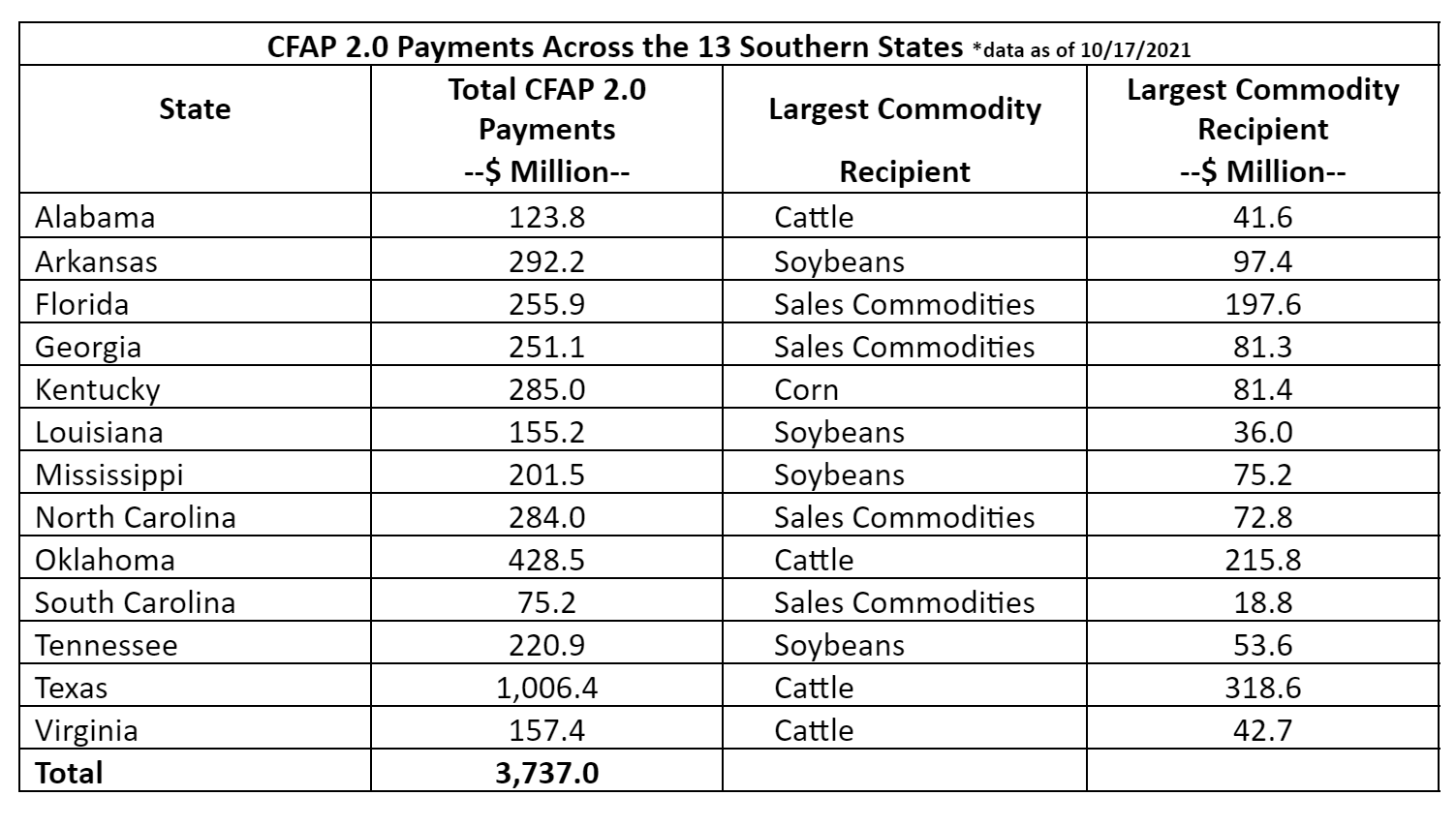
     CFAP 2.0 was widely accessed by producers across the South with the 13 southern states accounting for $3.7 billion or nearly 27 percent of the payments.  Soybeans, cattle, and sales commodities were the highest commodity categories in four states each, while corn was the highest in Kentucky.  Sales commodities include specialty crops, aquaculture, nursery crops and floriculture, and other commodities not included in the price trigger and flat-rate payment categories.

    CFAP 2.0 payments across the 13 southern states


    Outlaw, Joe, and J. Marc Raulston. “CFAP 2.0 Payments Across the South.” Southern Ag Today 1(43.4). October 21, 2021. Permalink