Blog

  • In Historic Town Centers Beauty is More than Skin Deep

    In Historic Town Centers Beauty is More than Skin Deep

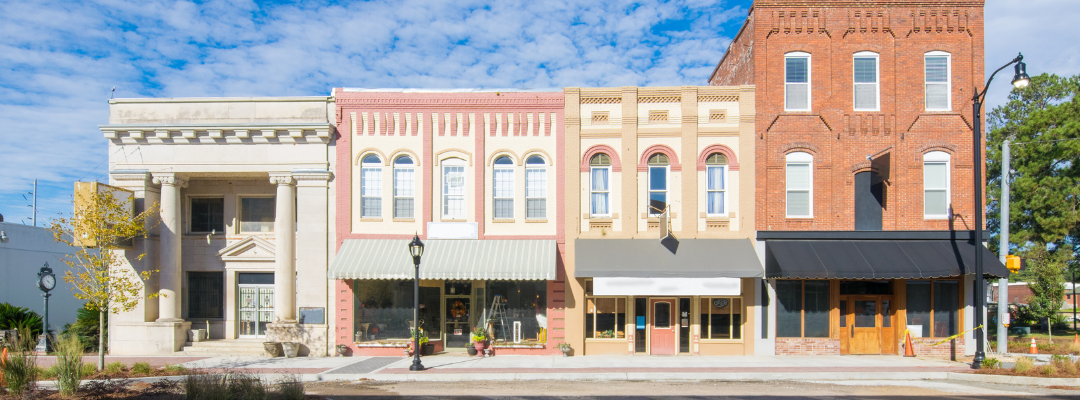
    Amid widespread decline and disinvestment, numerous small towns and rural communities throughout the US have taken action to restore their downtown as the focal point for economic, social, and civic activity in the region.

    Downtown revitalization approaches—such as the widely adopted “Main Street Program”—typically operate from the principle of “if you build it, they will come,” requiring community leaders, business owners, and volunteers to invest their resources and efforts in a vision that is hoped for, but not guaranteed. This involves capital investment toward building rehabilitation and corridor beautification, as well as less tangible investments of time and coordination toward promoting downtown, organizing events, and managing limited resources. 

    But does it work? The continuing popularity of the Main Street Program—with 1,500+ participants and counting—would suggest that downtown revitalization programs are, to some degree, effective. For many policymakers, however, anecdotal data is not sufficient to justify the investment of time and resources required to engage in revitalizing downtown.

    In a pair of recent articles, I examined the quantitative effect of the Main Street Program. The first study focused on job growth, finding that small towns in Iowa gained new retail jobs and establishments in the years after adopting the program. In the other study, I focused instead on residential property values, finding that homebuyers placed a higher premium on homes located closer to downtown districts with an active Main Street Program. Together, the two studies provide evidence for the idea that revitalization efforts go a lot further than simply beautifying a town’s historic business district. Vibrant downtowns are building momentum as places where people increasingly desire to live and work, creating the conditions for strong rural economies to flourish.

    Van Leuven, Andrew J. . “In Historic Town Centers Beauty is More Than Skin Deep“. Southern Ag Today 2(19.5). May 6, 2022. Permalink

  • Removing Fertilizer Tariffs is Not a (Phosphate) Rock and a Hard Place

    Removing Fertilizer Tariffs is Not a (Phosphate) Rock and a Hard Place

    Last month, 90 members of Congress sent a letter to the chair of the U.S. International Trade Commission (USITC) requesting suspension of the countervailing duties on phosphates from Morocco to help ease fertilizer prices for American farmers. These duties were imposed in March 2021 when the USITC ruled that fertilizer imports from Morocco and Russia were receiving illegal subsidies that were hurting the U.S. fertilizer industry. Farmers know the rest of the story—since the duties took effect, prices of phosphates have increased over 300% to record levels (See Figure 1). While inflation, China’s recent export ban, and other supply chain issues may be putting additional strain on the fertilizer industry, the USITC tariffs are certainly not helping. 

    The USITC is not stuck between a (phosphate) rock and a hard place on this issue. The U.S. is the third largest phosphate producer in the world, behind China and Morocco. The Mosaic Company—the largest U.S. producer—was the original petitioner requesting the USITC to investigate Moroccan and Russian imports. After a recent acquisition of CF Industries’ phosphate mines in Florida, Mosaic’s market share was recently estimated at around 74% of the U.S. market. And, instead of being crowded out of the market by foreign competitors, Mosaic exports around half of its annual production, mostly to Canada and Mexico. In fact, Mosaic’s own statements suggest that it does not need tariff protection. Larry Stranhoener, former CFO of Mosaic, said in an interview in 2013, “[fertilizer] is a product that is freely traded and frequently traded across borders, so regional market share data should not matter.”

    We agree with Mr. Stranhoener. The U.S. fertilizer industry will be fine if the USITC removes these duties. Doing so would alleviate at least some of the strain on U.S. fertilizer prices. On top of ongoing energy and food inflation pressureglobal supply chain failures, and the ongoing agri-food consequences of the Russian invasion of Ukraine, U.S. farmers and consumers should not have to bear the costs of geopolitical posturing in the fertilizer market. 

    Figure 1. Phosphate rock and diammonium phosphate (DAP) and triple superphosphate (TSP) prices ($/MT): January 2017 – December 2021  

    Note: Phosphate rock is the f.o.b. price for North Africa; DAP is the f.o.b. US Gulf price, and TSP is the import US Gulf price. MO1 and MO7 on the horizontal axes correspond to the first and seventh calendar month (i.e., January and July).
    Source: World Bank Commodity Price Data (The Pink Sheet). Data visualization provided by Professor Andrew Muhammad, PhD, University of Tennessee.                              

    Beeler, Ashley, and K. Aleks Schaefer. “Removing Fertilizer Tariffs is Not A (Phosphate) Rock and a Hard Place Issue.” Southern Ag Today 2(19.4). May 5, 2022. Permalink

  • The Value of Proper Soil pH

    The Value of Proper Soil pH

    The increased cost of fertilizers has many users asking where fertility costs can be reduced.  Soil testing has long been recommended for farmers, ranchers, and homeowners to identify fertility levels and enable them to only purchase/apply that which is needed.  In addition to replacing the right amount of nutrients, it’s important to consider the conditions which make the most efficient use of existing and applied nutrients.  One component of a fertility program (and soil testing) that should not be overlooked is identifying and correcting low pH through the application of agricultural lime.  Agricultural lime is an investment that will leverage  high-cost fertilization by providing improved nutrient utilization in row crops, forages, and most other agricultural crops we grow in the S.E. United States. . 

    Figure 1. How Soil pH Affects Availability of Plant Nutrients

    Figure 1 shows the range of soil pH that provides that greatest plant utilization of the listed nutrients in the soil. If the soil pH is out of the target range, the nutrients aren’t utilized as efficiently. It should be noted that higher pH range may result in less utilization of some micronutrients.  It is important to know the major nutrient and micronutrient requirements of the selected crop or forage.

    There are various materials that are used for liming, and they have different attributes. Check with your supplier about what liming materials are available. Many states have regulations or laws associated with the characteristics and efficiency of materials that can be marketed as agricultural lime. 

    It typically takes one to two months after an application of a liming material before it becomes effective, so plan accordingly. 

    Producers should check with their land grant university for soil testing related information.  

    Runge, Max. “The Value of Proper Soil pH“. Southern Ag Today 2(19.3). Permalink

  • Should Feeder Calves be PI Tested?

    Should Feeder Calves be PI Tested?

    In recent years, Southeastern producers have asked whether testing for Persistently Infected (PI) Bovine Viral Diarrhea (BVD) virus generates a premium for feeder cattle. The answer likely depends on certain factors. For example, if a group of feeder cattle is born and raised on the same ranch (home-raised), and the producer has a good vaccination program, then the producer might not PI test them before marketing. The risk of PI’s is likely much lower for cattle coming from a closed herd. Co-mingled cattle are likely to have a higher risk of being PI-positive. Backgrounding and stocker operations commonly  source calves from multiple cow-calf operations and multiple groups at auctions. However, co-mingled calves are perceived by buyers to be of higher risk than single-owner calves. So, sellers can use PI testing as a marketing tool to lower the risk perception of the cattle they are selling. 

    A recent University of Tennessee study examined price determinants at the Lower Middle Tennessee Cattle Association (LMTCA) Video Board Sale from 2015-2020. Figure 1 contains the annual percentage of PI tested lots sold for a for this sale. This trend has been seen in other value added sales throughout the Southeast. 

    Figure 1. Annual Percentage of PI Tested Lots Sold

    PI tested lots were found to generate a $1.19/cwt premium. These lots included cattle that sold from North Carolina, Alabama, and Tennessee. While there were home raised lots that were tested, majority of the tested lots were co-mingled lots. On average, cattle weighed 820 pounds in the study, generating a potential premium just under $10 per head. The cost of PI-testing varies by location, volume, and test type. In general, the test costs around $4-8 per head. However, it is important to note the test cost mentioned here does not include additional time spent, facilities utilized working cattle for testing purposes, or revenue loss from the proper disposal of cattle that test positive. 

    While there are some costs and risks associated with testing for PI-BVD, selling a “PI tested” lot does generate a premium. It does this by letting the buyer know that the cattle are guaranteed PI free and healthy, which mitigates risk for the buyer. These advantages are especially beneficial for co-mingled lots. 

    Martinez, Charley. “Should Feeder Calves be PI Tested?”. Southern Ag Today 2(19.2). May 3, 2022. Permalink

  • U.S. Total Rice Acerage Projected at 35 Year Low

    U.S. Total Rice Acerage Projected at 35 Year Low

    In the Prospective Plantings report released March 31st by USDA-NASS, total planted rice acreage for 2022 was projected at 2.452 million acres, down 3% or 80,000 acres from last year. If realized, this would be the lowest acreage of rice planted in the United States since 1987. The majority of the acreage reduction is due to a 60,000 acre decrease in California, which grows medium and short grain rice. Long grain acres, the main type grown in the Southern states, is projected at 1.943 million acres, down 1.4% from last year. Arkansas remains the largest growing rice state with 1.191 million acres, accounting for 49% of all acreage. Louisiana is the only state to increase acreage, adding 20,000 acres for 440,000 acres total, while Mississippi’s 100,000 acres is the lowest since 1975. 

                Higher input costs played a key role in producer unwillingness to add rice acreage this year. Enterprise budgets from Mississippi State University’s Department of Agricultural Economics project rice production expenses to increase by 10% to $899/acre averaged across production practices. A large driver of this increase is fertilizer costs, which are projected up 43%. University of Arkansas budgets project similar increases, with a 47% increase in production expenses from last year. Additional supply chain uncertainty for herbicides needed in rice production makes a lower input intensive crop like soybeans more attractive to producers. 

                Additionally, long grain rice had to compete with a better price outlook for alternative crops, such as corn and soybeans. The chart below shows the percent change in the harvest month futures price for corn, soybeans, and rice since December 1, 2021. The November CBOT Rough Rice futures contract price has increased approximately 20% since the 1st of December. The percent price increase of corn and soybeans though has outpaced rice at 25% for soybeans and over 35% for corn. The combination of higher input costs and a lower price relative to other crops has likely made producers take a longer-term outlook of the rice market. Lower acreage will continue to support the upward trend in rice prices seen this spring. While supplies are not necessarily tight at this point, we can expect increased price volatility due to any events that might influence production during the growing year. As of April 25th, the USDA-NASS Crop Progress report has rice planting at 26% complete compared to the 5-year average of 47%. If plantings remain stalled, the market will begin to worry about supply and push prices higher.    

    Note: Contracts used: Corn- CBOT DEC ’22; Soybeans- CBOT NOV ’22; Rice – CBOT Rough Rice NOV ‘22 

    Maples, William E. . “U.S. Total Rice Acreage Projected at 35 Year Low“. Southern Ag Today 2(19.1). May 2, 2022. Permalink