Blog

  • Talking about Transitioning our Farms and Ranches

    Talking about Transitioning our Farms and Ranches

    Agriculture is a multi-generational industry, and it is a source of pride for many people in the sector. However, it is also a challenge we must navigate as we move our businesses from one generation to another. There are several hurdles to transitioning a farm business to the next generation, including legal, financial, and social. Initially, we often turn to lawyers and accountants with our questions. However, perhaps the first and most challenging obstacle is the communication needed to bring our families together for these major decisions. 

    Research in the area of transition planning suggests that there are four stages to go through: (1) development of a retirement plan, (2) identifying a successor, either family or non-family, (3) transferring managerial control, and (4) legal transfer (lawyer and accountant). Many farm transition planning workshops host a lawyer and/or accountant to answer questions and help farm families, but it may be interesting to know that this is the last step in the complete process and that we tend to get stuck on the first step more often than not. 

    The legal barriers to transitioning a farm require expert help and will vary by farm business, as will the tax implications for different asset bases and in different states. The financial barriers can either speed up or slow down transition plans as the available funds may affect the viability of bringing another person or family into the business. The social barriers will also vary and can include things like delaying a transition decision while waiting for a child to make career and/or marital choices. Marriages and divorces can complicate transition planning as well. Finally, it can be very hard for a farmer or rancher to give up their identity as a producer and control of business decisions by handing over the keys to another, even when it is the next generation of their family. The social barriers arise because farms are a unique intersection between families and businesses.

    In conducting qualitative research in Alabama, we have talked to many farmers between the ages of 35 and 50 about their management styles and the issues that challenge them in their operations and lives. We are learning that transition planning is at the top of their minds but approaching the older generations who still own and/or control farm assets is not always easy. They don’t know how to start the conversation in a respectful way that keeps the line of communication open. It may be that encouraging them to attend a transition planning session put on by Extension or at a commodity meeting is one way to start the conversation. Another is asking a family friend to breach the topic, reminding them that time can slip away from them if this gets put off indefinitely. Maybe the first step is as simple as forwarding a copy of this article and asking them to share a conversation over a cup of coffee. Whatever your approach, it is a worthwhile thing to consider and discuss.


    Taylor, Mykel, and Kelli Russell. “Talking about Transitioning our Farms and Ranches.Southern Ag Today 5(14.1). March 31, 2025. Permalink

  • Understanding Renewable Energy Agreements: Easement, Option, and Lease Phases Explained

    Understanding Renewable Energy Agreements: Easement, Option, and Lease Phases Explained

    As we continue to see rural landowners offered renewable energy leases, it’s important to remember the phases these agreements often include and what may happen during each phase.  If you are presented with a lease agreement for a renewable energy project and are considering it, talk with an attorney with experience in the area before signing.  In many cases, you can go to your state bar association’s website and look for members in your area and talk with them to better understand their experience with these agreements.  At the same time, you can reach out to groups like the American Agricultural Law Association to see if any of their members may have experience in your area.  Working with an attorney early on can help ensure you get a fair deal that protects your interests.

    Wind and solar energy agreements usually have three stages: an easement period, an option period, and a lease period. In the first stage, the easement period, the landowner allows the developer to study the land to see if it’s good for a wind or solar project. The developer may survey the land, place sensors to measure wind and sunlight and study the impact on the environment and wildlife. They will also check if the land is suitable for construction. This stage can last anywhere from one to three years. During this time, the landowner can still use the land if they don’t interfere with the developer’s equipment on the property during the surveying.  At the same time, the landowner will continue to receive rental payments.

    During the second phase, called the option to lease, the developer works on getting permits and funding for the project. For example, in Maryland, they need approval from the Public Service Commission and other permits to start construction. Other states may need different permits from local governments and approval to connect to the power grid. This phase usually lasts two to five years. The developer is not required to proceed with the project during this time. The landowner can still use the land as usual and will also receive rental payments for the land during this phase.

    The third and final phase is the lease. In this phase, solar panels or wind turbines are installed, and the landowner starts receiving lease payments. This phase includes building, operating, possible renewal, and eventually removing the equipment. All told this phase of the agreement may run for 30 or more years with renewals included.  The landowner will have limits on how they can use the land to avoid interfering with the project.

    This agreement could end early in the first phase if the surveys show the property is unsuitable for renewable energy development.  It could also end in the second phase if the permitting is not approved.  As mentioned earlier, it’s important to always talk with an attorney and have the agreement reviewed before signing it.


    Goeringer, Paul. “Understanding Renewable Energy Agreements: Easement, Option, and Lease Phases Explained.Southern Ag Today 5(13.5). March 28, 2025. Permalink

  • Signup for Economic Assistance Announced… Producers Turn Their Focus to Physical Disaster Assistance

    Signup for Economic Assistance Announced… Producers Turn Their Focus to Physical Disaster Assistance

    Every once in a while, the stars align and our elected officials, political appointees, and career USDA employees get it right and, in this case, right on time.  On December 21, 2024, President Biden signed the American Relief Act of 2025—the continuing resolution (CR) that funds the government through March 14, 2025, and extended the 2018 Farm Bill provisions through September 30, 2025—into law.  Also included in the CR was $10 billion for economic assistance for farmers and $20 billion to cover losses due to natural disasters.  In a nod to the dire conditions in the countryside, Congress stipulated that USDA had 90 days to get the program developed and the assistance flowing.  Agricultural committee leadership in both the House and Senate kept the pressure on Congressional leadership to include help for our nation’s struggling farmers, and Congress delivered.  All that needs to be said is “well done and thank you.”

    Between the time the CR was signed into law and Secretary Rollins was confirmed, career USDA-FSA employees were working on developing implementation details and software updates so they could meet the Congressional mandate of 90 days.  Once confirmed, Secretary Rollins made getting the funding out by the deadline one of her top priorities.  Again, all that needs to be said is “well done and thank you.”

    As was reported by every agricultural news outlet, on March 18, 2025—and ahead of schedule—USDA-FSA announced that signup was open for the Emergency Commodity Assistance Program (ECAP), the economic disaster part of the CR that will provide up to $10 billion to eligible producers.  This program provides economic assistance payments to eligible producers of specific commodities to help mitigate the impacts of increased input costs and falling commodity prices during the 2024 crop year.  Specific program details are available from USDA here (https://www.fsa.usda.gov/resources/programs/emergency-commodity-assistance-program).

    As my colleagues and I have written in Southern Ag Today multiple times over the past six months, the assistance was badly needed, and I know it is much appreciated.  Now farmers are beginning to email with questions about the timing and potential benefits from the natural disaster program.  I know that the Secretary and USDA are working diligently to finalize this program, but I have a favor to ask in the interim: send a “thank you” email to House and Senate Agricultural Committee leadership (and their staff) and Secretary Rollins thanking them for their hard work on getting this much needed assistance out the door.  All of their emails are easy to find, and if you do that you also deserve a … “well done and thank you.”


    Outlaw, Joe. “Signup for Economic Assistance Announced… Producers Turn Their Focus to Physical Disaster Assistance.” Southern Ag Today 5(13.4). March 27, 2025. Permalink

  • Estimating Corn Planted Acres for 2025

    Estimating Corn Planted Acres for 2025

    With planting season underway across much of the South, and soon across the Corn Belt, one of the major questions that will impact price direction is planted acreage.  At the Agricultural Outlook Forum (AOF) in late February, USDA projected corn area planted at 94.0 million acres, up from 90.6 million in 2024 (Figure 1). The increase in acres from 2024 to 2025 was not a surprise given recent strength in corn prices relative to that of soybeans. But, the magnitude of the increase relative to trade expectations can have an impact on futures prices. 

    Additional information on farmer planting intentions will be released in the March 31 Prospective Plantingsreport. This survey is administered by the National Agricultural Statistics Service (NASS) during the first two weeks in March. The next official report of planted acres is the Acreage report of June 30, an additional farmer survey of actual crop acres planted (and remaining intended). 

    Acres planted is a fluid variable with estimates moving from USDA’s model-based projections (February Outlook) to late-winter farmer intentions (March Prospective Plantings) to area actually planted (June Acreage).  Shifts in futures prices as we move from winter to spring offer some indication of what to expect in forthcoming reports. 

    First, is the relationship between the numbers of the Outlook forum and the prospective plantings survey. In the 29 years since 1996 (the Freedom to Farm era, which moved away from acreage restrictions to greater flexibility in farmer planting decisions), farmer planting intentions were lower than the acreage number presented at the Outlook Forum 17 times (59%); while 12 years were higher (41%). The average for all years is 184,000 acres less of actual planted acreage compared to the Outlook forecast. Balanced against trade expectations, this would generally be seen as bullish for corn prices. 

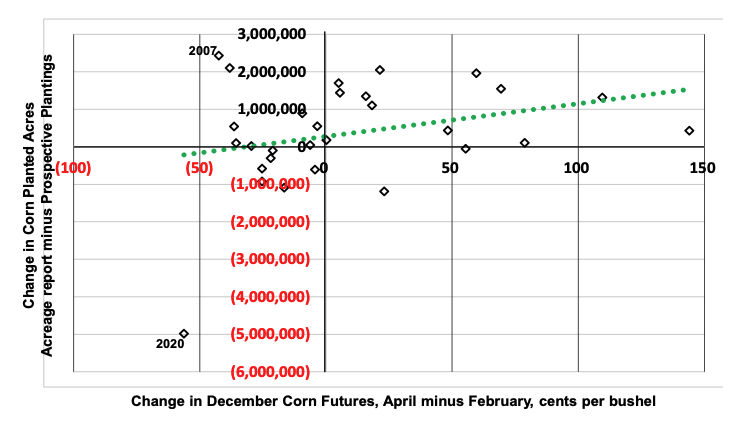
    Second, do changes in futures prices affect farmer planting decisions as we move from late winter to spring? Using monthly average inflation adjusted prices of the December corn contract, there is a positive relationship between price changes and acres planted (Figure 2). Years in which the December futures contract increased from February to April tend to be correlated with an increase in acres planted relative to intended. A decline in prices from February to April is associated with fewer acres planted than intended. A rough estimate of that relationship is that a one-cent change in price changes area planted by about 9,000 acres.[1]

    How does this information position us for the release of 2025 acreage numbers? First, the greatest likelihood is for corn acres intended to come in lower than the projections of the Outlook Forum (bullish). Next, at the time of this writing, the average 2025 December corn futures closing price in March is 451.77 compared to 469.67 in February. If this relationship holds, that is, if the average price in April is still below the February price, that suggests a further reduction in acres from intended to actual (bullish). 

    Of course, a multitude of other supply and demand variables will ultimately influence the harvest price of corn. Extremes in the change in corn acres planted in response to price came in years of dramatic shifts in demand: 2007 (+2.4 million acres at the beginning of the biofuel era) and 2020 (-5.0 million acres, Covid). Developments related to tariffs and trade may be the catalyst for magnified response in the dynamics of price and acreage in 2025.  

    Figure 1. U.S. Corn Acres: Agricultural Outlook Forum (AOF), Prospective Plantings (PP), and Acreage

    Figure 2. Corn planted acres in response to a change in price

    [1] For more on farmers’ response to price shocks on planting decisions, see “Estimating Supply Elasticities for Corn in the United States: Accounting for Prospective Plantings”, Raghav Goyal, Michael K. Adjemian, and William Secor, AAEA, 2022.


    References:

    USDA, NASS, Acreage. Available online at https://usda.library.cornell.edu/concern/publications/j098zb09z.

    USDA, Agricultural Outlook Forum. Available online at https://www.usda.gov/about-usda/general-information/staff-offices/office-chief-economist/agricultural-outlook-forum

    USDA, NASS, Prospective Plantings. Available online at https://usda.library.cornell.edu/concern/publications/x633f100h


    Welch, J. Mark. “Estimating Corn Planted Acres for 2025.Southern Ag Today 5(13.3). March 26, 2025. Permalink

  • Chickens Before Eggs

    Chickens Before Eggs

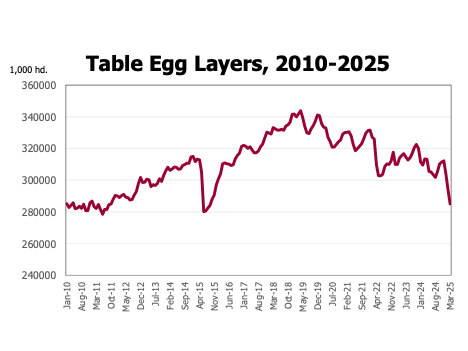
    While some of us might be tired of reading (and writing) about eggs, there is some new data out that sheds some more light on the pace of production recovery.  USDA released its Chickens and Eggs report on Friday, March 21st.  For eggs, two of the most important numbers in the report are: the number of table egg layers and the number of pullets on March 1st.  These numbers tell us where we are currently in short term supplies and where we are headed in flock rebuilding.

    The report indicated that there were 285.1 million table egg layers on March 1.  That was down 8.7 million from February 1 and down 28.3 million from last March.  It was the fewest table egg layers for any month since October 2015 and the fewest for March 1 since 2011.  HPAI continued in full swing during February, far outstripping the ability to replace lost birds.  

    The number of pullets, young hens heading to egg production, of all types was up 6.8 million or 5.5 percent over March of 2024.  About 500,000 more were available than in February.  While pullet production facilities have not been immune from HPAI occurrences, their numbers are growing as the industry responds to high prices and short supplies.  Beyond the increased number of pullets, more eggs in incubators and eggs per 100 layers running ahead of a year ago indicate some more growing supplies.  

    On the price side of eggs, many have noted in the last couple of weeks falling wholesale egg prices.  For the week of March 22nd USDA-AMS reported egg prices delivered to warehouses of $3.96 per dozen.  That is down from the peak of $8.51 per dozen for the first week of March.  Egg prices tend to be highly volatile and this data highlights that.  Based on data from the chickens and eggs report, it does not appear that growing supplies are driving lower prices.  The most likely factor is demand economics.  For almost all goods, people buy fewer quantities of an item when its price goes up.  It appears that consumers are reacting to record high prices by purchasing fewer eggs which results in lower prices. 

    The bottom line is that while there are fewer table egg layers currently, increased egg production appears to the on the way.  While egg prices are volatile, increased supplies, given a respite from HPAI caused chicken losses, will keep prices trending lower.

    Anderson, David. “Chickens Before Eggs.Southern Ag Today 5(13.2). March 25, 2025. Permalink