Blog

  • Price Risk Always Exists, Even in a Bull Market

    Price Risk Always Exists, Even in a Bull Market

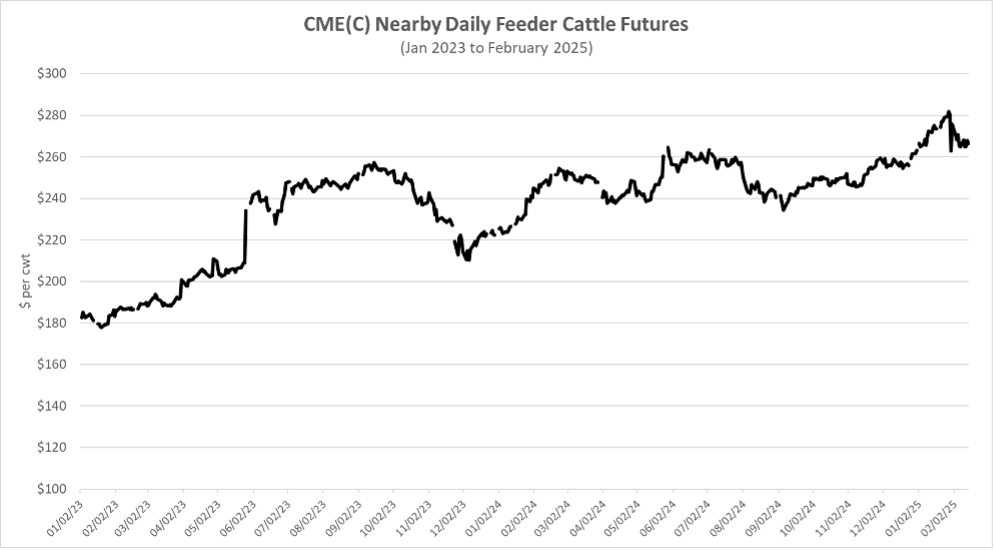
    I doubt many would take issue with me calling the last couple of years a “bull market” for cattle. The combination of tight supplies and strong demand has resulted in cattle markets tracing an upward trajectory over the last couple of years. As an illustration, the chart below tracks the daily nearby CME© feeder cattle futures price over the last 26 months. In January 2023, the nearby feeder cattle futures price was in the $180’s. As I write this article, the nearby feeder cattle futures price is in the $260’s.

    While it is hard to dispute the overall strength of the recent cattle market, it is also important to note that during the last 26 months there have been multiple times when markets saw significant downward swings. The most recent of these occurred since the end of January and was likely sparked by the resumption of live cattle imports from Mexico, continued talk of trade disruptions, Avian Influenza, and any number of other factors. The market also fell by more than $40 per cwt from September to December 2023 and more than $30 per cwt from late May to early September 2024. For producers who sold cattle during those pullbacks, the impact on returns was significant.

    There are a lot of potential strategies to manage price risk, and the simplest one may be a forward contract. By forward contracting cattle, price risk is largely eliminated as the seller and buyer agree on a purchase price prior to delivery of the cattle. A similar strategy would be selling cattle through an internet auction and specifying delivery at a later time. In both cases, the seller entering the forward contract still has production risk as they must meet the specifications of the contract (weight, quality, etc.), but market swings are no longer a concern.

    Futures and options markets are also common tools for price risk management. Short futures positions allow producers to capitalize on the expectation of cattle prices in the future that are manifested in CME© futures prices. When utilizing a short futures position to offset potential decreases in cattle prices, farmers are essentially exchanging price risk for basis risk. Producers utilizing short futures positions also need to plan for potential margin calls if markets move substantially higher. Put options give producers the right to sell a future contract if they choose, and they pay a premium for this flexibility. This effectively sets a price floor for cattle as the strike price on the put option and the premium paid sets a minimum price for the cattle being sold.

    Finally, I have talked more about Livestock Risk Protection (LRP) insurance than any other risk management strategy recently. It works almost exactly like a put option but is much simpler and has the advantage of flexibility on scale. Unlike several other price risk management tools, LRP insurance can be purchased on any number of head, which is much easier for smaller operations to utilize. LRP has been made more attractive over the last several years through increased premium subsidies and allowing producers to pay premiums after the ending date of the policy.

    The specific tool or strategy that cattle producers utilize to manage price risk is less important than their overall risk management plan. I encourage producers to know what risk management tools are available to them, understand how changes in sale price impact their profits, and plan to cover themselves from downside price risk. I still feel good about the fundamentals of the cattle market, but I think the first couple weeks of February have been a good reminder that price risk always exists, even in a bull market!
    Burdine, Kenny. “Price Risk Always Exists, even in a Bull Market.Southern Ag Today 5(11.1). March 10, 2025. Permalink

  • Who’s Buying this Round? Insights from Florida to Help Breweries Reach Consumers

    Who’s Buying this Round? Insights from Florida to Help Breweries Reach Consumers

    The number of breweries has grown substantially over the past decade, becoming a ubiquitous establishment in communities nationwide. However, many of these breweries are small craft producers that lack resources for in-depth market research, creating a need for localized consumer insights—especially in the Southeast where growth of the beer sector has been slower. This synthesis of our case study on the consumption and purchasing habits of Florida beer consumers provides insight into how breweries can effectively market their products to specific segments. 

    We find that craft beer has broad appeal with 72% of those surveyed reporting regular purchases. As expected, millennials lead in both purchase frequency and spending, with the highest median monthly beer expenditure at $50 (see Figure 1 and Table 1). Though spending is less ($25 median) among baby boomers, it is not negligible, and, in some areas, they represent a sizable market when aggregated. Women spend nearly the same amount and purchase craft beer at close to the same frequency as men, in-line with national trends towards gender parity and a sign that inclusive marketing is an increasingly important consideration as breweries look to expand their consumer base in a competitive market. 

    Table 1. Median monthly beer expenditure by gender and generation

     1st QuartileMedian3rd Quartile
    Gender   
    Female(n = 325)$15$25$50
    Male(n = 257)$15$30$75
    Generation   
    Millennials (n = 127)$20$50$100
    Gen X (n = 141)$15$30$60
    Baby Boomers (n = 298)$13$25$50
    Notes: Data from our survey of 582 Florida beer consumers. We exclude Gen Z due to the small number of responses from this segment.

    Regarding where consumers drink and shop, beer is most frequently consumed at home (68%) and purchased from grocery stores (66%). This presents two significant challenges for small breweries with goals of tapping into broader marketing channels: (1) acquiring and maintaining canning or bottling equipment and facilities is a major capital investment decision which cannot be easily reversed, and (2) grocery stores dedicate limited shelf space to beer and favor widely recognized brands. To successfully expand into packaged beer, breweries should consider developing a targeted marketing strategy for off-premises retail sales. 

    The full case study can be found at https://edis.ifas.ufl.edu/publication/FE1160


    Hambaryan, Meri, Glory Orivri, Nathan Palardy, John Lai, and Bachir Kassas. “Who’s Buying this Round? Insights from Florida to Help Breweries Reach Consumers.Southern Ag Today 5(10.5). March 7, 2025. Permalink

  • Market Showdown: U.S. Beef Faces New Challenges in Japan Amid Brazilian Reentry

    Market Showdown: U.S. Beef Faces New Challenges in Japan Amid Brazilian Reentry

    Brazilian beef was first banned in Japan in 2012 due to concerns over Bovine Spongiform Encephalopathy (BSE), also known as Mad Cow Disease. Brazil is currently in talks with Japan to begin beef shipments once again. Although Japanese imports of Brazilian beef were negligible prior to 2012, the possible reentry of Brazilian beef into the Japanese market could pose a significant challenge to U.S. beef exports. 

    The importance of Japan to global beef trade and U.S. beef exports cannot be overstated. Japan is the third largest beef importing country in the world and the second largest market for the U.S. In 2024, U.S. beef exports reached $10.5 billion. That year, exports to Japan accounted for 18% of the total (USDA, 2025a, 2025b). While Japan is important to U.S. export disappearance, the U.S. is especially important to Japan as its leading supplier. In 2024, for instance, Japan imported $1.8 billion worth of U.S. beef. This was 43% of Japan’s total beef imports, exceeding imports from Australia ($1.7 billion and 39%), and significantly larger than countries such as Canada, New Zealand, and Mexico. Despite the current strong position of U.S. beef in Japan, this could be challenged by the reentry of Brazilian beef into the Japanese market.

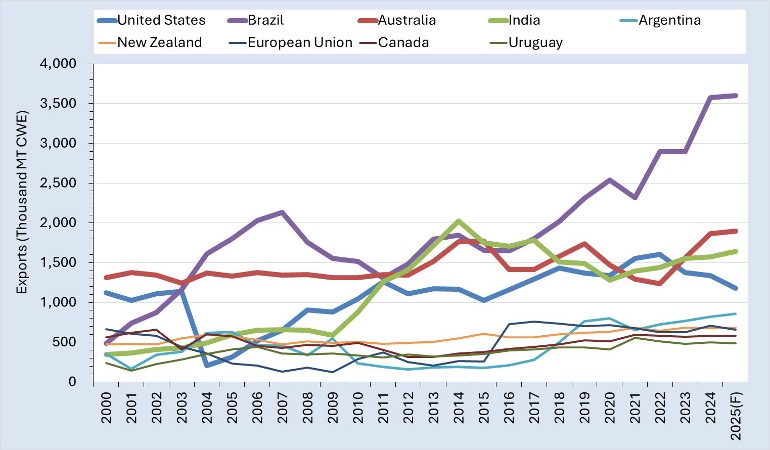
    Around the time of the U.S.-China trade war in 2018, Brazil emerged as the leading global beef exporter, surpassing the U.S., Australia, and India (Figure 1). The rise of Brazil as a major beef exporter is largely due to increased demand in China. (https://southernagtoday.org/2023/01/12/chinas-import-of-u-s-beef-continues-to-increase-but-how-does-the-u-s-compare-to-other-competing-countries/). As China emerged as the leading beef importing country (almost $14 billion in 2024), Brazil became its leading supplier accounting for 45% of total Chinese imports in 2024, far exceeding other exporting countries.

    With exports already exceeding those of major exporters such as the U.S. and Australia, does Brazil have the capacity to gain a significant share of the Japanese foreign beef market? In 2024, cattle and beef production in Brazil was based on 192.5 million head of cattle (including all beef and dairy cows and calves). Over the past couple of years, Brazil’s national cow herd has been liquidating, leading to higher supplies of slaughter cattle and total production. Last year, Brazil’s national herd was reduced by 2% and was expected to continue shrinking midway through 2025 (Aquino, 2024). Despite the shrinking herd, Brazil has maintained its share of world trade. Given the expectation of rebuilding, Brazil’s herd could rebuild at a higher pace to capitalize on the new demand from the Japanese market.

    Future Japanese demand will be based on a combination of quality and quantity. Over the last few decades, Japanese beef consumers have trended more towards the preferences of the typical U.S. beef consumer. Products like ground beef, steaks, burgers, and fajitas have become increasingly popular in Japan. The key question is whether Brazil can match the quality of U.S. beef in Japan. Quantity is a lesser obstacle for Brazil with this potential market opportunity.

    Figure 1. Beef and Veal Exports (Top Countries): 2000 – 2025(F)

    Source: U.S. Department of Agriculture, FAS PSD Database

    References

    Aquino, Camila. (2024). Livestock and Products Semi-annual: Brazil. Report Number: BR2024-0001. USDA, Foreign Agricultural Service.

    USDA. (2025a). Production, Supply, and Distribution Online (PSD Online). Foreign Agricultural Service. https://apps.fas.usda.gov/psdonline/app/index.html#/app/home

    USDA. (2025b). Global Agricultural Trade System (GATS). Foreign Agricultural Service. https://apps.fas.usda.gov/gats/default.aspx


    Muhammad, Andrew, Charles Martinez, and Md Deluair Hossen. “Market Showdown: U.S. Beef Faces New Challenges in Japan Amid Brazilian Reentry.Southern Ag Today 5(10.4). March 6, 2025. Permalink

  • Changes in Relative Financial Risk for Corn, Cotton, and Soybeans in 2024 and 2025

    Changes in Relative Financial Risk for Corn, Cotton, and Soybeans in 2024 and 2025

    Compared to last year, pre-planting relative financial risk between corn, cotton, and soybean production has changed for many mid-south crop producers. The change in pre-planting financial risk can be illustrated using projected crop insurance prices and crop budgets for 2024 and 2025. Crop insurance prices in this analysis were determined February 1-28 and crop budgets were University of Tennessee Crop Budgets for non-irrigated production. For ease of comparison, actual production history (APH) is unchanged between years and is equal to the target yield in the crop budgets.

    Table 1 shows the difference between the crop insurance revenue guarantee for corn, cotton, and soybeans at a 75% buy-up coverage in 2024 and 2025. The crop insurance coverage per bushel or pound is the revenue guarantee divided by the APH. The crop insurance coverage level for corn increased slightly from $3.50/bu to $3.53/bu; however, coverage was reduced for cotton ($0.62/lb to $0.52/lb) and soybeans ($8.66/bu to $7.91/bu). At the same time, from 2024 and 2025, cost of production changed by +/- 2-3% depending on the commodity (Table 2). Cost of production will vary based on geographic location, targeted yield, and production practices.

    Cost of production should be estimated for two separate measures—cash costs and economic costs. Cash costs are expenses that need to be paid during the production and marketing year, while economic costs include cash costs as well as ownership and other non-cash costs. In the short run, farms can operate covering cash costs, however, economic costs need to be covered for the operation to remain viable in the long-term. The cash and economic cost per bushel or pound are calculated by dividing cost by target yield (breakeven cash and economic cost per bushel or pound).

    The crop insurance coverage per bushel or pound divided by the cash or economic cost provides an estimate of the relative financial risk by year and commodity. The analysis in Table 2 shows that in 2024, 74-75% of the economic cost of production for corn, cotton, and soybeans was covered by Revenue Protection crop insurance, compared to 76% for corn, 65% for cotton, and 67% for soybeans in 2025. For the start of the 2025 crop year, the financial risk mitigated by crop insurance favors corn over soybeans and cotton. 

    Calculating relative cash and economic risk exposure between commodities produced on a farm can help guide crop insurance purchasing decisions (buyup coverage, unit structure, and companion policies) and guide a marketing and price risk management strategy to secure prices beyond crop insurance protection. 

    Table 1. Revenue Protection Crop Insurance for Corn, Cotton, and Soybeans, 2024 and 2025

    2024 Crop Insurance
    CommodityProjected Crop Insurance Price($/bu or $/lb)APH(bu or lb)Coverage Level (%)Revenue Guarantee ($/acre)Crop Insurance Coverageper bu or lb
    Corn$4.6617575%$612$3.50
    Cotton$0.831,15075%$716$0.62
    Soybeans$11.555075%$433$8.66
    2025 Crop Insurance
    CommodityProjected Crop Insurance Price($/bu or $/lb)APH(bu or lb)Coverage Level (%)Revenue Guarantee ($/acre)Crop Insurance Coverage per bu or lb
    Corn$4.7017575%$617$3.53
    Cotton$0.691,15075%$595$0.52
    Soybeans$10.545075%$395$7.91
    *Crop insurance coverage per bushel or pound is calculated as the revenue guarantee divided by the APH.

    Table 2. 2024 and 2025 Estimated Cost of Production for Non-Irrigated Corn, Cotton, and Soybeans and Relative Crop Insurance Coverage 

     2024 Cost of Production
     Cash Costs ($/acre)Economic Costs ($/acre)Target Yield(bu or lb)Cash Cost ($ per bu or lb)Economic Cost ($ per bu or lb)Crop Insurance Coverage divided by Cash Cost (%)Crop Insurance Coverage divided by Economic Cost (%)
    Corn$697 $825 175$3.98$4.7188%74%
    Cotton$777 $958 1,150$0.68$0.8392%75%
    Soybeans$464 $579 50$9.28$11.5893%75%
     2025 Cost of Production
     Cash Costs ($/acre)Economic Costs ($/acre)Target Yield(bu or lb)Cash Cost ($ per bu or lb)Economic Cost ($ per bu or lb)Crop Insurance Coverage divided by Cash Cost (%)Crop Insurance Coverage divided by Economic Cost (%)
    Corn$696$817175$3.98$4.6789%76%
    Cotton$760$9321,150$0.66$0.8178%64%
    Soybeans$477$58750$9.54$11.7483%67%
    *Cash and economic cost per bushel or pound are calculated as cash/economic cost divided by target yield

    References and Resources:

    University of Tennessee Crop Budgets. 2024 and 2025. https://arec.tennessee.edu/extension/budgets/.

    USDA Risk Management Price Discovery. https://public-rma.fpac.usda.gov/apps/PriceDiscovery.


    Smith, Aaron. “Changes in Relative Financial Risk for Corn, Cotton, and Soybeans in 2024 and 2025.Southern Ag Today 5(10.3). March 5, 2025. Permalink

  • UPDATED March 4, 2025…..End of the Line for Corporate Transparency Act Requirements?

    UPDATED March 4, 2025…..End of the Line for Corporate Transparency Act Requirements?

    The Corporate Transparency Act (CTA) is a federal law aimed at combating financial crimes like money laundering and tax evasion. Under the CTA, most corporations, limited liability companies (LLCs), and similar entities were required to disclose their “beneficial owners”—individuals who own or control at least 25% of the business or exercise significant decision-making authority.  

    Numerous court actions were filed challenging the requirement.  The rulings since that time have gone back and forth, with a series of injunctions from some courts prohibiting the enforcement of the law while other courts allowing it.  After the most recent injunction was lifted, the Department of Treasury announced a mid-March, 2025 deadline for compliance.  

    However, on March 2, 2025, the Department of Treasury announced that it would no longer be enforcing any penalties or fines associated with the beneficial ownership reporting requirements.  Further, the Department will “be issuing a proposed rulemaking that will narrow the scope of the rule to foreign reporting companies only.”  As of today, March 4, 2025, entities are not required to disclose their beneficial owners or comply with the existing CTA regulations.    

    Background on CTA & Reporting Requirements  

    On January 1, 2024, the CTA’s rules went into effect. Entities created before that date were given until January 1, 2025 to comply, while companies formed during 2024 were given 90 days to report the beneficial ownership information.

    CTA regulations for reporting entities required they:

    1. Identify Beneficial Owners: Determine who qualifies as a beneficial owner within your company. Consider factors like ownership percentage and decision-making power.
    2. Collect Required Information: Gather key details about each beneficial owner, including their full legal name, date of birth, residential address, and an identification number (e.g., from a passport or driver’s license), as well as a scan or picture of that identifying document.
    3. Submit Information to FinCEN: File the information securely with the Financial Crimes Enforcement Network (FinCEN) through its online reporting system. Detailed instructions are available on the FinCEN website.

    Noncompliance had significant consequences, including fines of up to $10,000 and/or imprisonment for up to 2 years. CTA requirements were separate from and in addition to any corporate paperwork that is filed with a state agency. It is an additional, and new, federal requirement.  Entities also had an ongoing requirement to update the report if information changes. 

    Highlights of previous legal challenges:

    As noted, several court actions were filed in 2024 challenging the new requirement.  For example, a federal district court in Alabama ruled early in 2024 that the CTA was unconstitutional. Plaintiffs in that case were granted summary judgement, and CTA enforcement was suspended only for the named plaintiffs and members of the National Small Business Association.  

    However, rulings with larger effect came about at the end of 2024.  One of those began on December 3rd, 2024 when Judge Amos Mazzant, a federal judge in Texas, issued a nationwide injunction. This injunction paused the reporting deadlines and prevents enforcement of the regulations. The ruling in Texas Top Cop Shop, Inc. v. Garland was in response to a request for a preliminary injunction, where the court found that the plaintiffs demonstrated a substantial likelihood of success on the merits of their claims. It was not a final determination of the case itself. The case was appealed, and the 5th Circuit Court of Appeals was asked two things: to decide based on the merits of the case, and to decide whether the injunction was issued appropriately.  And this is where the road zigzagged!  

    On December 23rd, the 3-judge panel (the “motion” panel) responsible for considering the injunction decided that it was not issued appropriately and suspended enforcement of the injunction, reinstating the reporting requirements.  Then, on December 27th, a 3-judge panel responsible for deciding the merits of the case (the “merits” panel) overturned the motion panel and reinstated the injunction.  The foundation of the ruling, according to the court, was “to preserve the constitutional status quo while the merits panel considers the parties weighty substantive arguments”.  Arguments for the appeal have been scheduled for April 1st in New Orleans. 

    The government chose to appeal the ruling of the merits panel to the United States Supreme Court (“SCOTUS”), arguing that the injunction should be lifted.  On January 23, 2025, SCOTUS issued a ruling on the government’s “application for stay,” agreeing that the injunction should be lifted (and reporting requirements reinstated) until the litigation ends.  

    In the meantime, another district court judge had considered the issue.  In that case, plaintiffs Samantha Smith and Robert Means challenged the constitutionality of CTA.  On January 7th, Federal District Court Judge Jeremy Kernodle agreed with their contentions for the purposes of a preliminary ruling, which acted as a second nationwide stay. 

    This was only a temporary hold however, because in light of the SCOTUS ruling Judge Kernodle lifted the stay on February 17th.  While this effectively re-imposed CTA requirements, the Department of Treasury soon announced that it would no longer enforce the regulations.  

    What’s next?

    The Department of Treasury has announced that it will be issuing an interim final rule to narrow the scope of the rule.  It expects to have that rule completed and issued by March 21st, 2025. 

    Further, there is also movement in Congress that may affect the future of the CTA.  On February 10, the House of Representatives unanimously passed H.R. 736, which would modify the CTA by extending the filing deadline until January 1, 2026.  That proposal has now moved to the Senate for consideration.  A companion bill, S. 505, is also being considered in the Senate.  Both the House and Senate versions would postpone the deadline, but leave the reporting requirements intact. 

     Other legislation, introduced together as H.R. 125 and S. 100, the “Repealing Big Brother Overreach Act,” would repeal the CTA entirely.  They are under committee consideration in their respective chambers. 

    Changes could be made based on further developments in this court case (or others), changes in the regulations or guidance or even further Congressional action.  Because of that, it is important to stay aware of future developments.  

    If you have additional questions, please reach out to a legal or financial professional.

    Information on finding an attorney in your area is available here. Further, the FinCEN website

    provides additional resources and information to clarify requirements and future changes.


    Rumley, Elizabeth. “Corporate Transparency Act Deadline Upcoming.Southern Ag Today 4(48.5). November 29, 2024. Permalink