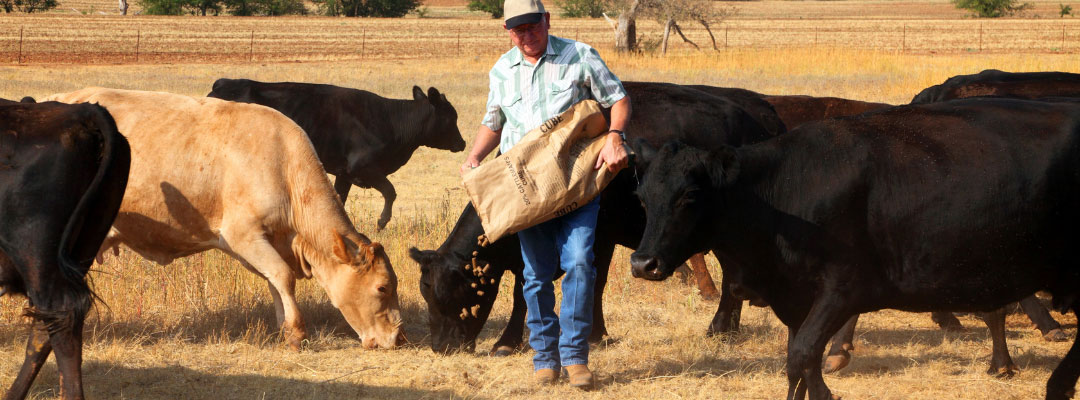
The latest USDA Cattle on Feed report was released on Friday and showed drought conditions continued to impact cattle movement into feedlots during August. Dry weather and poor pasture conditions in some areas have likely led to producers selling cattle sooner than normal. Placements into feedlots during August were up slightly over year-ago levels but were driven by lighter weight cattle.
Placements of cattle weighing less than 700 pounds were about five percent higher than in August 2021 while placements of cattle weighing more than 700 pounds were about two percent lower than a year ago. Looking at Texas where drought conditions have been severe, August placements of cattle weighing less than 700 pounds were nearly 12 percent higher than a year ago while total placements were up 9 percent.
The late summer months are seasonally the lowest cattle on feed months, and it appears August will be the low for 2022. Feedlot inventory on September 1st was estimated at 11.3 million head which is up slightly from August 1st and also up slightly from a year ago. Feedlot inventories will grow in the fall months but by how much is the big question. The increased placements of lighter cattle over the summer suggest there will be fewer placements during the fall months than usual. It is likely that some cattle that would have normally been placed in September through November were already placed into feedlots during the summer. Early indications for wheat pasture in the Southern Plains look disastrous unless some sustained rainfall comes soon. Poor wheat pasture establishment will reduce stocker calf demand this Fall but may send more to feedlots at lighter weights.
Several articles have discussed the benefits of on-farm storage for southern producers (Maples, 2022 and Duncan and Smith, 2022). However, there are marketing strategies that producers can investigate if they do not have on-farm storage. These include delayed pricing contracts, commercial storage, and using futures or options to establish a re-ownership position for the commodity sold.
Delayed pricing contracts allow ownership of the grain to be transferred to a local elevator, barge point, or other purchaser without establishing the price. Delayed pricing contracts allow the producer to fix the price after delivery at a future point in time. As with any legal contract, attention to detail is important to fully understand the differences in terms and conditions offered. Additionally, counterparty risk should be investigated. Counterparty risk is the probability that the other party in a transaction may not fulfill its part of the deal and may default on the contractual obligations.
Commercial storage is another option that can be investigated. Commercial storage requires the producer to pay a monthly storage fee, while maintaining ownership of the grain. Storage fees are highly variable, based on facilities provided and local availability. Not all producers will have access to commercial storage in their location. Similar to delayed pricing contracts, terms, conditions and counterparty risks for commercial storage agreements should be fully understood.
Futures and options can be used to establish a re-ownership position after the sale of the crop. Producers can buy a futures contract or a call option for a deferred contract month and experience financial gains if the futures contract price appreciates after the cash crop is sold. For example, buying a March corn contract at $6.90 can provide a financial gain if the March futures contract, between purchase date and expiration, increases (buying low and selling high). This is a speculative position and can result in losses if the contract price declines. This strategy also requires a margin account to cover any losses incurred by the futures position.
Buying a call option allows a producer the opportunity to profit if prices go higher with a limit on losses if prices decline. The cost of this opportunity is the upfront premium paid. For example, on September 7, 2022, a $6.80 March corn call could be purchased for 47 cents, thus the March futures contract would need to trade above $7.27 before a financial benefit is received by the purchaser. Premiums can be high, so producers may want to offset the premium cost. Selling a call option can reduce the upside potential but save the producer premium costs. Figure 1 shows a simple strategy of selling a $7.50 March corn call for $0.29 and buying a $6.80 call option for $0.47. The net result is a maximum loss of $0.18 and a maximum gain of $0.52. The return to the producer will be contingent on the price of the March corn contract and when options are exercised. The risk and reward should be fully understood before a producer enters any futures or options position.
Figure 1. March corn option example: buying an at-the-money call option and selling an out-of-the money call option
On occasion, I am approached by a group of producers who have a business idea that is too big for any one producer to achieve. Their first thought is “we need a cooperative.” Their second thought is often “what is a cooperative, and how does it work?” Simply put, a cooperative is a business that is jointly owned by its customers. It operates much like any other business; however, its ownership and distribution of profits is based on an individual’s use of the business. Cooperatives are an integral part of our agricultural system and help to guarantee market access and manage risk for agricultural producers. They benefit their communities by helping profits to remain in the local economy.
Cooperatives generally form out of an economic need to correct shortcomings in the market. In general, agricultural producers form cooperatives for various reasons:
Reduce costs through volume purchasing
Obtain market access to more buyers
Improve bargaining power when marketing commodities
Obtain products and services that might not otherwise be available
Improve quality of offered products and services
Improve income through activities that add value to commodities
Cooperation, then, is a strategy that agricultural producers jointly employ to achieve their business goals. However, this strategy comes with added complexity to manage. Further, it isn’t a solution for a poor business plan. A cooperative is a business with a joint ownership structure. Its success is subject to the economics of the business and its approach to the competitive environment. For those who are interested in forming a cooperative, you might ask yourselves a few pertinent questions.
Do we have a business plan?
What volume is required for profitability?
Will we have enough members to provide the needed volume of business?
Is this product or service already provided in the market?
Who are our competitors, and how might they react?
Is the cooperative necessary to combat the market power of our buyers or sellers?
Your Extension professional can help you think through these issues.
Recently the importance of agricultural trade for the United States was discussed which accounts for over one-third of U.S. gross farm income. However, the benefits of trade freedom or having less trade barriers go well beyond a specific industry or country as seen in the graph below. Countries are divided into three trade freedom groups, lowest, middle, and highest. The areas compared for each trade freedom group are higher average per capita national income, food security, political stability along with violence and terrorism, and the environment. Countries with more trade freedom have higher average per capita national income, $28,947, compared to $8,513 and $3,769 for the middle and lowest trade freedom groups, respectively. Moreover, countries with higher trade freedom scored higher in terms of food security. This is an interesting point as some people believe that in order to have food security most of the food must be produced domestically, which is not necessarily the case. Countries should produce agricultural products in which they have comparative and competitive advantages and import the ones that they do not or cannot produce them year-round.
Countries with higher trade freedom experience more political stability and less violence and terrorism. Something very important for law-abiding citizens that just want a peaceful life for themselves and their families. Finally, countries with more trade freedom also have healthier environments and less polluted ecosystems. As in the area of food security, trade freedom allows countries to be more efficient in the use of their resources by producing those products that they are competitive and import the rest.
As more aggressive action has been taken to confront the climate crisis under the Biden Administration, environmental sustainability issues have become more relevant. Interest in the value of cover crops as a means to preserve and improve cropland has continually increased. Cover crop use has once again been on the rise (2017 Census of Agriculture) as our producers continually seek a balance between environmental and financial sustainability. Among the challenges reported by producers, cover crop seed availability is an issue. Many producers have also said cover crop seed costs are too high and that the additional cost of planting and managing a cover crop stymies cover crop adoption.
The University of Georgia Cooperative Extension Service conducted a cover crop survey with cotton, corn, and peanut producers throughout Georgia, Alabama, and Florida, from January 28, 2021, to March 31, 2021. Figure 1 illustrates the cost of cover crop seed based on the number of species in the cover crop blend. The average seed cost of single specie cover crops was $23.53 per acre, and for multi-species cover crops, it was $25.88 per acre. Most producers using cover crop monoculture indicate their seed cost ranges from $10 to $19 per acre. For mixed cover crops, there is more of a spread in the responses, with the $20-$29 range being the most common.
To solve the challenge of the availability of cover crop seed, some producers reported that they harvested their cover crop seed to either sell it or plant it the following year. However, most farmers were not harvesting their cover crop seed. A few possible explanations for not harvesting and selling seed could be machinery related, time, seed germination, or understanding the value of the seed if they were to sell. Another possibility for not keeping seed is that they have chosen either not to plant a cover crop the following year or to plant a different type. One last explanation could be that farmers participating in a cost-share program could not harvest the cover crop. Most conservation cost-share programs won’t allow producers to harvest seed to sell or save for seed.
A cover crop is relatively expensive to plant. Most farmers who responded to our survey in these three states do not currently graze or harvest their cover crop, which would help to offset some of that expense. It is important for farmers to find and adopt the most beneficial cropping practices, which may include cover crops. As more producers become interested in planting cover crops, emerging local business opportunities may materialize for specialized seed companies to identify and stock the cover crop seed mixes that are of interest.
Figure 1. Number of producers reporting specified ranges of cover crop seed cost per acre for single specie cover crops and multi-species cover crops for cotton, peanut, and corn producers in Georgia, Alabama, and Florida. Total respondents are 40.
References and Resources:
USDA National Agricultural Statistics Service, 2017 Census of Agriculture. Complete data available at www.nass.usda.gov/AgCensus.