Blog

  • Cull Cow Prices High and Bull Prices Break $200

    Cull Cow Prices High and Bull Prices Break $200

    Authors: David Anderson and Josh Maples

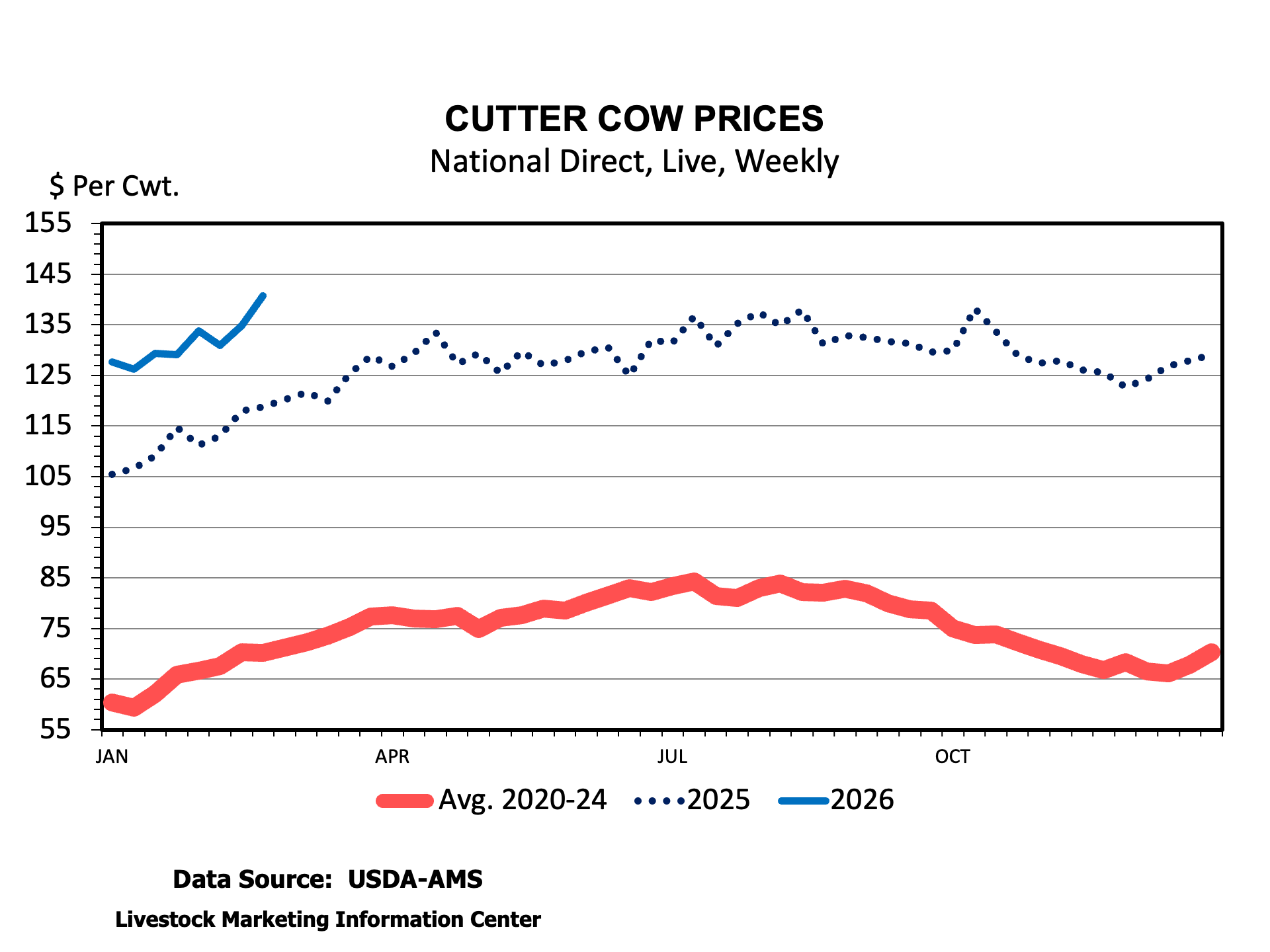
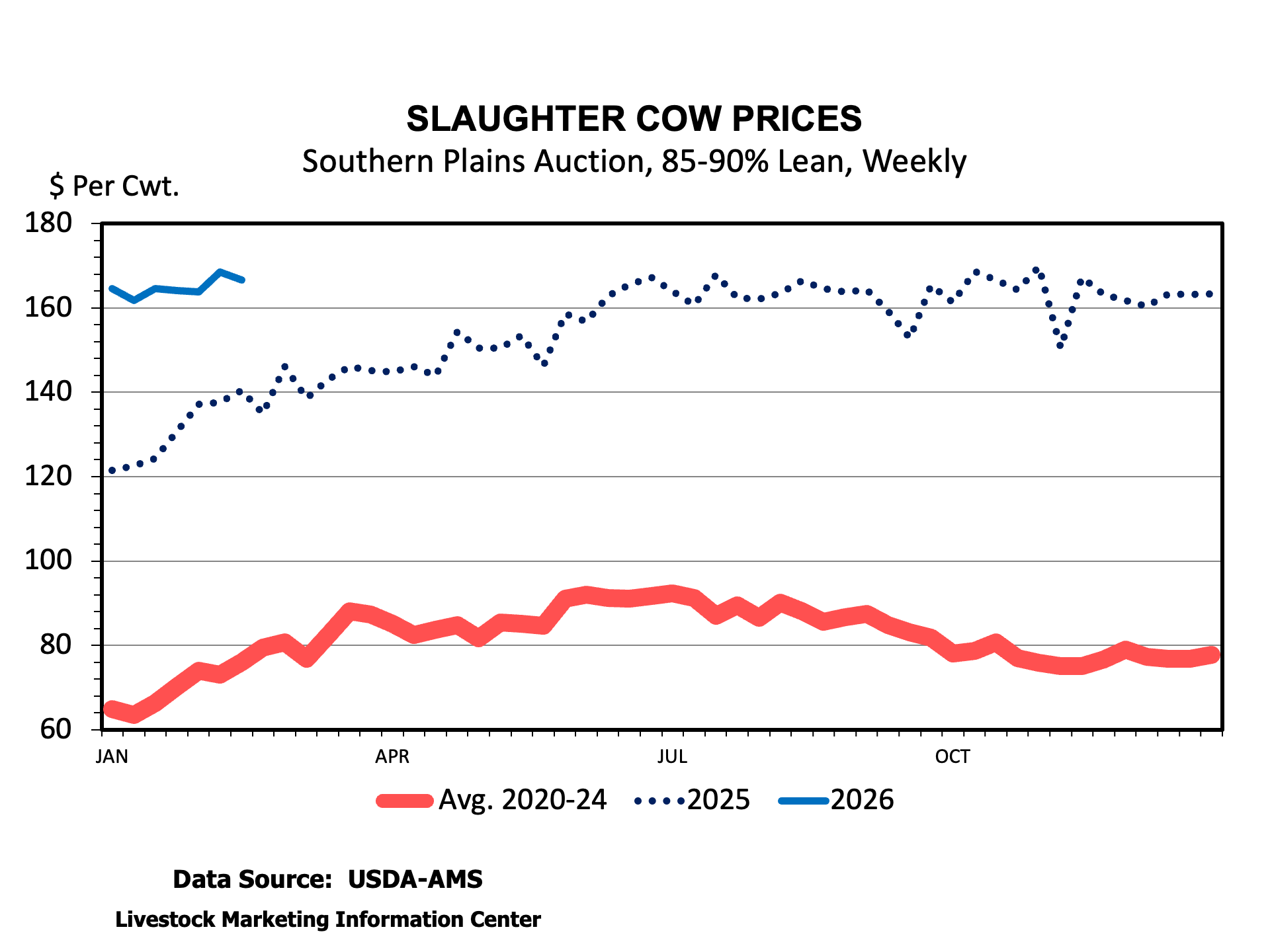
    Cow prices normally increase seasonally until about June each year.  2026 prices have had little seasonal increase, but they remain in record high territory.    Auction prices in the Southern Plains for 85-90 percent lean cows have increased by about $3 per cwt to $167 per cwt since the beginning of January.  National average cutter quality cows have increased about $13 per cwt since the first of the year.  Likewise, the cow beef cutout has steadily increased by $19 per cwt to $331 per cwt in early March.  

    Across the South, cull cows at auctions have trended higher this year.  Since the first of the year, Mississippi breaker quality cow auction prices have been as high as $175, and started early March at $162 per cwt.  Kentucky culls of the same quality began in March at $164.  Breaker cows at Georgia auctions have been even higher, beginning in March at $174 per cwt.  

    Yield grade 1 cull bulls broke the $200 per cwt barrier during February in Mississippi and Georgia auctions.  Those prices are about $30 per cwt higher than this time last year.  Bull prices have increased a little more than cow prices this Spring.  

    Tighter supplies are boosting prices.  Beef cow slaughter is down more than 20 percent from last year so far in 2026. Only 34,200 head were slaughtered during the last week of January, making it the smallest non-holiday week slaughter in years.  Dairy cow slaughter is running 7.3 percent higher than last year.  The largest dairy cow herd since the early 1990s and sharply lower milk prices will keep dairy cow slaughter ahead of 2025’s pace in the coming weeks.  The high price of calves, especially beefXdairy crossbred calves, has helped to boost dairy cow inventory as producers are seeing larger returns from the calves to help offset lower milk prices. 

    Short supplies of fed cattle are reducing overall beef production, which is helping to keep non-fed beef prices high.  Record high fed steer dressed weights, over 980 pounds per carcass on average, are boosting supplies of fat.  The larger supplies of fat require larger amounts of lean beef to blend to desirable ground beef percentages.  That increase in processor demand for lean beef to mix with ample supplies of fat is also helping to boost cull cow values. Cull prices are seeing a boost from both the supply and demand sides of the equation.  

    Events of the last week are likely to test the strength of beef demand.  Ground beef usually gets a grilling season boost in the Spring and could get an extra boost ahead of this summer’s FIFA World Cup. That demand bump usually leads to higher cull cow prices.  So, there is still some room for higher cull cow prices this Spring.


    Anderson, David, and Josh Maples. “Cull Cow Prices High and Bull Prices Break $200.” Southern Ag Today 6(11.2). March 10, 2026. Permalink

  • What Determines Peanut Crop Insurance Projected and Harvested Prices During the Price Discovery Period?

    What Determines Peanut Crop Insurance Projected and Harvested Prices During the Price Discovery Period?

    Authors: Yangxuan Liu, Associate Professor, Department of Agricultural and Applied Economics, University of Georgia; Susmitha Kalli, Graduate Student, Department of Agricultural and Applied Economics, University of Georgia; Hunter D. Biram, Assistant Professor, Department of Agricultural Economics and Agribusiness, University of Arkansas

    For peanut farmers, understanding how crop insurance projected and harvested prices are determined is essential for purchasing crop insurance with confidence. The projected price determined in early spring guides how much crop insurance coverage a peanut grower can expect. Later in the season, the harvest price determines whether an indemnity payment is triggered if market conditions fall short. 

    The U.S. Department of Agriculture (USDA) Risk Management Agency (RMA) sets the peanut crop insurance projected and harvest prices using the Peanut Formula Price (PFP). Because peanuts do not have an active futures market, their crop insurance projected and harvested prices are based on the futures prices of related commodities of wheat, cotton, soybean oil, and soybean meal. The market behavior of these commodities has historically correlated with peanut prices.

    The PFP is calculated from the December futures contracts of these four commodities traded during the peanut crop insurance price discovery period within the insurance year. USDA also establishes a loan rate for in-shell peanuts, which serves as a price floor for both projected and harvest prices used in crop insurance. If the calculated PFP falls below this loan rate, the loan rate becomes the effective minimum, ensuring that coverage does not drop below a guaranteed level, even during a market downturn. 

    Factors that determine PFP are announced annually by the USDA and vary by production year and by sales closing date. For peanut crop insurance, the sales closing dates include January 31, February 28, and March 15 (Kalli, Liu & Biram, 2025). For the 2026 crop year, the following links take you to the RMA technical pages with current peanut factor values: January 31, 2026, February 28, 2026, and March 15, 2026.

    Based on the peanut factors announced by RMA, the projected prices ($ per Pound) for the 2026 peanut crop insurance with different sales closing dates are as follows:

     January 31February 28March 15
    Runner 0.24090.24550.2477
    Spanish 0.33000.31910.3220
    Valencia0.27220.28480.2848
    Virginia0.27220.28480.2848

    References:


    Liu, Yangxuan, Susmitha Kalli, and Hunter D. Biram. “What Determines Peanut Crop Insurance Projected and Harvested Prices During the Price Discovery Period?” Southern Ag Today 6(11.1). March 9, 2026. Permalink

  • Paraquat and Glyphosate: An Update and Outlook

    Paraquat and Glyphosate: An Update and Outlook

    Authors: Jennifer S. Friedel, Esq. and Henry Davenport, LUVA Fellow Virginia Tech, Dept. of Agricultural and Applied Economics

    Court dockets and regulatory desks are no stranger to pesticide legal challenges. Public concern about health and environmental implications, and what seems like an unceasing cycle of litigation, surrounds their use. At the federal and state levels, executive and legislative officials act to implement substantive changes. Meanwhile, the judiciary wades through new and lingering claims by and against their manufacturers while recent major policy developments may give users and manufacturers an upper hand.

    Paraquat: Regulatory Reform on the Horizon 

    In January, a proposed ban on the manufacture, distribution, use, or sale of paraquat dichloride, the herbicide commonly referred to as paraquat was introduced before Virginia’s General Assembly as HB1375.[1] On February 11, Virginia’s House Agriculture, Chesapeake and Natural Resources Committee unanimously voted to continue HB1375 to the 2027 session, effectively killing the bill. 

    Used on more than 250,000 acres in Virginia alone, paraquat is a rain-fast non-selective contact herbicide that targets cell membranes, stopping photosynthesis and killing vegetation quickly. Outside of agricultural uses, paraquat is commonly used for vegetation management on infrastructure and fencing. The herbicide is particularly effective in combating increasing glyphosate-resistant vegetation.[2]

    Proponents of the bill noted the herbicide’s risk to human health including its potential link to Parkinson’s disease in addition to environmental concerns and the fact that it is currently banned in 70 countries. In 2021, the EPA issued an interim decision on the registration review of paraquat finalizing new, stronger protections intended to reduce exposure.[3] As part of EPA’s ongoing registration review process for paraquat, it continues to evaluate its volatilization potential and anticipates releasing an updated analysis in addition to possible refinements of EPA’s bystander inhalation exposure analysis but to date, has not identified any clear links from labeled uses of paraquat and adverse health, including Parkinson’s disease and cancer.[4]

    Glyphosate: Federal Favorability and Legal Setbacks

    Meanwhile, on the glyphosate forefront, litigation and policy developments are swiftly rolling in. Since acquiring Monsanto in 2018, Bayer has been steeped in litigation over the safety of its flagship glyphosate-based product, Roundup. In February of this year, Bayer reached a $7.25 billion settlement to compensate current and future users who experience adverse effects from Roundup.[5] The class settlement aims to mitigate current and future Roundup claims alleging non-Hodgkin lymphoma injuries. As of October 2025, almost 200,000 claims have been resolved by Bayer or deemed ineligible.[6]

    In January, the U.S. Supreme Court announced that it will hear an appeal from Bayer in Durnell v. Monsanto, a case which will determine whether state-based failure to warn claims are preempted by the Federal Insecticide, Fungicide, and Rodenticide Act’s (FIFRA’s) labeling requirements. In Durnell, plaintiffs allege that Monsanto failed to give appropriate warning of Roundup’s health risks, including its alleged propensity to cause cancer. In response, Bayer argues that the EPA’s pesticide labeling requirements under FIFRA preempt such state law claims as such warnings are not federally required.[7] Regardless of the outcome of Durnell, the case is expected to either reinforce or dismantle thousands of pending lawsuits involving state claims related to pesticide and herbicide use. Oral arguments before the U.S. Supreme Court are scheduled for April 27, 2026. 

    On February 18, 2026, President Trump issued an executive order declaring elemental phosphorus and glyphosate-based herbicides central to American economic and national security. Elemental phosphorus is both a precursor element to glyphosate herbicides and a critical component of many defense technologies and a key input of weapon-system supply chains. National security concerns regarding these have stepped into the spotlight due to ongoing trade negotiations and instability in the supply chain. The executive order also directs the Secretary of Agriculture to protect domestic glyphosate-based herbicide production, to ensure adequate supply. Domestic production relies on a single U.S. producer of elemental phosphorus and glyphosate-based herbicides which currently does not meet annual demand. The executive order establishes protections for domestic producers aimed at protecting corporate viability of domestic producers. [8]

    While Bayer maintains confidence that the end of litigation over glyphosate’s safety is near, paraquat thus far survives emerging policy challenges. 


    [1] H.B. 1375, 164th Gen. Assem., Reg. Sess. (Va. 2026). 

    [2] Owens, Brian. Resistance to glyphosate on the rise among weeds. Chem. Inst. Can. (May 2024), https://www.cheminst.ca/magazine/article/resistance-to-glyphosate-on-the-rise-among-weeds/ (accessed February 27, 2026).

    [3] U.S. Envtl. Prot. Agency, Paraquat Dichloride, https://www.epa.gov/ingredients-used-pesticide-products/paraquat-dichloride (accessed February 27, 2026).

    [4] Id.

    [5] Bayer AG, Monsanto announces Roundup™ class settlement agreement to resolve current and future claims. Bayer Global, https://www.bayer.com/media/en-us/monsanto-announces-roundup-class-settlement-agreement-to-resolve-current-and-future-claims/ (accessed February 27, 2026).

    [6] Bayer AG, Managing the Roundup™ Litigation, Bayer Global, https://www.bayer.com/en/managing-the-roundup-litigation (accessed February 27, 2026).

    [7] Id.

    [8] Exec. Order No. 14387, 91 FR 8703 (2026). 


    Friedel, Jennifer S., and Henry Davenport. “Paraquat and Glyphosate: An Update and Outlook.” Southern Ag Today 6(10.5). March 6, 2026. Permalink

  • Where is All the Tariff Money Going and Is it Being Used to Help Farmers?

    Where is All the Tariff Money Going and Is it Being Used to Help Farmers?

    Authors: Bart L. Fischer and Joe Outlaw

    Over the last few weeks, much of the attention around reciprocal tariffs has centered on the Supreme Court’s ruling about President Trump’s use of the International Emergency Economic Powers Act (IEEPA) to levy tariffs. While many questions have been raised about the impact of the court’s ruling on tariff revenue already collected—with a federal judge on the U.S. Court of International Trade ruling on this issue just yesterday—this article focuses on where tariff revenue goes once it’s collected. Interestingly enough, the answer to that question is rooted in the Agricultural Adjustment Act (AAA) of 1935.

    How much tariff revenue has been collected?

    From 2017 to 2019, during the first Trump Administration, customs duties more than doubled (from $34.6 billion to $70.8 billion, respectively).  From 2024 to 2026, the Congressional Budget Office (CBO) estimates that customs duties will increase by 443% (from $77 billion to $418 billion, respectively), a reflection of President Trump’s renewed use of tariffs in his second term.

    Figure 1. Customs Duties by Fiscal Year.

    Source: The Budget and Economic Outlook: 2026 to 2036, Congressional Budget Office.

    Where does the tariff money go?

    So, if billions of dollars are collected in tariff revenue, where does it go?  Section 32 of the AAA of 1935 requires that 30% of tariff revenue be used to:

    1. encourage the export of agricultural products;
    2. encourage the domestic consumption of farm products by diverting surpluses and increasing usage; and
    3. reestablish farmers’ purchasing power by making payments in connection with the normal production of any agricultural commodity for domestic consumption.

    In 2017, Section 32 amounted to roughly $10.4 billion (or 30% of the $34.6 billion in tariff revenue collected in 2017).  If $413 billion in tariff revenue is collected in 2026, the Section 32 amount would balloon to $125 billion, all of which is required to be set aside for the purposes/priorities listed above.

    How are these priorities being met?

    While 30% of customs duties flow to USDA, USDA then transfers a small amount off the top (30% of customs receipts from fishery products) to the Department of Commerce. USDA is then required to retain a portion of the funds (roughly $1.8 billion in fiscal year 2026) as reserved spending authority to support farmers and domestic food assistance programs primarily through commodity purchases. This amount is limited and indexed to inflation. The vast majority is then transferred to the Food and Nutrition Service (FNS) for the child nutrition programs. For example, in fiscal year 2024, 94% of the Section 32 funds (or $28.785 billion) flowed through to the child nutrition programs. Otherwise, USDA has virtually no discretion in the use of Section 32 funds. 

    With the tariff revenue projections for fiscal year 2026, the Section 32 funds available will dwarf total spending on the child nutrition programs at USDA. So, where does that leave farmers?

    How are the tariffs being used to help farmers?

    As noted above, clause 3 authorizes the use of Section 32 funds to reestablish farmers’ purchasing power by making payments in connection with the normal production of any agricultural commodity for domestic consumption. One would think Section 32 funds would be an obvious choice for helping farmers given (1) other countries have retaliated against U.S. products with their own tariffs in response to reciprocal tariffs and (2) farmer purchasing power has been decimated by inflation over the last 5 years.  INSTEAD, since fiscal year 2018—including in the fiscal year 2026 agricultural appropriations bill that was signed into law in November 2025—the appropriators have mandated that no more than $350 million in carryover from Section 32 can be used for clause 3 activities. In other words, if CBO’s projections for fiscal year 2026 hold, Congress will essentially be dictating that no more than 0.28% of the $125 billion in tariff revenue flowing to USDA can be used to help farmers.

    While the Trump Administration has drawn on authority and funding from the Commodity Credit Corporation (CCC) to provide trade and economic relief via the new Farmer Bridge Assistance (FBA) program, it begs the question of why Congress continues to insist that virtually none of the tariff revenue that flows to USDA via Section 32 be used to help farmers. 

    Sources:

    The Budget and Economic Outlook: 2026 to 2036, Congressional Budget Office, February 11, 2026 (https://www.cbo.gov/publication/61882)

    Farm and Food Support Under USDA’s Section 32 Account, Congressional Research Service, August 5, 2025 (https://www.congress.gov/crs_external_products/IF/PDF/IF12193/IF12193.5.pdf)


    Fischer, Bart L., and Joe Outlaw. “Where is All the Tariff Money Going and Is it Being Used to Help Farmers?” Southern Ag Today 6(10.4). March 5, 2026. Permalink

  • What Determines a “Good” Price?

    What Determines a “Good” Price?

    A common question producers ask is, “What is a good price to sell at?” The best answer is that there is no single number that fits every farm. A “good price” is not defined solely by price. It is defined by individual cost structure, yield expectations, and financial goals. One producer with a lower production cost may lock in soybeans at $10.50 per bushel and achieve the same profit margin as another producer who needs $11.50 per bushel to cover higher expenses. The difference is the unique financial conditions facing the operation. Thus, producers must consider various factors when deciding on a “good” price for marketing. 

    When setting price goals, the cost of production should be the starting point, as it determines the breakeven price when combined with an expected yield. A breakeven price forms the foundation of any pricing decision. Previous Southern Ag Today articles have discussed how to use enterprise budgets to estimate costs and calculate breakeven prices, including Estimating Cost of Production and Breakeven Prices with Enterprise Budgets and Enterprise Budgeting. We encourage producers to revisit these resources to better understand their numbers before establishing price targets.

    Once breakeven prices are determined, they must be adjusted to meet the farm’s broader financial goals. An operation cannot remain viable if it only breaks even year after year. Starting with breakeven, producers should begin layering in profit targets that reflect debt obligations, capital replacement needs, working capital goals, and desired returns to management and equity. This stage provides an opportunity to align the marketing plan with the overall financial health and strategic direction of the farm business.

    The condition of the farm balance sheet also influences price targets. Producers focused on improving liquidity or reducing leverage may prioritize securing modest but reliable margins. Others in a stronger financial position, or those pursuing expansion, may be willing to target higher price levels before committing bushels. In either case, price targets should reflect the operation’s financial needs and risk tolerance rather than a single benchmark price.

    It is also important for producers to understand their local basis when determining price targets. While cash contracts can be used to manage price directly, any futures-based marketing strategy requires accounting for basis risk. Ignoring basis can lead to missed expectations, even if the futures market reaches the targeted level. 

    Seasonality can help structure tiered price targets. As shown in Figure 1, the 10 year average soybean futures price, using the November contract pre-harvest and a nearby series post-harvest, tends to rise through the growing season as weather uncertainty builds, soften ahead of harvest pressure, and often strengthen again after harvest as stored supplies are rationed. While this pattern is not guaranteed in any given year, it provides useful context for historically favorable pricing windows. Producers might consider setting an initial pre-harvest target in the spring or early summer when weather-driven volatility supports prices, with additional tiers near typical post-harvest seasonal highs. However, post-harvest targets must account for carrying costs, including storage, interest, shrink, and quality risk, since higher futures prices do not necessarily translate into higher net returns if those costs outweigh the seasonal gain.

    Ultimately, a good price is influenced by farm-specific factors unique to each operation. By grounding price targets in cost of production, financial goals, basis expectations, and seasonal tendencies, producers can move from asking “Is this a good price?” to confidently knowing when a price meets their operation’s needs.

    Figure 1. Ten-Year Average Soybean Futures Prices Across the Pre- and Post-Harvest Marketing Window

    Note: Pre-harvest prices reflect the November soybean futures contract. Post-harvest prices are based on a continuous nearby futures series.

    Maples, William. “What Determines a “Good” Price?” Southern Ag Today 6(10.3). March 4, 2026. Permalink