We’ll take a break from the cattle and beef market news of the last week to take a look at dairy markets. However, there is one important interaction between beef and dairy markets that intersects with recent news.
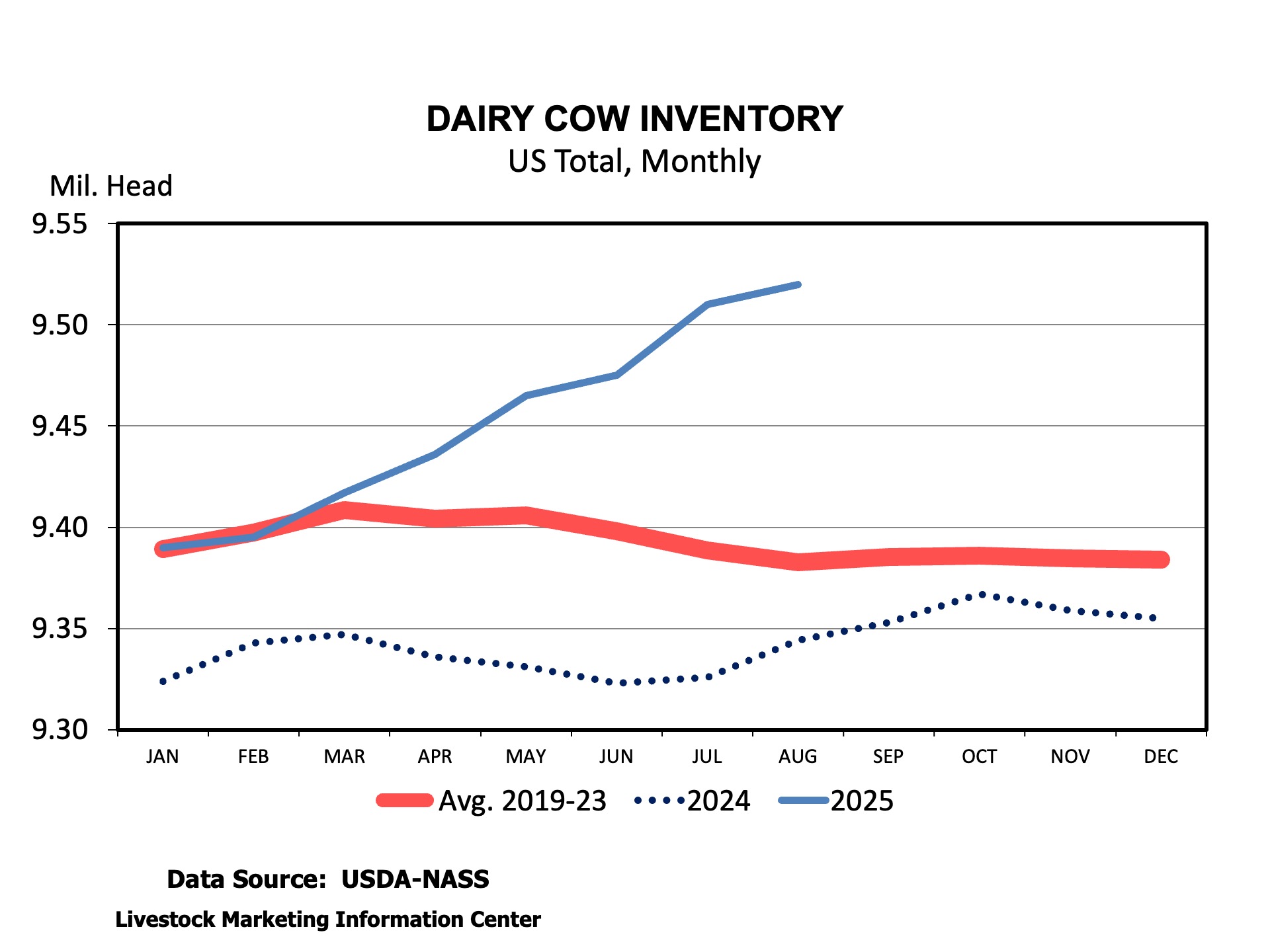
Profitable milk prices and falling feed costs in 2024 have led to a surge in the number of dairy cows since the first of the year. USDA’s August Milk Production report indicated 9.52 million dairy cows in the U.S. That is the highest number of dairy cows since 1993. The number of dairy cows in the U.S. has typically fluctuated between 9.3 and 9.4 million over the last decade. Cow numbers are particularly higher in the Plains. Dairy cows in Texas hit 699,000 head; this is the most dairy cows in the state since 1958! Milk processing capacity is growing hand in hand with cow numbers.
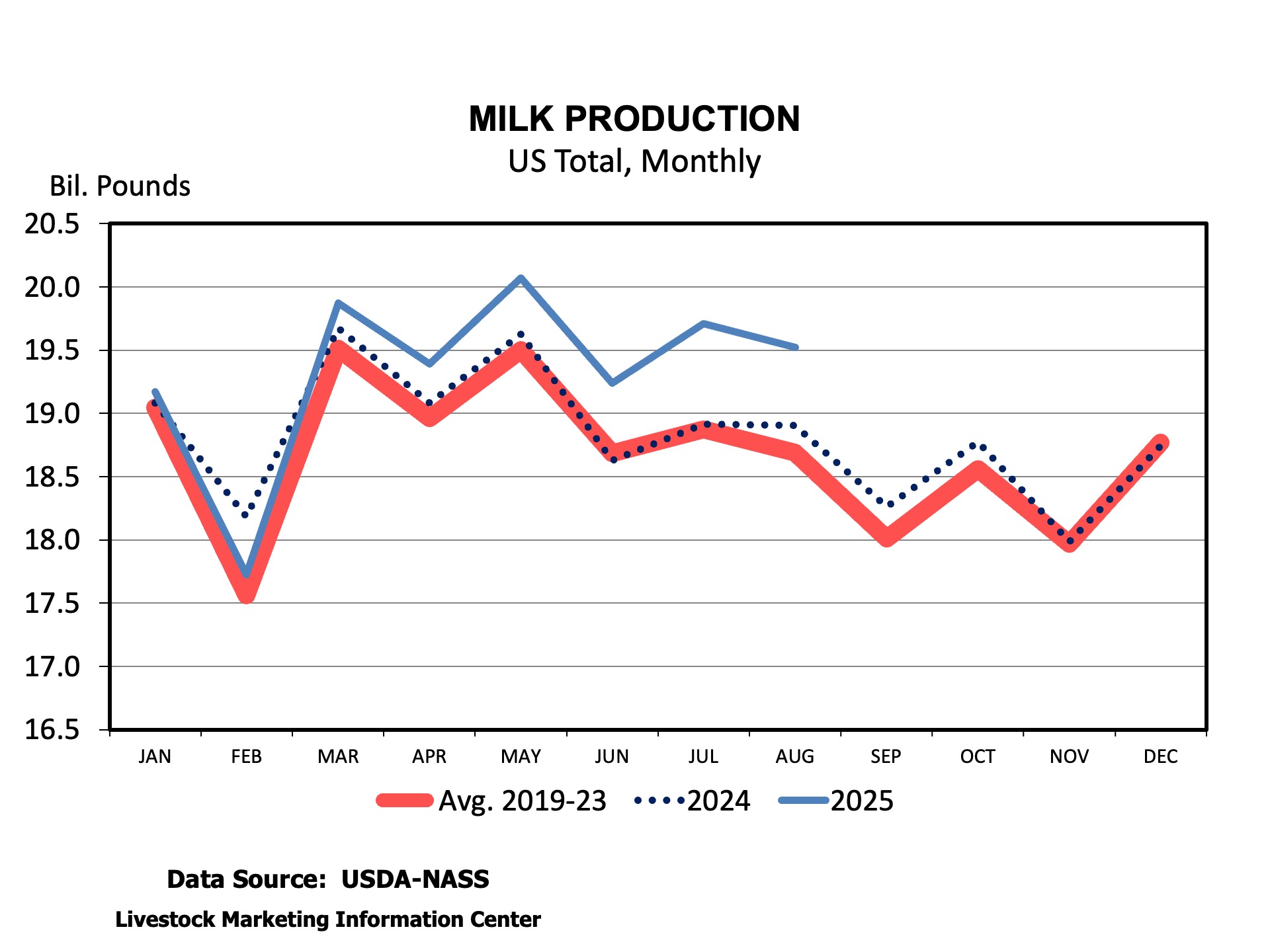
In addition to more cows, milk production per cow has increased since April. Production per cow hit 2,050 pounds in August, the largest August milk production per cow on record, up 1.3 percent compared to August 2024. The combination of more cows and more milk per cow has milk production up 3.6 percent over the last 3 months compared to the same period last year.
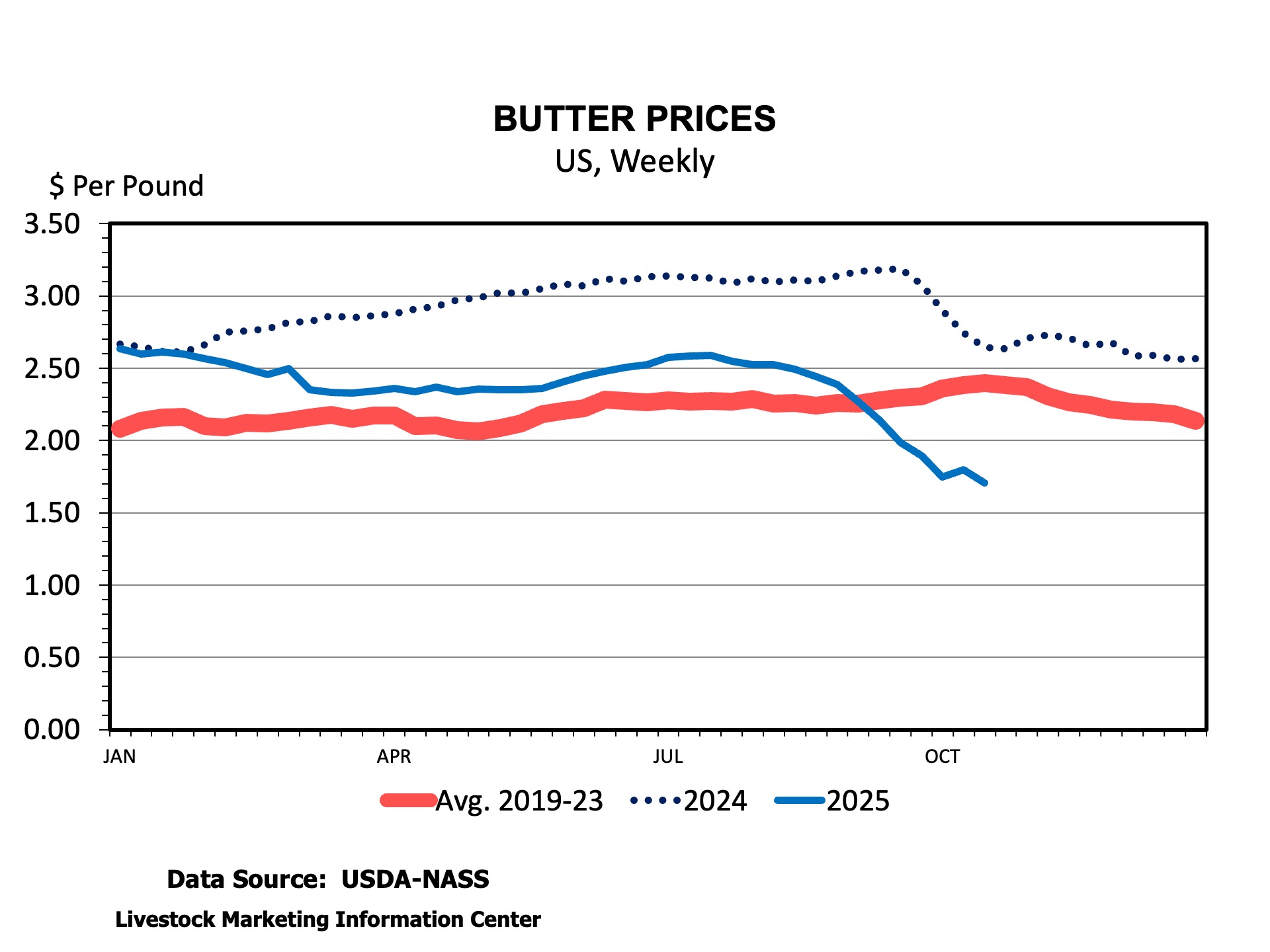
As production has surged, prices are beginning to decline sharply. Cheese, butter, and non-fat dry milk (NFDM) prices are the basic product prices forming federal milk marketing order prices. Cheddar cheese, 40 pound blocks, has moved between about $1.95 and $1.70 per pound all year. While prices should be increasing seasonally, heading into the holidays, they are about $0.30 per pound below a year ago. Butter prices have declined sharply over the last few weeks from $2.50 per pound to about $1.70 in mid-October. NFDM prices have fallen sharply to $1.14 per pound, their lowest price of the year. Lower product prices are filtering through to much lower milk prices to dairy farmers.
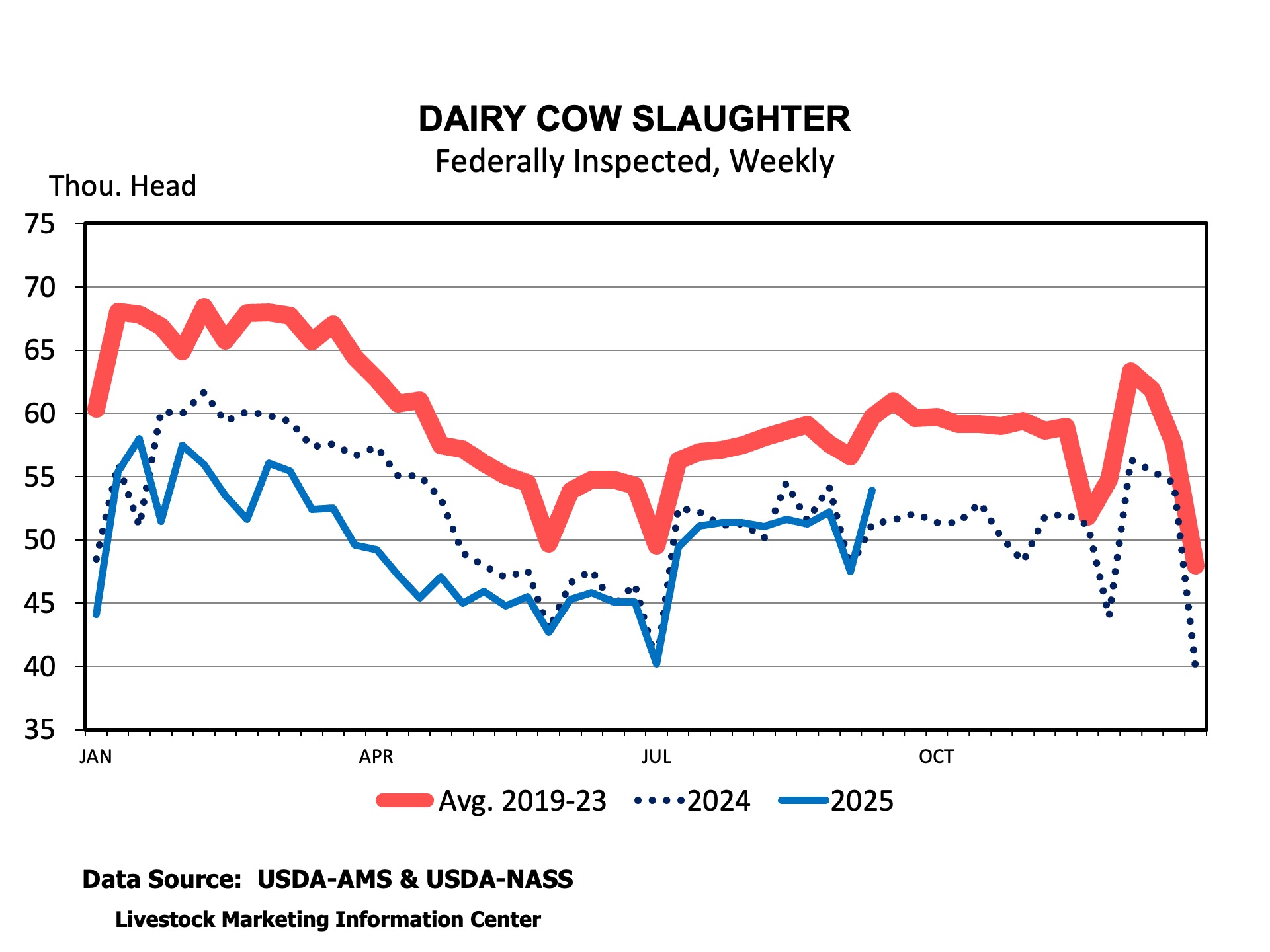
One area of interaction between dairy and beef cows is the cull cow market. While beef cow slaughter remains much lower than last year, dairy cow slaughter is picking up and has been equal to last year since mid-year. More dairy cows in the herd, falling milk prices, and record high cull cow prices will likely cause some more cow culling in the coming weeks. A recent newspaper article quoted a dairy farmer in Wisconsin as saying we really needed more dairy culling to boost milk prices and increase supplies of beef. Harkening back to the 1980s and the dairy herd buyouts, which caused even more worries for many cattle producers. At the moment, there is no government program to encourage dairy cow culling. Unless something changes, it looks like the market will take care of this, too.
The One Big Beautiful Bill (OBBB) Act, signed into law on July 4, 2025, introduces new opportunities for U.S. peanut producers to manage risk. This article explores the current crop insurance options available to peanut farmers and highlights how the new law expands these choices beginning crop year 2026. Under the OBBB, peanut producers continue to have access to traditional deep-loss and shallow-loss programs, while also gaining access to a new combination of income protection tools: the Supplemental Coverage Option (SCO) and Agriculture Risk Coverage – County (ARC-CO). These programs are designed to help farmers safeguard their income against unexpected losses. This article provides a detailed look at these options and how they can benefit peanut producers.
Deep Loss Programs protect against significant losses, including complete crop losses. The Federal Crop Insurance Program (FCIP) for peanuts offers three farm-level insurance plans that fall into this category. These plans form the foundation of a peanut producer’s risk management strategy. They are also referred to as the underlying policy that peanut producers can purchase to protect against potential losses. (1) Yield Protection (YP) insures against losses when yield falls below a selected coverage level due to natural disasters or other covered events. (2) Revenue Protection (RP) safeguards revenue when it falls below the selected revenue coverage level, either due to low yields, declining prices, or both. (3) Revenue Protection with Harvest Price Exclusion (RP-HPE) functions similarly to RP but does not increase the revenue guarantee if harvest prices rise above the projected price. This typically results in lower premium costs for producers.
Shallow Loss Programs provide additional coverage for smaller, more frequent losses that can impact a farmer’s income. For peanut producers, shallow loss insurance options include SCO and the Enhanced Coverage Option (ECO). These are add-ons, not standalone policies, and must be paired with an underlying policy, such as YP, RP, or RP-HPE. By layering SCO and/or ECO onto their base policy, producers can often achieve higher overall coverage at a lower combined premium than by raising the base policy’s coverage level alone. This layered approach, which combines shallow-loss and deep-loss tools, is explored here by Biram and Connor (2023), who demonstrate that strategic combinations can enhance overall risk protection.
Unlike deep loss programs, which provide protection at the farm level, shallow loss programs do not cover complete crop failures. SCO and ECO are both area-based programs, triggered by county-level yield or revenue outcomes depending on the underlying policy. They help fill the “deductible gap”, covering losses that fall between the individual coverage level of the underlying policy and the higher coverage level selected for SCO or ECO. Biram (2024) discusses how ECO may provide meaningful protection in years when county yields are strong, but market prices decline, offering producers an effective tool to manage upside yield risk and downside price exposure.
Beginning crop year 2026, under the OBBB, producers can now purchase SCO regardless of whether their base acres are enrolled in ARC-CO, removing a major restriction from previous farm bills. This means that the same acres can now be enrolled in both the ARC-CO and SCO programs. Additionally, the maximum SCO coverage level was increased to 90%, and its premium subsidy rate was raised to 80% (Biram & Maples, 2025). RMA has issued guidance on implementing the legislative changes. Under this new guidance[1], the 80% higher premium subsidy rate will also extend to the Enhanced Coverage Option (ECO) and the Hurricane Insurance Protection–Wind Index (HIP-WI).
Additional Program: In addition to the deep and shallow loss programs, peanut producers can also purchase Hurricane Insurance Protection – Wind Index (HIP-WI). This endorsement helps cover part of the deductible from the primary crop insurance policy when sustained hurricane-force winds impact the county or a neighboring one. HIP-WI can be combined with SCO and ECO, but only if the acreage is already insured under an underlying policy (YP, RP, or RP-HPE). HIP-WI has gained popularity, particularly in regions prone to hurricanes and tropical storms.
Understanding these insurance options empowers farmers to develop customized risk management strategies. By combining standalone policies with supplemental options and endorsements, producers can strengthen their financial resilience against both major and minor losses. For more information, producers are encouraged to visit the U.S. Department of Agriculture’s Risk Management Agency website and use the Agent Locator Tool to connect with a certified crop insurance professional.
Table 1. Individual and Area Crop Insurance Products with Associated Indemnity Triggers and Standalone Status for Peanuts
Hurricane Insurance Protection – Wind Index (HIP-WI)
Area
Hurricane or Tropical Storm
No
[1] Starting in 2027, RMA will increase the maximum SCO coverage level from 86% to 90%. For 2026, producers can use ECO to cover that band instead and will receive the same 80% premium subsidy that applies to SCO.
The H-2A program is an important provider of agricultural labor in the United States. The H-2A program is jointly administered by three federal agencies – Department of State (“DOS”), Department of Homeland Security (“DHS”), and Department of Labor (“DOL”). DOS issues the H-2A visas to workers through embassies and consulates in the worker’s country of residence. DHS, through U.S. Citizenship and Immigration Services (“USCIS”), oversees the petition process. DOL provides H-2A certifications to employers and ensures that wage, housing, and other U.S. labor laws are followed. In 2025, there have been several changes to the H-2A program through federal agency actions and court injunctions.
Visa Updates
On September 18, 2025, the DOS announced that certain H-2A visa applicants would be exempt from the nonimmigrant visa interview requirement starting on October 1, 2025. According to the DOS’s announcement, “applicants renewing an H-2A visa within 12 months of the prior visa’s expiration when the prior visa was issued for full validity at the time of issuance” are exempt from the interview requirement if specified conditions are met:
The applicant was at least 18 years old;
The applicant applied in his or her country of nationality or usual residence;
The applicant has never been refused a visa; and
The applicant has no apparent or potential ineligibility.
Adverse Effect Wage Rate Rules
On August 25, 2025, a judge in the Western District of Louisiana issued a ruling in Teche Vermilion Sugar Cane Growers Ass’n v. Chavez-Deremer, 6:23-CV-831, 2025 WL 2472461 (W.D. La. Aug. 25, 2025) granting a permanent injunction and vacating DOL’s 2023 Adverse Effect Wage Rate (“AEWR”) rule. In 2023, DOL issued a final rule amending the formula for calculating the AEWR for non-range agricultural occupations. The AEWR is the minimum hourly rate, determined for each state, that employers must pay H-2A workers. DOL announced that it would be reverting back to utilizing the methodology to calculate the AEWR laid out in the 2010 rule until the department can promulgate new regulations.
On October 2, 2025, DOL issued an interim final rule amending how the AEWR is calculated. This rule replaces the methodology from the 2010 and 2023 rules. There are three major changes under the new rule. The first major change is that the rates set by the DOL will be based on the Occupational Employment and Wage Statistics (OEWS) instead of the Farm Labor Survey, which USDA is discontinuing. The next major change is that DOL will set one AEWR for the five standard occupational class codes that comprise the “field and livestock workers (combined)” category and separate AEWRs for all other standard occupational class codes. The last major change is that the interim final rule implements AEWRs for two different skill levels – entry level and experienced. Skill level I, or entry-level, require no formal education or specialized training. Skill level II, or experienced-level, requires skills obtained through education, training, or experience to perform the job. This means that for each AEWR set, there will be a wage for skill level I jobs and a wage set for skill level II jobs. The interim final rule went into effect on October 2, 2025, and comments are being accepted until December 1, 2025.
Filing of H-2A Petitions
On October 2, 2025, DHS issued a final rule updating the timing to submit a temporary labor certification (“TLC”) for unnamed beneficiaries in order to reduce the time it takes to complete the H-2A program enrollment process for employers. Prior to the rule, employers were required to wait until DOL certified the TLC before submitting the required forms to USCIS. Under the new rule, employers can now submit the I-129H2A form after receiving a notice of acceptance from DOL and before the TLC is certified. This will allow the two agencies, USCIS and DOL, to concurrently process portions of the H-2A application process. However, USCIS will not approve the petition until DOL approves the TLC. It is important to note that the new rule only applies to electronic petitions with unnamed beneficiaries. For petitions with named beneficiaries or petitions filed by paper, the process remains unchanged.
We often use Farm Policy Thursdays at Southern Ag Today to address questions we’ve been hearing, either from producers or from the general public. Today is no exception. With all the talk about low crop prices and high input costs, we increasingly are getting questions like these: “If farmers are projected to lose money this year, then why plant anything? And, isn’t the market telling them there’s too much supply and they should plant less?”
On the surface, those are pretty simple and relatable questions. But, as with most things in agriculture, the answer is much more complex.
If a farmer has sufficient cash on which to live and no debt to service, that might work. But, unless that applies to you or you have a job off the farm that provides supplemental income, shutting down would be guaranteeing no income for the farm/family for the year.
U.S. farmers must also contend with the fact that they operate in a global market. If U.S. farmers were to simply sit out this growing season, how would the rest of the world respond? Would they also idle their operations, allowing prices to rise so that everyone could enjoy higher prices together? Of course not. While we could fill pages on this topic, the bottom line is that prices would certainly rise, but other countries would likely ratchet up their production to take advantage of those prices at the expense of U.S. farmers.
Perhaps the most important factor is that farmers are eternal optimists. After all, they are putting a seed in the ground in hopes that sufficient rain will fall for the seed to germinate. They then spend months tending to plants to ensure that weeds and insects don’t choke the plant out. Many spend the rest of the time praying that hail, floods, snow, and hurricanes—you name the disaster—won’t leave the crop in tatters. With that same spirit, they also plant that crop in hopes that the market will turn around by harvest time so they can make enough money to pay off the banker and have enough left over to feed their families and start over again next year.
Most farmers we know and work with have chosen that profession—in spite of all the risks and historically low returns—because they want to help their fellow man. Farming isn’t a job…it’s part of who they are. Simply sitting out a crop isn’t really in their DNA.
We suspect those answers would be followed by this question: “Okay, I understand they can’t totally idle their farm, but can’t they just shift from one crop to another that makes more economic sense?”
We would argue that farmers are always considering that option, but that generally only works if those opportunities exist. At this point, most crops are facing negative returns, and it’s not remotely clear that one crop would be preferred over any other, especially after accounting for all of the things farmers can’t control.
Most farmers that grow multiple crops have a carefully crafted, multi-year rotation that they want to maintain for a variety of reasons (e.g., controlling weeds, maintaining fertility and soil health, controlling erosion, etc).
Often equipment and supporting infrastructure is crop specific, limiting the ability for farmers to substitute crops (or at least serving as a consideration). For example, the only thing you will accomplish by running a cotton picker through a corn field is creating a giant mess.
In summary, simply not planting a crop is just not a viable option for most farmers, and shifting the crop mix—while always under consideration by farmers—comes with its own set of considerations and challenges. It’s for these reasons, in part, that each Congress and successive Administrations have repeatedly supported farmers when things do not turn out as they planned or hoped.
Throughout this growing season, much of the conversation has centered around expectations for a historically large U.S. corn crop. In its September report, USDA projected production at 16.8 billion bushels, nearly 1.5 billion more than the previous record set in 2023. As noted in last week’s Southern Ag Today article, Potential Market Impacts of Missing a WASDE Report During Government Shutdowns, the October WASDE was canceled due to the government shutdown, leaving producers without updated yield or demand estimates. Now that harvest is well underway and yields are coming in, USDA may trim its yield estimate slightly, but even with a small adjustment, we are still looking at a massive crop. The key question moving forward is simple: what are we going to do with all of it?
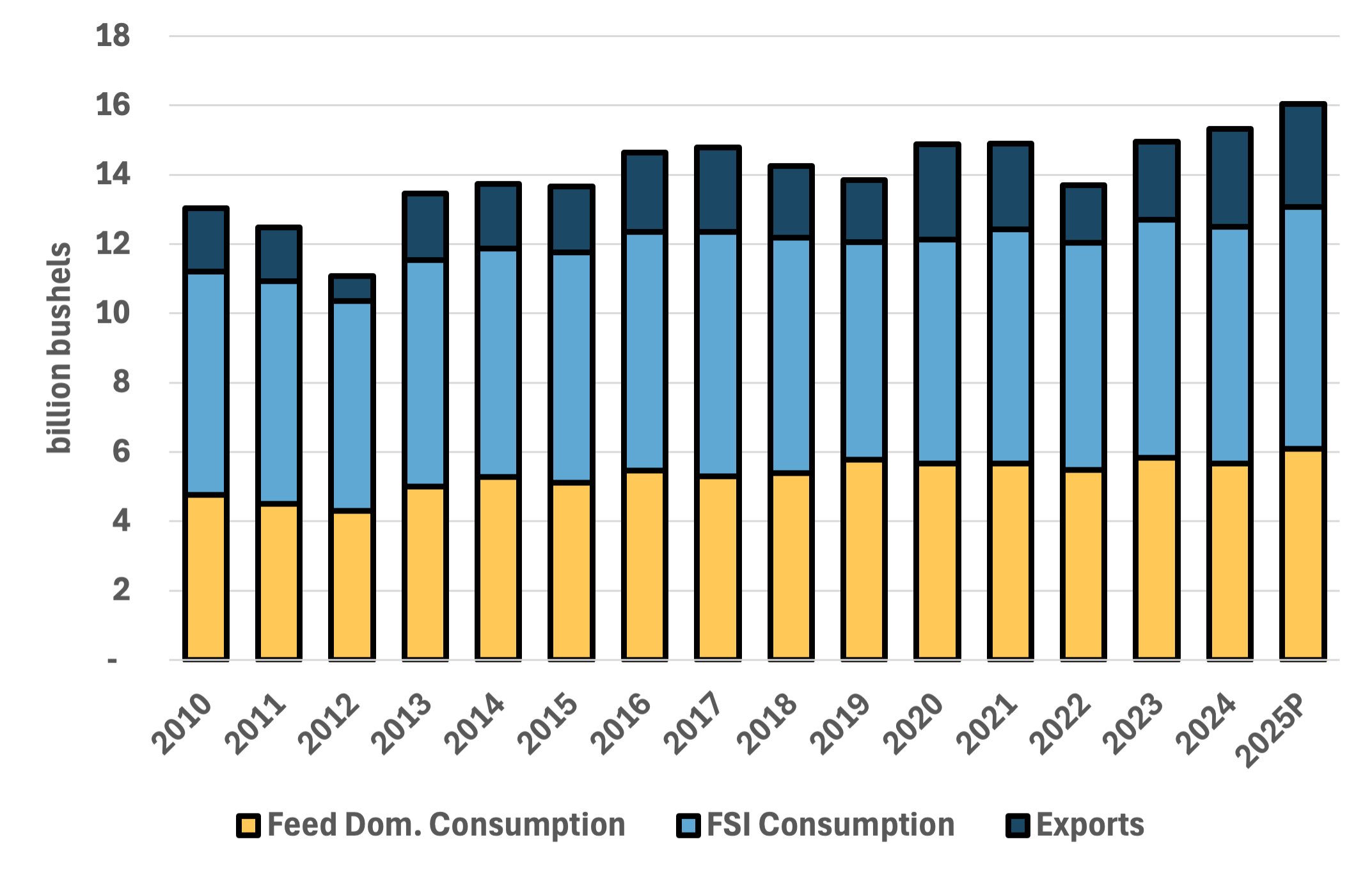
Most U.S. corn is used for three primary purposes: livestock feed, ethanol production, and exports, which together account for roughly 97 percent of total use. The remaining share goes toward food and seed. Figure 1 shows annual corn consumption since 2010. Corn used for feed is currently projected at 6.1 billion bushels, the highest level since at least 2000. The projected grain-consuming animal units (GCAUs), a USDA measure of animals on feed, are estimated at 100.8 for 2025. Even with a smaller cattle supply, this is higher than the 2024 measure of 99.9, driven by increases in hogs, layers, and broilers. Lower corn prices make it a more competitive feed ingredient that will continue to support feed demand in the year ahead.
Corn use for ethanol production is projected at 5.6 billion bushels for the 2025 marketing year, up from 5.4 billion bushels last year. Although ethanol use has leveled off since the rapid expansion seen during the 2010s, it remains a steady and reliable source of demand for U.S. corn. Recent policy discussions around allowing year-round sales of E15 could provide an additional boost to corn demand through expanded ethanol use.
While other commodities have faced headwinds, exports have been a bright spot for corn demand this year. Export sales have moved at a blistering pace, with the current forecast calling for a record 3 billion bushels of U.S. corn exports. Notably, this surge has occurred without purchases from China, which has remained absent from the U.S. corn market since the 2023/24 marketing year. Instead, sales to traditional trading partners have been strong, led by Mexico, followed by Japan and Colombia. Due to the government shutdown, USDA has not updated its weekly export sales report since the week of September 18. When reporting resumes, the next update will be closely watched to see whether corn export sales have maintained their rapid pace.
Given the elevated demand projections for corn, it is hard to see a significant price boost coming from the demand side throughout the rest of the year. Large supplies will continue to weigh on the market, and all eyes will be on the final production numbers. In this environment, managing price risk becomes critical. Producers with unpriced grain should consider setting clear marketing targets and evaluating tools such as forward contracts, futures, or options to lock in favorable opportunities when they arise. A disciplined approach to marketing can help balance downside risk while keeping flexibility for potential rallies later in the year.
Figure 1. U.S. Corn Consumption by Category, 2010-2025. Source: USDA