Blog

  • ARC and PLC Enrollment Starts Next Tuesday

    ARC and PLC Enrollment Starts Next Tuesday

    On Monday, the U.S. Department of Agriculture (USDA) announced that enrollment for the Agriculture Risk Coverage (ARC) and Price Loss Coverage (PLC) programs will begin next Tuesday (January 21) and run through April 15. Even if you plan to keep the same elections, make sure to reach out to your local Farm Service Agency (FSA) office about signing your annual enrollment contract…preferably well before the deadline.

    As you start to think about program election, the Effective Reference Prices for the 2025 crop year can be found in Table 1. The 2025 ARC-County benchmark yields and revenues as of January 6, 2025 can be downloaded here. While adjustments are being made to incorporate the latest data from FSA, the Agricultural & Food Policy Center’s (AFPC) 2025 ARC-CO/PLC Decision Aid will soon be available at https://afpc.tamu.edu. While we are more than a year away from knowing whether either program will trigger for the 2025 crop year, AFPC’s decision tool can be used to explore a variety of potential outcomes, including those based on the latest macroeconomic projections from our sister center, the Food & Agricultural Policy Research Institute (FAPRI) at the University of Missouri. If you have questions about the enrollment decision, don’t hesitate to reach out to us or a member of our team. We are happy to be a resource.

    Table 1. Effective Reference Prices (ERPs) for the 2025 Crop Year

    Covered CommodityUnits2025 ERP
    WheatBushel$5.56
    BarleyBushel$4.95
    OatsBushel$2.76
    PeanutsPound$0.2675
    CornBushel$4.26
    Grain SorghumBushel$4.51
    SoybeansBushel$9.66
    Dry PeasPound$0.1163
    LentilsPound$0.2297
    CanolaPound$0.2054
    Large ChickpeasPound$0.2477
    Small ChickpeasPound$0.2190
    Sunflower SeedPound$0.2015
    FlaxseedBushel$11.53
    Mustard SeedPound$0.2317
    RapeseedPound$0.2015
    SafflowerPound$0.2275
    CrambePound$0.2100
    Sesame SeedPound$0.2317
    Seed CottonPound$0.3670
    Rice (long grain)Pound$0.1400
    Rice (med/short grain)Pound$0.1400
    Rice (temperate japonica)Pound$0.1990

    Fischer, Bart L., and Joe Outlaw. “ARC and PLC Enrollment Starts Next Tuesday.” Southern Ag Today 5(3.4). January 16, 2025. Permalink

  • Corn Price Reaction to Changes in USDA WASDE Projections 

    Corn Price Reaction to Changes in USDA WASDE Projections 

    The January USDA World Agricultural Supply and Demand Estimates (WASDE) report provided more revisions to the U.S. corn balance sheet. Revisions to USDA domestic corn estimates have been mostly positive for corn prices since the USDA’s September WASDE projections. This month’s revisions propelled March corn futures 20 ½ cents higher in two trading days, from $4.56 to $4.76 ½. Since the September WASDE, March corn futures have increased from $4.04 ¾ to $4.76 ½, a $0.71 ¾ increase. 

    Was the price increase justified based on the revised information? Yes. 

    Table 1 compares the USDA WASDE estimates in September to January for corn. The two primary changes were a decrease in the national average yield of 4.3 bu/acre (183.6 to 179.3 bu/acre), a 2.3% decrease, and an increase in exports of 150 million bushels (2.3 to 2.45 billion), a 6.5% increase. Driven by these two adjustments, projected 2024/25 marketing year ending stocks in the United States decreased 517 million bushels, from 2.057 billion to 1.54 billion bushels. A 25.1% decline in ending stocks, combined with the change in use, resulted in a decline in stocks-to-use from 13.7% to 10.2%. Small percentage adjustments to supply and demand can result in relatively large changes in stocks-to-use and the marketing year average price.

    Table 1. September and January USDA WASDE Projections for Corn for the 2024/2025 Marketing Year

     2024/25 Marketing Year Projections
     SeptemberJanuaryChange% Change
    Planted (million)90.790.6-0.1-0.1%
    Harvested (million)82.782.90.20.2%
    U.S. Avg. Yield (bu/acre)183.6179.3-4.3-2.3%
    Beg. Stocks 1,8121,763-49-2.7%
    Production15,18614,867-319-2.1%
    Imports252500.0%
    Total Supply17,02216,655-367-2.2%
    Feed and Residual5,8255,775-50-0.9%
    Ethanol5,4505,500500.9%
    Food, Seed & Industrial1,3901,39000.0%
    Exports2,3002,4501506.5%
    Total Use14,96515,1151501.0%
    U.S. Ending Stocks2,0571,540-517-25.1%
    Foreign Stocks 10,08210,008-74-0.7%
    U.S. Mrk. Year Avg. Price ($/bu)$4.10 $4.25 $0.15 3.7%
    U.S. Stocks/Use13.7%10.2%-3.6%-25.9%

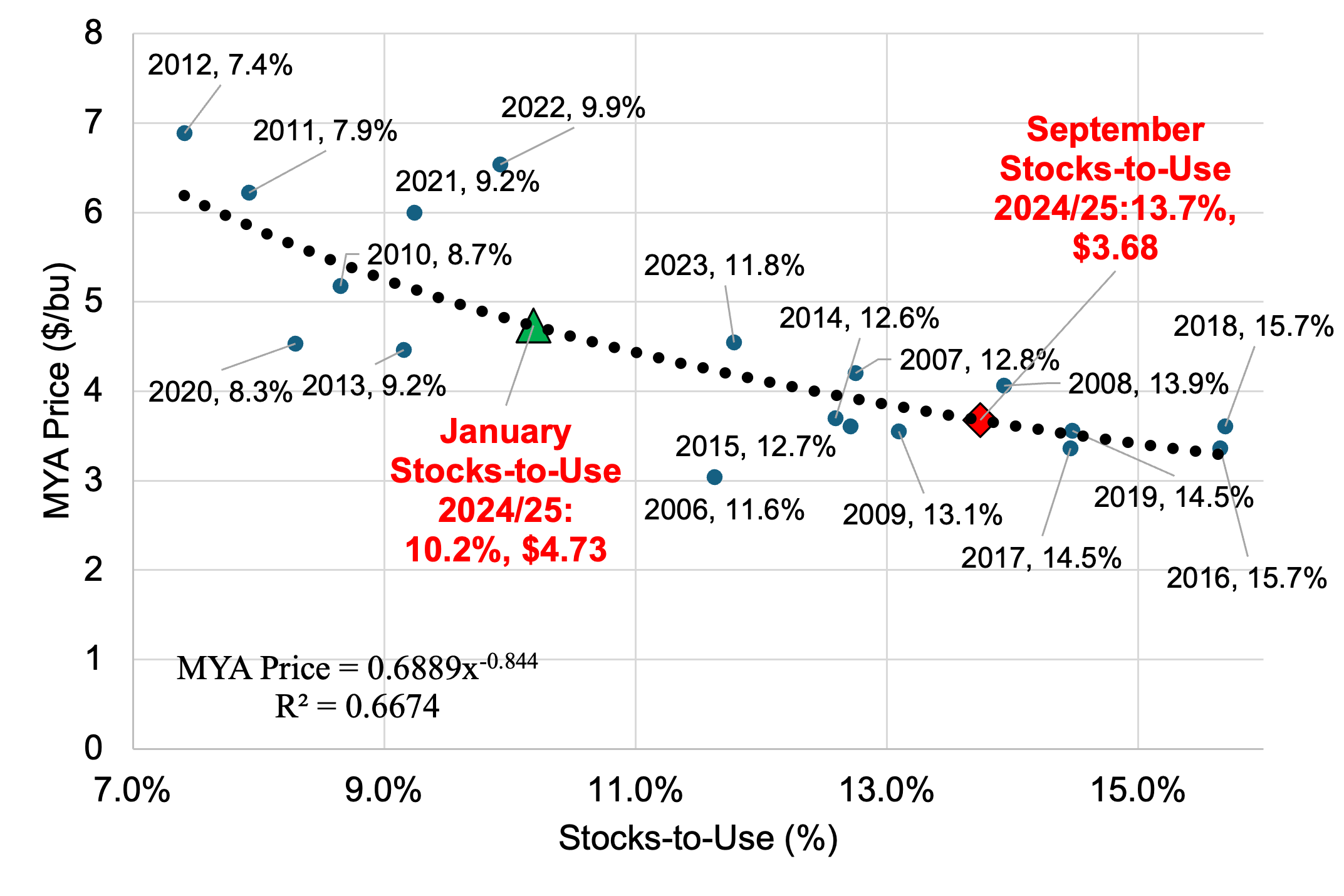
    Stocks-to-use is one of the better predictors of the corn marketing year average price. In September, the USDA projected stocks-to-use at 13.7% and estimated the marketing year average price at $4.10, higher than the predicted value of $3.68 (Figure 1). In January, stocks-to-use were projected at 10.2% and the marketing year average price at $4.25, lower than the predicted value of $4.73. The muted response in the USDA WASDE price and the stocks-to-use predicted price can be partially attributed to the crop marketed between September and January.

    The key takeaway from the USDA revisions to projected corn supply and demand estimates and the futures market reaction:, the revisions justify the increase in prices. Based on current information, a reasonable nearby corn futures price trading range is $4.60-$5.10.   

    Figure 1. Corn U.S. Stocks-to-Use Ratio and Marketing Year Average Price 2006/07 to 2023/24

    References

    USDA World Agricultural Supply and Demand Estimates (WASDE) report. January and September. https://www.usda.gov/about-usda/general-information/staff-offices/office-chief-economist/commodity-markets/wasde-report.

    Barchart.com. March 2025 Corn Futures Contract. Accessed at: https://www.barchart.com/futures/quotes/ZCH25/interactive-chart.

  • Fed Cattle Weights and Herd Expansion

    Fed Cattle Weights and Herd Expansion

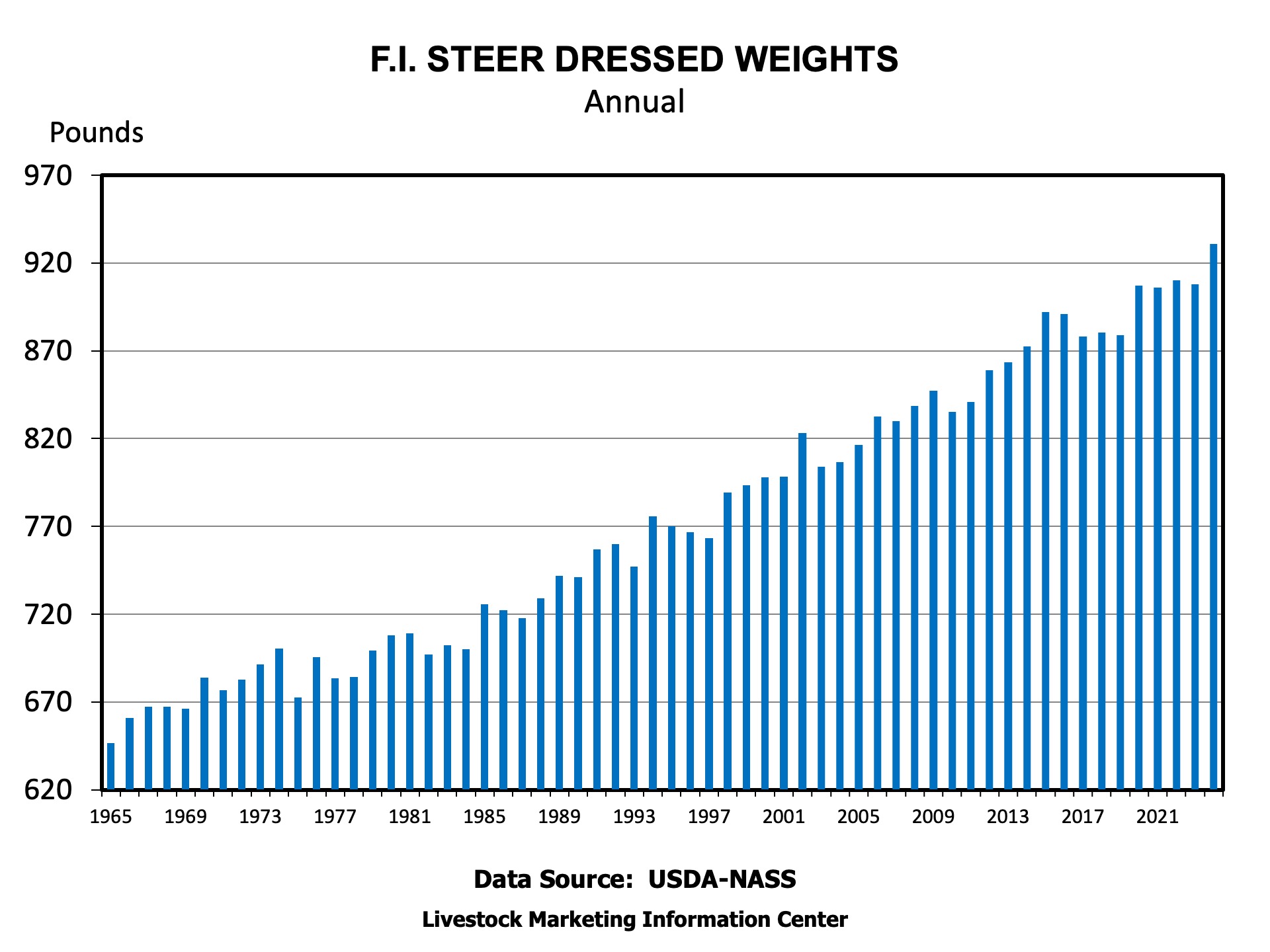
    Recent SAT articles on the cattle market have mentioned the surge in fed cattle dressed weights as an important factor in boosting fed beef production in 2024.  This article puts 2024’s dressed weights into some historical context and looks at some factors that will influence dressed weights this year. Since 1964, federally inspected steer dressed weights have increased from 662 pounds to 931 pounds in 2024.  That is a 41 percent increase over that time period.  A simple average of percentage change per year equals 0.68 percent, or 4.75 pounds per year increase in steer dressed weights.

    The chart of steer dressed weights illustrates this trend in increasing weights.  It also illustrates that this growth is not a straight line of increasing weights every year.  There are many examples of year-to-year declining steer weights.  Many of these years with large weight changes correspond to years with interesting challenges.  For example, steer dressed weights declined 28 pounds from 1974 to 1975 and rebounded 23 pounds from 1975 to 1976.  Other examples might be 2001-2003 or 2014-2016. The 23 pound increase in annual average dressed weight from 2023 to 2024 is significant, but is not the largest year-over-year increase.  Even larger annual increases were recorded in 1985, 1994, 1998, 2002, and 2020.  

    Large annual increases are often followed by declining weights.  Could weights decline in 2025?  There are several factors that could lead to a decline in weights including winter storms that pull down weights.  As cattle numbers further tighten, the need to run packing plants at efficient levels could pull cattle out of feedlots faster and lighter.  However, good beef demand will create an incentive to try to produce more beef per head pushing weights higher to offset fewer cattle.  Continued lower corn prices lowers the cost of gain which is an incentive to feed to heavier weights.  

    We might consider the effect of increasing weights and the implied increase in production per cow on beef cow inventory in the future.  Heavier weights implies fewer beef cows are needed to maintain level beef production.  The 23-pound increase in dressed weight multiplied by the approximately 15.1 million head of federally inspected steers slaughtered in 2024 is the equivalent of about 371 thousand steers.  Put another way, increased dressed weights offset the need for 371,000 steers suggesting the need for fewer cows.  This is a rough example that could use some refinement, but the point remains that increased weights likely impact the cow herd expansion.

    This article used only steer dressed weights.  Heifer dressed weights have increased at an even faster rate and cow weights have increased, too.  Heavier weights are not limited to cattle as hog and poultry weights have increased over time but, those weights are for another article.  There is little reason to expect weights to stop their long-term growth.  But the data shows it’s a bumpy ride to heavier weights with fits and starts along the way.


    Anderson, David, and Josh Maples. “Fed Cattle Weights and Herd Expansion.” Southern Ag Today 5(3.2). January 14, 2025. Permalink

  • After Hurricane Helene: How to claim timber casualty losses and defer taxes on salvage timber sales

    After Hurricane Helene: How to claim timber casualty losses and defer taxes on salvage timber sales

    Hurricane Helene struck six southern states, from Florida to Virginia, in late September 2024. It made landfall in Florida’s Big Bend region as a Category 4 hurricane, weakened to a Category 2 across Georgia, and became a tropical storm as it moved through South Carolina, North Carolina, Tennessee, and Virginia. Over 250 counties have been declared federal disaster areas eligible for individual and/or public assistance (see Figure 1). Many timber owners in and near these areas have suffered significant timber losses. The hurricane caused around $1.86 billion in timber losses across 1.5 million acres, including some of the Southeast’s most productive timberland. While full recovery will take years, timber owners can take some immediate steps to mitigate losses, such as claiming timber casualty losses on federal income tax returns and conducting salvage timber sales.

    There are a few key points for deducting timber casualty losses resulting from a federally declared disaster like Hurricane Helene and deferring taxes on salvage timber sales:

    • Timber casualty loss deduction. You may be able to claim a deduction for timber casualty losses on your federal income tax return. 
    • Choice of tax year to claim the loss. If your damaged or destroyed timber was in a federally declared disaster area (see Figure 1), you can choose to claim the casualty loss on either your 2023 or 2024 tax return. 
    • Method for determining loss. Timber casualty losses should generally be determined using the timber depletion block approach, rather than simply adding up the value of the damaged or destroyed timber. 
    • Deduction limit. The deductible amount for timber casualty losses cannot exceed the adjusted basis of the affected timber depletion block. This amount is often lower than the retail value of the affected timber block.
    • Salvage timber sales. Claiming a casualty loss deduction and conducting a salvage timber sale are separate events. You do not have to wait until you complete a savage sale to claim your timber casualty loss. 
    • Tax deferral on gains from salvage sales. You can defer taxes on profits from salvage timber sales if you use the proceeds to purchase qualifying replacement property.

    For more information, please refer to this publication.  Although the publication focuses on Georgia timber owners affected by Hurricane Helene, the general principles apply to timber losses caused by other casualty events, such as fires, floods, hurricanes, and storms. Please visit FEMA for the list of federally declared disasters related to Hurricane Helene in Florida (DR-4828-FL), North Carolina (DR-4827-NC), South Carolina (DR-4829-SC), Tennessee (DR-4832-TN), and Virginia (DR-4831-VA).  Be sure to consult your accountant and/or tax specialists.

    Figure 1. Designated areas due to Hurricane Helene

    Source: FEMA

    Timber Stand Damage 

    photo credit: E. David Dickens
  • 2024 Brought Unprecedented Zoonotic Disease Control Challenge As Well As Far-Reaching Questions of Legal Authority  

    2024 Brought Unprecedented Zoonotic Disease Control Challenge As Well As Far-Reaching Questions of Legal Authority  

    While the current outbreak of highly pathogenic avian influenza (HPAI) began in 2022 primarily infecting wild birds and domestic poultry, 2024 produced evidence of a mutated virus infecting dairy cattle in large numbers, as well as evidence of human infections thankfully limited in both case numbers and virulence.   

    In human and animal health circles, the concepts underlying the terminology “One Health” (i.e. an integrated, collaborative approach by the medical and veterinary professions to the control of zoonotic disease) have been discussed for years.  However, during this past year, the reality of the general public itself following a multi-disciplinary and multi-state epidemiological investigation of the HPAI strain in dairy cattle has thus far produced a complex set of still-evolving answers. 

    To some, in particular those who feel they are now armed with relevant recent knowledge gained from the COVID-19 pandemic, USDA and CDC disease control efforts have been perceived as not aggressive nor collaborative enough. In the end, perhaps only the history books will be able to render a judgment on that score.

    But in the meantime, one fairly recent development in an unrelated legal dispute may address questions at the core of any One Health effort to control this zoonotic disease.  What are the statutory limits of the federal government’s attempts to control a potential animal disease?  

    The federal government’s legal authority in this regard arises from a law known as the Animal Health Protection Act. This law vests broad and sweeping powers in USDA’s Animal and Plant Health Inspection Service (USDA APHIS) over the import, export and interstate movement of livestock and “articles or means of conveyance,” by regulations and orders “necessary to prevent the introduction into or dissemination within the United States of any pest or disease of livestock.”  7 U.S.C. § 8305(1). The primary statutory tools have and likely will continue to be orders designed to control interstate movement of dairy cattle, as well as other means of disease conveyance—including milk itself. 

    By fortunate historical circumstances and decades of regulatory precedent, mandatory pasteurization of milk in interstate commerce fits the bill as the most effective and efficient control measure for this zoonotic disease.  

    Nevertheless, re-examination and a fundamental questioning of the Animal Health Protection Act’s parameters of authority has been raised by the October 30, 2024, commencement by beef cattle producers of a lawsuit seeking to invalidate USDA’s final rule on electronic identification eartag (“EID”) requirements for certain cattle and bison. The final rule was promulgated, effective November 5, 2024, pursuant to Animal Health Protection Act authority, specifically animal disease traceability as a subset of the broad authority over any and all means of disease conveyance. 

    In Ranchers-Cattlemen Action Legal Fund United Stockgrowers of America v. United States Department of Agriculture, No. 5:24-cv-05085, multiple beef cattle producers (hereinafter collectively referred to simply as “R-CALF USA”) commenced a lawsuit by complaint in the U.S. District Court for the District of South Dakota seeking to invalidate the USDA APHIS final rule titled “Use of Electronic Identification Eartags as Official Identification in Cattle and Bison” (89 FR 39540). For the purposes of this article, the portion of the final rule at issue is the new text at 9 CFR §86.4(a)(1)(i) stating that all official eartags sold for and applied to cattle and bison that are required to be officially identified for interstate movement must be readable both visually and electronically. 

    The producers allege, among multiple claims, that the final rule exceeds the authority granted by the Animal Health Protection Act to take actions “necessary to prevent the introduction or dissemination” of a pest or disease of livestock because “participants within the production chain [of affected animals] may continue to use EID eartags in the exact same way that they use visual-only eartags,” and as such, the rule is not necessary because it “does not actually fix the problems it is supposedly addressing.”  In other words, the determination of “necessity” is lacking for the new requirement of electronic readability. 

    By way of further explanation, according to the complaint, “USDA has previously ‘stated that a participation rate of 70 percent of the nation’s cattle herd would be necessary for a [animal disease traceability, or “ADT”] program to be effective’ . . . but the Rule only applies to 11 percent of the nation’s cattle herd.”  R-CALF USA goes on to state: “APHIS provides only a conclusory statement that the ADT program helps prevent the dissemination of disease by helping minimize the effect of outbreaks through restrictions, such as the EID eartag requirement, that the agency has determined are necessary for efficient livestock tracing. . . But this bold statement does not reasonably explain how the EID Final Rule achieves any efficiency gains or why hypothetical efficiency gains are significant enough to be deemed ‘necessary’ under the Animal Health Protection Act.”

    This litigation’s outcome could have broad and negative implications for all USDA APHIS actions taken pursuant to Animal Health Protection Act authority. The case essentially argues that every aspect of each regulatory requirement justified as serving animal disease control objectives must be subjected to the type of rigorous and individualized proof of “necessity” suggested by the R-CALF USA plaintiffs, taken out of the context of its role and place in the cumulative impact of the regulatory scheme on disease control and regulation. If this position is a correct interpretation of the law, the toolbox of measures available to USDA APHIS may shrink to only a handful of measures—perhaps only those which are proven to have a direct and independent causal relationship to ending the disease’s biological functioning. 

    While such a restrictive view of executive branch regulatory authority under the Animal Health Protection Act may not be inconsistent with some recent U.S. Supreme Court decisions reigning in administrative rulemaking, it would be a sea change in zoonotic disease control.


    Duer, Brook, and Paul Goeringer. “2024 Brings Unprecedented Zoonotic Disease Control Challenge As Well As Far-Reaching Questions of Legal Authority.Southern Ag Today 5(2.5). January 10, 2025. Permalink