Blog

  • 2025 U.S. Agricultural Trade Outlook: Navigating Uncertainty Amid Policy Shifts

    2025 U.S. Agricultural Trade Outlook: Navigating Uncertainty Amid Policy Shifts

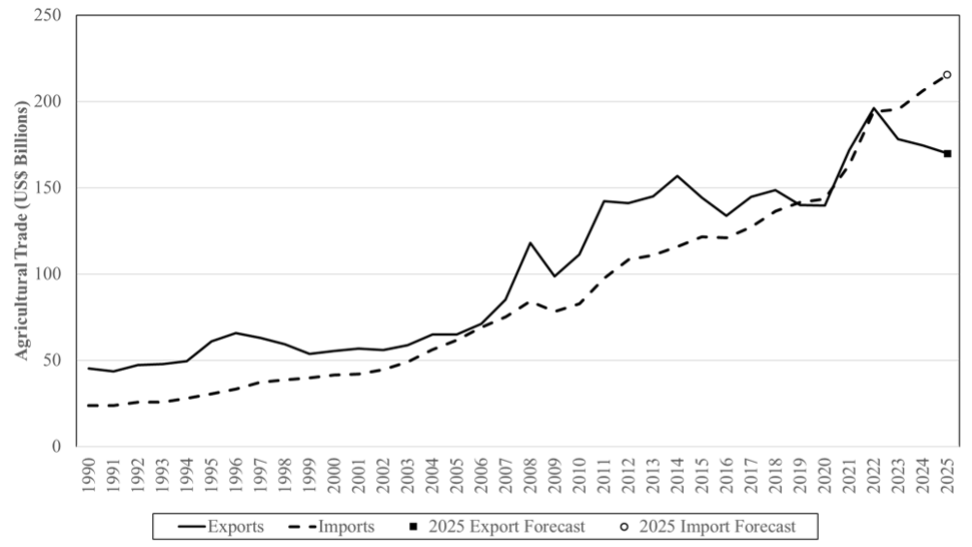
    The U.S. agricultural trade outlook for 2025 is clouded with uncertainty driven by both global economic dynamics and domestic policy shifts. As shown in Figure 1 below, the USDA projects that agricultural exports could reach $170 billion—a slight decrease from the 2024 calendar year. Imports are expected to reach a record $215.5 billion. If both projections are accurate, these trade patterns would result in a record $45.5 billion agricultural trade deficit.

    Figure 1: USDA Outlook for Agricultural Trade

    Source: USDA Economic Research Service (2024) “Outlook for U.S. Agricultural Trade,” available at https://www.ers.usda.gov/topics/international-markets-u-s-trade/u-s-agricultural-trade/outlook-for-u-s-agricultural-trade/

    However, prospective changes in domestic trade policy loom large over these projections. The incoming Trump administration has signaled plans for sweeping tariffs, including a proposed 60% tariff on Chinese goods and a 10% tariff on all other imports. These measures aim to protect domestic industries, but they risk triggering retaliatory tariffs from key trade partners. A resurgent trade war could severely restrict access to critical export markets, particularly China, the largest buyer of U.S. soybeans prior to the previous trade war. Retaliatory actions could further depress already struggling commodity prices and deepen challenges for U.S. farmers.

    The USDA’s outlook underscores that exports to traditional markets such as Mexico and Canada are forecasted to remain strong, driven by demand for corn, beef, and dairy. However, exports to China are expected to decline further, exacerbated by weakened soybean demand and competition from Brazilian suppliers. At the same time, the anticipated tariffs could raise costs for imported agricultural inputs, further squeezing U.S. producers. 

    The broader economic context offers mixed signals. Easing inflation and steady global GDP growth may support international demand for U.S. agricultural products. However, a strong dollar continues to challenge U.S. export competitiveness, particularly as other nations’ currencies depreciate. Another main contributor to the loss of competitiveness of U.S. agricultural products in the international arena is the increase of cost of production in recent years. In 2018, U.S. farmers spent a total of $354 billion on inputs, however, by 2023 farmers spent $481.9 billion, an increase of 36 percent.

    The long-term impact of the Trump administration’s trade policies remains to be seen, but the path forward will require balancing protectionist strategies with the need to maintain and grow critical trade relationships to support the agricultural sector.


    Schaefer, K. Aleks, and Luis Ribera. “2025 U.S. Agricultural Trade Outlook: Navigating Uncertainty Amid Policy Shifts.Southern Ag Today 5(2.4). January 9, 2025. Permalink

  • Record High Global Soybean Stocks

    Record High Global Soybean Stocks

    As soybean producers prepare for the upcoming growing season, global soybean stocks are exerting a bearish influence on the market. Currently, USDA projects the 2024/25 marketing year to have a record-high level of ending stocks at 131.87 million metric tons. If realized, this would be 17.62 million metric tons greater than the previous record high in 2018. The final estimate for ending stocks will depend on how the South American crop concludes. So far, Brazil has experienced favorable weather conditions, making it likely that it will achieve its estimated record soybean production this year. The outlook for Argentina is less certain.

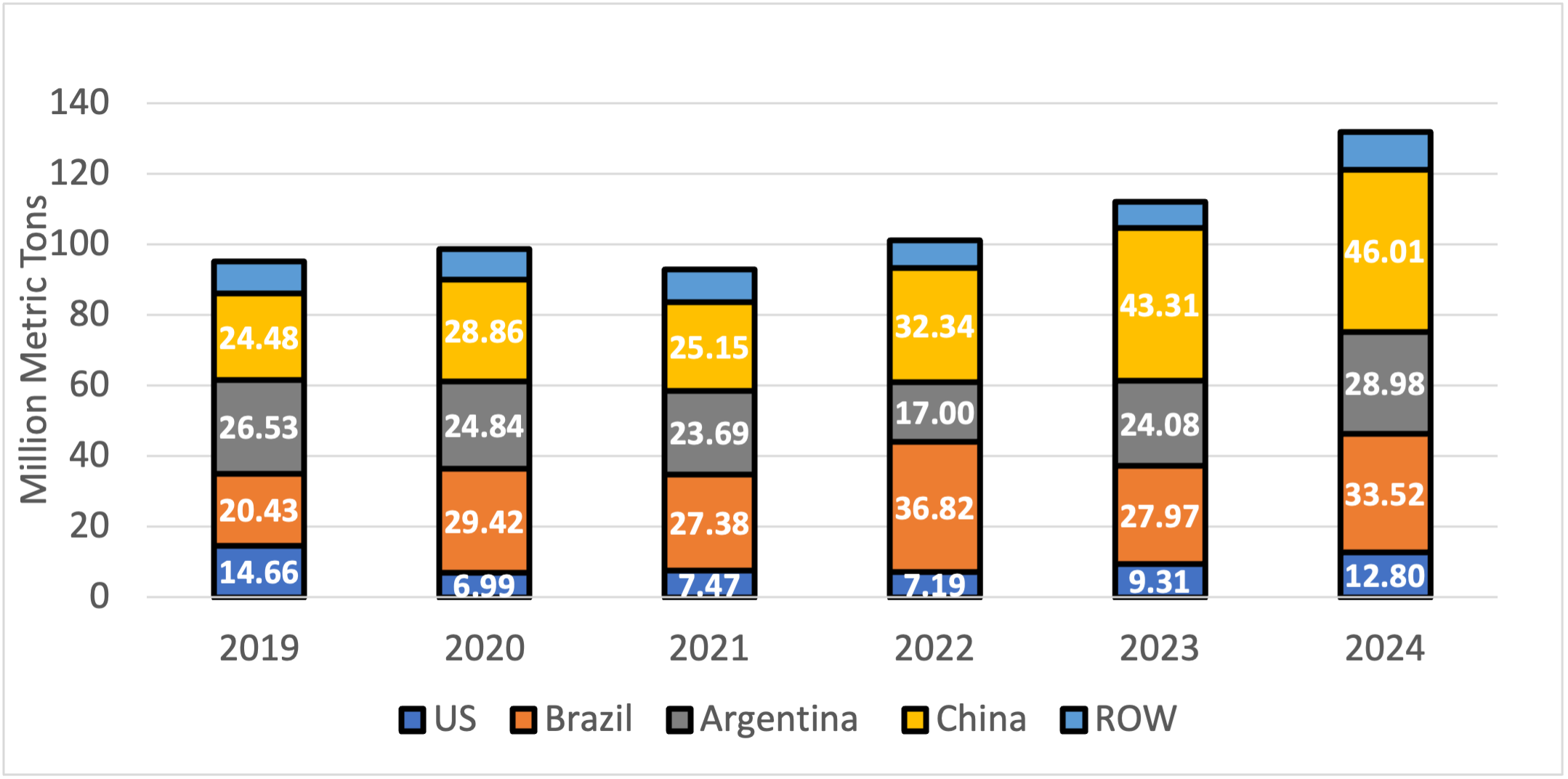
    The majority of the increase in global soybean stocks can be attributed to one country (Figure 1). China holds the largest share of these stocks, with 46.01 million metric tons, marking an 83% increase since 2021. This growth accounts for 53% of the overall increase in global stocks during the same period. Brazil and Argentina have seen a 22% increase in ending stocks since 2021. In contrast, of the four major countries in soybean markets, the United States maintains the smallest amount of stocks at 12.8 million metric tons, but this still reflects a 71% increase since 2021.

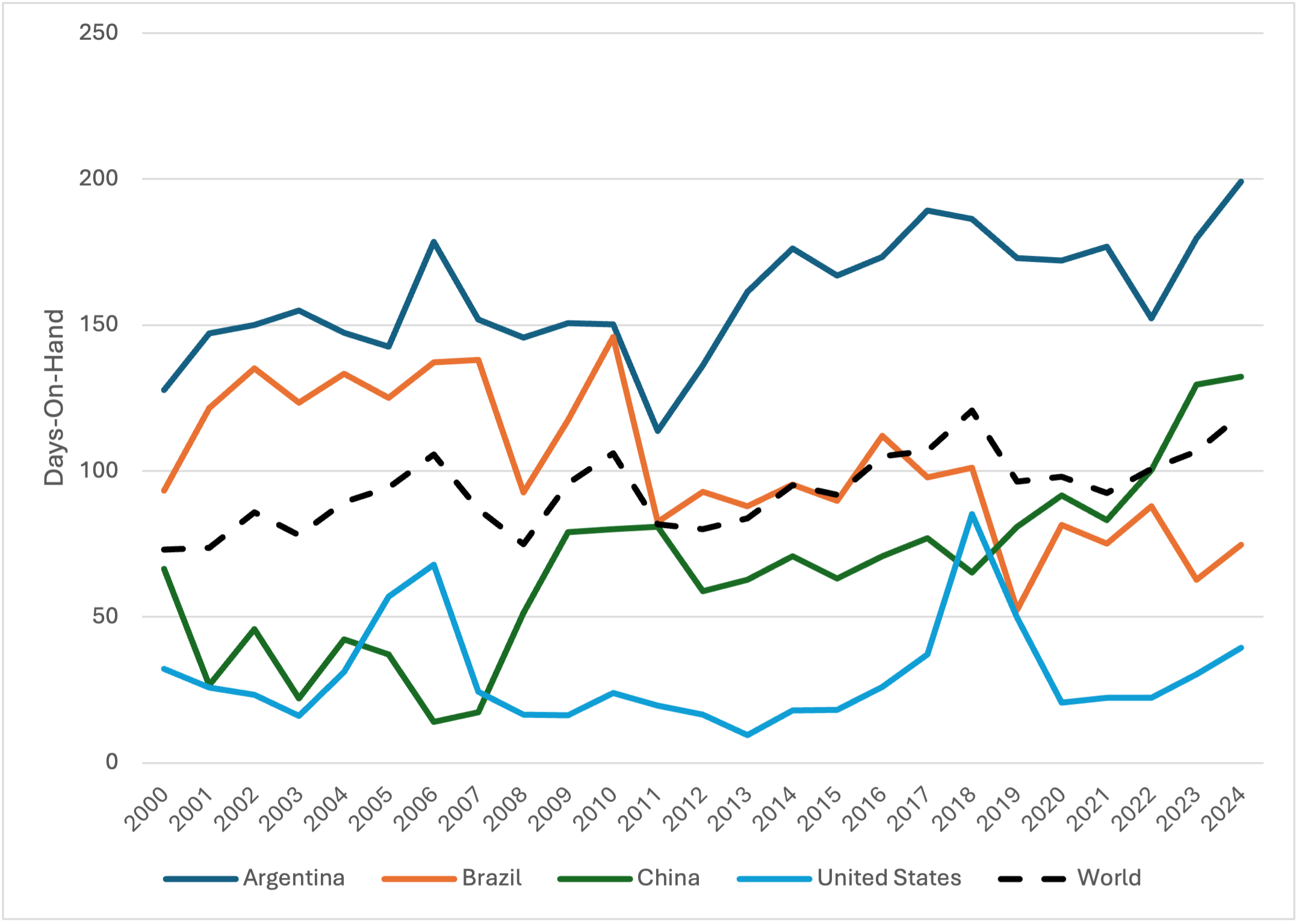
    Another way to analyze ending stocks is by comparing them to a country’s annual usage, which can be illustrated through the concept of days-on-hand. Figure 2 shows the days-on-hand globally and for Argentina, Brazil, China, and the United States. Global days-on-hand are projected at 119 days, the second highest on record. Before 2022, China never had more than 92 days on hand but is currently projected to have a record 132 days of soybeans on hand. Argentina has increased from a decade-low of 152 days on hand in 2022 to a record 199 days on hand in 2024. The United States is projected to have 119 days of soybeans on hand, the second-highest figure since days-on-hand peaked during the 2018 trade war with China.

    Due to the current high levels of stocks projected by the USDA, soybean prices are expected to remain weak in early 2025. With a record crop expected from Brazil, the market is unlikely to see significant upward price movements in the coming months. While changes in weather conditions or harvest delays in South America could potentially drive prices higher, producers may have to wait until the market shifts its focus to the planting of the upcoming U.S. soybean crop before witnessing any substantial increases in prices. Given the uncertainty regarding future price direction, it is essential for producers to start preparing a marketing plan for the upcoming year and be ready to take advantage of profitable prices if they arise.

    Figure 1. Global Soybean Stocks by Country; 2019-2024

    Figure 2. Soybean Days-On-Hand; World and Select Countries; 2000-2024


    Maples, William E. “Record High Global Soybean Stocks.Southern Ag Today 5(2.3). January 8, 2025. Permalink

  • Four Questions the 2025 Cattle Market Will Need to Answer

    Four Questions the 2025 Cattle Market Will Need to Answer

    Trends are always difficult to ascertain coming out of holiday periods as many markets are closed and volumes tend to be pretty light, but cattle prices have started 2025 very strong. While questions exist on the demand side, tight cattle supplies will remain the primary driver in the new year and should continue to support prices. And as always, weather will have a significant impact on feed and forage availability and cattle marketing patterns. As I write this article in early January, I want to discuss four questions that I think will be important for the 2025 cattle market to answer.

    Will we start to see significant heifer retention? – This question has been circulating for the better part of the last two years. There are a lot of reasons why retention has been delayed including weather, production costs and interest rates. But market conditions should be very favorable again and I do think heifer retention could be seen in 2025 if weather cooperates. When heifer retention does pick up, it will further tighten supplies of cattle as those females are held out of the marketing system. This will be the first stage of growing this cowherd, which is currently at a 60+ year low.

    Can slaughter weights keep increasing? – Most analysts are forecasting beef production to be lower in 2025. These forecasts are based on continued decreases in cattle numbers and the potential for decreased female harvest in response to high prices. In truth, I could have written this exact same thing last year. But with cattle supplies tight, beef prices high, and feed prices relatively low, cattle were fed longer and to heavier weights. This increase in pounds largely offset the decrease in female slaughter and resulted in steady beef production levels for 2024. I will readily admit that I don’t know how much further weights can be pushed, if at all, but those same factors are largely at play again this year. So, I will be watching harvest weight trends very closely.

    Will we see greater than expected growth in pork and poultry production? – Holding everything else constant, lower feed prices increase returns across all livestock species and lead to greater production levels. And production levels of competing meats do impact beef and cattle prices. Recent increases in pork production have been driven almost entirely by productivity, rather than increases in breeding inventory, and increases in broiler production have been running close to the long run trend. I just point this out because production increases can occur much faster in the hog sector than the cattle sector, and faster still in the poultry sector. While there aren’t many indications of expansion in other species currently, this was a factor in 2015, and I think it bears watching in 2025. It is important to remember that beef supplies are not the only factor that impacts beef prices. All proteins compete in the meat case.

    What will be the impact of any changes in trade policy? – Trade has been a major topic of discussion recently and I doubt that will change in 2025. Beef exports have been lower in recent years due to tight domestic supplies and high prices, but the US still exported the equivalent of roughly 11 percent of production last year. In the past, retaliatory tariffs have impacted beef and cattle prices, so it bears watching going forward. It is also important to remember that the nature of beef trade very much depends on the trading partner. For example, we export a lot of beef to Mexico and Canada, but we are also a significant import market for those two countries. And while trade discussions typically focus on beef, a significant number of live cattle enter the US from Mexico and Canada each year. Conversely, over half of US beef exports go to Japan, South Korea and China, but those are almost exclusively export markets. The complexity of each of these trading relationships makes discussion of trade impacts very complex and something that will be interesting to follow this year.


    Burdine, Kenny. “Four Questions the 2025 Cattle Market Will Need to Answer.Southern Ag Today 5(2.2). January 7, 2025. Permalink


  • Good Farm Management Starts with Good Records

    Good Farm Management Starts with Good Records

    Many producers don’t like doing record keeping. Keeping up-to-date records can be time-consuming and sometimes boring, with having to sift through all your deposits and receipts and then input these into spreadsheets and creating income and cash flow statements. The reward is not always readily seen compared to other farming activities. If you have weeds in your field and you spray it with herbicide, the weeds die. If you feed your calves, they gain weight. Conversely, the benefits of record-keeping may not be seen for months, but it can be the difference between losing and making money. 

    Good records are the foundation of decision-making on the farm and should be used to inform your marketing, crop insurance, and loan choices. Any decision made on the farm has a financial impact that affects your revenue, costs, or both and, subsequently, your bottom line. Record keeping is important when things are tough as it allows you to evaluate areas of the farm that can be improved or where costs can be cut. The more detailed your records the more specific changes you can make. This will allow you to evaluate your farm as a whole, by specific crops, or even by specific fields, to determine where problems may arise. A detailed analysis could show that a field was unprofitable because it had some nutrient deficiencies or maybe the crop grown on that field needs to be re-evaluated. Or perhaps the terms of rental agreement is what is causing that field to not be profitable. After diagnosing the issue, you can then determine how changes to this field will impact the farm’s financial performance as a whole. In a tough year, this sort of evaluation is crucial to breaking-even or at least minimizing losses.

    Record keeping is equally important when things are going well and to avoid overextending your farm financially. In a good year, the question that needs to be asked when making a large purchase, like equipment, is not “Can I afford this now?” but “Can I afford this over its lifetime?”. There are many instances when high market prices encourage large purchases that set a farm up for failure when prices inevitably fall. If a purchase causes your break-evens to increase so that it is only profitable when prices are above average or high, then it is a risky investment. 

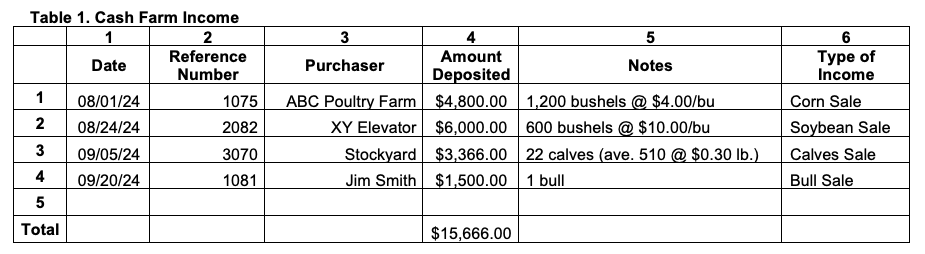
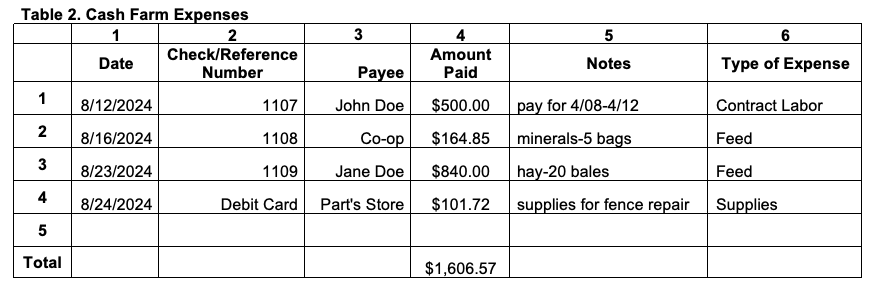
    Accurate record-keeping starts with accounting for all income and expense transactions. For each income transaction, you should include: Date, Reference Number, Purchaser, Amount Deposited, and the Type of Income (Table 1). For expense transactions, the following should be included: Date, Check/Reference Number, Payee, Amount Paid, and the Type of Expense (Table 2). Having this information will ensure that each transaction is accurately recorded. The more detailed your record keeping, the more specific adjustments can be made. 

    There are programs that can help with record keeping, such as QuickBooks or Excel, or you can handwrite them. Any record-keeping is better than none. Many producers already have data on specific fields through yield maps, soil maps, etc. Using these along with your other records to make more specific evaluations and how these changes impact the farm’s financial statements and ratios is key to long-term financial stability. 

  • D.C. Circuit Rules that CEQ Lacks Rulemaking Authority

    D.C. Circuit Rules that CEQ Lacks Rulemaking Authority

    In November 2024, the D.C. Circuit Court of Appeals ruled that the Council on Environmental Quality (“CEQ”) does not have authority to issue binding regulations. Since the late 1970s, CEQ has issued regulations that implement the National Environmental Policy Act (“NEPA”). Federal agencies have followed these regulations when carrying out the NEPA while courts have consistently enforced them. Following the D.C. Circuit’s decision in Marin Audubon Soc’y v. Fed. Aviation Admin., No. 23-1067 (D.C. Cir. 2024), it is unclear what authority CEQ will have going forward. 

    The primary purpose of NEPA is to “declare a national policy which will encourage productive and enjoyable harmony between man and his environment[.]” To achieve this goal, NEPA outlines a process by which federal agencies can assess the environmental impacts of their actions before making final decisions. 

    NEPA provides two levels of environmental review. For proposed actions that have a “reasonably foreseeable significant effect on the quality of the human environment,” agencies should issue an environmental impact statement (“EIS”) that provides detailed information about the expected impacts of the action. For all other actions, agencies should prepare a “concise” document known as an environmental assessment (“EA”) that will either establish the agency’s “finding of no significant impact” or conclude that preparation of an EIS is necessary. NEPA also allows federal agencies to identify categories of actions that do not have significant effects on the environment. Such actions are called “categorical exclusions” and do not require NEPA review. 

    NEPA also established CEQ and laid out its functions and duties, such as reviewing federal government activity to ensure NEPA compliance and making an annual report to the President on the “state and condition of the environment.” 

    In 1970, President Nixon issued an Executive Order directing CEQ to issue “guidelines” to federal agencies on how to prepare NEPA documents. In 1977, President Carter issued a separate Executive Order empowering CEQ to issue regulations rather than guidelines. CEQ’s first round of NEPA regulations were issued in 1978 and established a framework that is still largely in effect today. Since 1978, federal agencies have followed those regulations while drafting NEPA documents and the Supreme Court in Andrus v. Sierra Club, 442 U.S. 347 (1979), held that CEQ’s NEPA regulations are “entitled to substantial deference.”

    The plaintiffs in Marin Audubon Soc’y v. Fed. Aviation Admin. initiated their lawsuit in early 2023 to challenge a finalized plan between the FAA and the NPS that would allow tourism flights to operate over four parks in northern California. When the FAA and the NPS first announced the air tour plan, they also announced their intent to develop an EA. However, the agencies ultimately concluded that the plan was categorically exempted from NEPA review. That decision prompted the plaintiffs to file suit, claiming that the FAA and the NPS had violated NEPA by failing to conduct necessary review.

    The D.C. Circuit Court of Appeals issued its ruling in Marin Audubon Soc’y v. Fed. Aviation Admin. on November 12, 2024. While the court concluded that the FAA and the NPS had violated NEPA by approving the air tour management plan without drafting an EA or an EIS, the bulk of the court’s decision focused on whether CEQ had authority to issue NEPA-implementing regulations. Ultimately, the court concluded that CEQ lacked that authority.

    According to the court, the text of NEPA does not grant CEQ specific rulemaking authority. While NEPA provides that CEQ shall “make recommendations to the President,” Congress did not include language instructing CEQ to draft rules and regulations to implement NEPA. Instead, CEQ relies on the Executive Orders as the basis for its rulemaking authority. According to the D.C. Circuit, agencies cannot derive rulemaking authority from Presidential Executive Orders. The court relied on the Take Care Clause of the U.S. constitution which provides that the President “shall take care that the laws with faithfully executed[.]” Specifically, the court concluded that the Take Care Clause does not authorize the President to grant federal agencies rulemaking authority to “faithfully execute” the laws passed by Congress. Only Congress has the authority to grant federal agencies rulemaking power. Because NEPA does not specifically instruct CEQ to adopt implementing regulations, the D.C. Circuit concluded that CEQ does not have the authority to issue regulations, and any regulations it has issued are non-binding.

    The decision was issued by a three-judge panel, but only two judges joined in the majority ruling. The third judge on the panel dissented. Primarily, the dissenting judge noted that neither the plaintiffs nor the defendants in Marin Audubon Soc’y v. Fed. Aviation Admin. challenged CEQ’s regulations. According to the dissent, the majority’s opinion violated the “principle of party presentation,” a legal concept which provides that judges may only consider the legal questions that are presented and argued before the court. The dissent concluded that there was no reason for the majority to consider the validity of the CEQ regulations because no one had asked them to do so.

    It is currently unclear exactly what impact the decision in Marin Audubon Soc’y v. Fed. Aviation Admin. will have. While the court declined to vacate CEQ’s NEPA regulations, the decision establishes a precedent that CEQ lacks rulemaking authority, and that all regulations it issues are non-binding. The parties are expected to seek an en banc review of the decision, but the timeline is currently unclear.

    In the meantime, the ruling is likely to cause delays for any activity currently undergoing NEPA review as federal agencies determine how to proceed. If the decision ultimately withstands further judicial review, federal agencies may face the challenge of drafting their own NEPA regulations or otherwise establishing some sort of policy to ensure that the agency meets its NEPA obligations. At the moment, the decision in Marin Audubon Soc’y v. Fed. Aviation Admin. has provided more questions than answers.


    Rollins, Brigit. “D.C. Circuit Rules that CEQ Lacks Rulemaking Authority.Southern Ag Today 5(1.5). January 3, 2025. Permalink