Blog

  • USDA Projects a Widening Trade Deficit for Fiscal Year 2025

    USDA Projects a Widening Trade Deficit for Fiscal Year 2025

    In previous Southern Ag Today articles, we reported on the rising U.S. agricultural trade deficit as forecasted by the U.S. Department of Agriculture (USDA). Last month (August), the USDA released new forecasts for the fiscal year (FY) 2025, indicating an even larger deficit than FY 2024. According to the USDA, the U.S. will conclude this fiscal year with agricultural exports at $173.5 billion and imports at $204.0 billion, resulting in a negative trade balance of $30.5 billion. For FY 2025, the USDA forecasts agricultural exports at $169.5 billion and imports at $212.0 billion. If these projections hold true, the continued decrease in exports and increase in imports will cause the U.S. agricultural trade deficit to rise to a record $42.5 billion (Kenner et al., 2024). As mentioned in previous articles, this is not necessarily a concern because we import high-value agricultural and food products that are very different from the bulk commodities that dominate U.S. exports. For instance, U.S. imports of beer, wine, and spirits accounted for more than half of this deficit in recent years (Muhammad and Hossen, 2024b). That said, the continued decline in U.S. agricultural exports should be a concern.

    The differences between the latest FY 2024 and FY 2025 forecasts are reported in Table 1. Soybeans account for the largest expected decline at $1.5 billion, a decrease of over 6%. Beef and veal exports are expected to be lower by $1 billion, nearly an 11% decline. Other noted declines include cotton (-$900 million, -17%), soybean meal (-$700 million, -10%), and sorghum (-$400 million, -27%). While there are projected declines for several major commodities, some sectors are projected to increase, albeit the projected increases are smaller by comparison.

    The shift from historical trade surpluses presents both challenges and opportunities for U.S. agricultural policy, with an increased urgency to address declining export sales. To mitigate the impact of declining exports, particularly to China, U.S. policymakers must focus on diversifying export markets. Exports to China have declined by 30.9% between 2021 and 2023 (Muhammad and Hossen, 2024a), and they are projected to fall further to $24.0 billion in FY 2025 from $27.0 billion in FY 2024. There is an urgent need to seek new markets in regions such as Southeast Asia, Africa, and Latin America. Negotiating new trade agreements with these emerging markets could open opportunities for U.S. agricultural products. Additionally, providing export promotion assistance and investing in market research will be essential in identifying and capitalizing on opportunities in untapped markets.

    Table 1. Difference in USDA exports forecasts: FY 2024 versus FY 2025
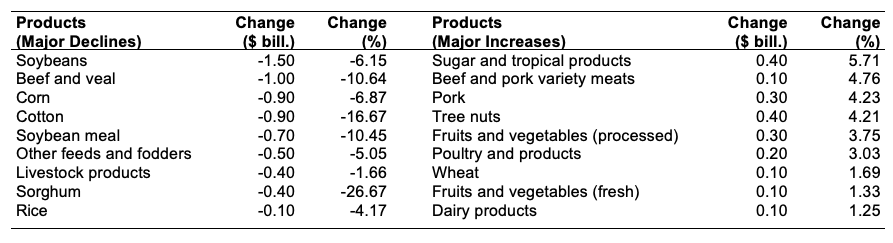
    Note: Change = FY2025 forecast – FY2024 forecast.
    Data Source: Kenner, Bart, Hui Jiang, James Kaufman, and Angelica Williams. (2024). Outlook for U.S. Agricultural Trade: August 2024. Report AES-129. U.S. Department of Agriculture. https://www.ers.usda.gov/publications/pub-details/?pubid=109831

    For more information:

    Kenner, Bart, Hui Jiang, James Kaufman, and Angelica Williams. (2024). Outlook for U.S. Agricultural Trade: August 2024. Report AES-129. U.S. Department of Agriculture. https://www.ers.usda.gov/publications/pub-details/?pubid=109831

    Muhammad, Andrew, and Md Deluair Hossen. (2024a). “Understanding the Growing U.S. Agricultural Trade Deficit: The Fall in Exports.” Southern Ag Today 4(26.4). June 27.

    Muhammad, Andrew, and Md Deluair Hossen. (2024b). “Understanding the Growing U.S. Agricultural Trade Deficit (Part 2): What’s Happening with Imports?” Southern Ag Today 4(30.4). July 25.


    Hossen, Md Deluair, and Andrew Muhammad. “USDA Projects a Widening Trade Deficit for Fiscal Year 2025.Southern Ag Today 4(38.4). September 19, 2024. Permalink
  • Minimal Price Gains Amid Record Yields: A Tough Outlook for Grain Producers in 2024

    Minimal Price Gains Amid Record Yields: A Tough Outlook for Grain Producers in 2024

    The September World Agricultural Supply and Demand Estimates (WASDE) report indicates modest changes in supply and demand for corn and soybeans. The World Agricultural Outlook Board (WAOB) increased their estimated corn yield by 0.5 bushels per acre, offset by a decrease in carryover from the 2023 marketing year. Soybean demand also saw a slight increase of 2 million bushels. Both cotton and rice yields were cut; however, the lower yield expectations were offset by lower demand, resulting in no change to the projected season-average price.

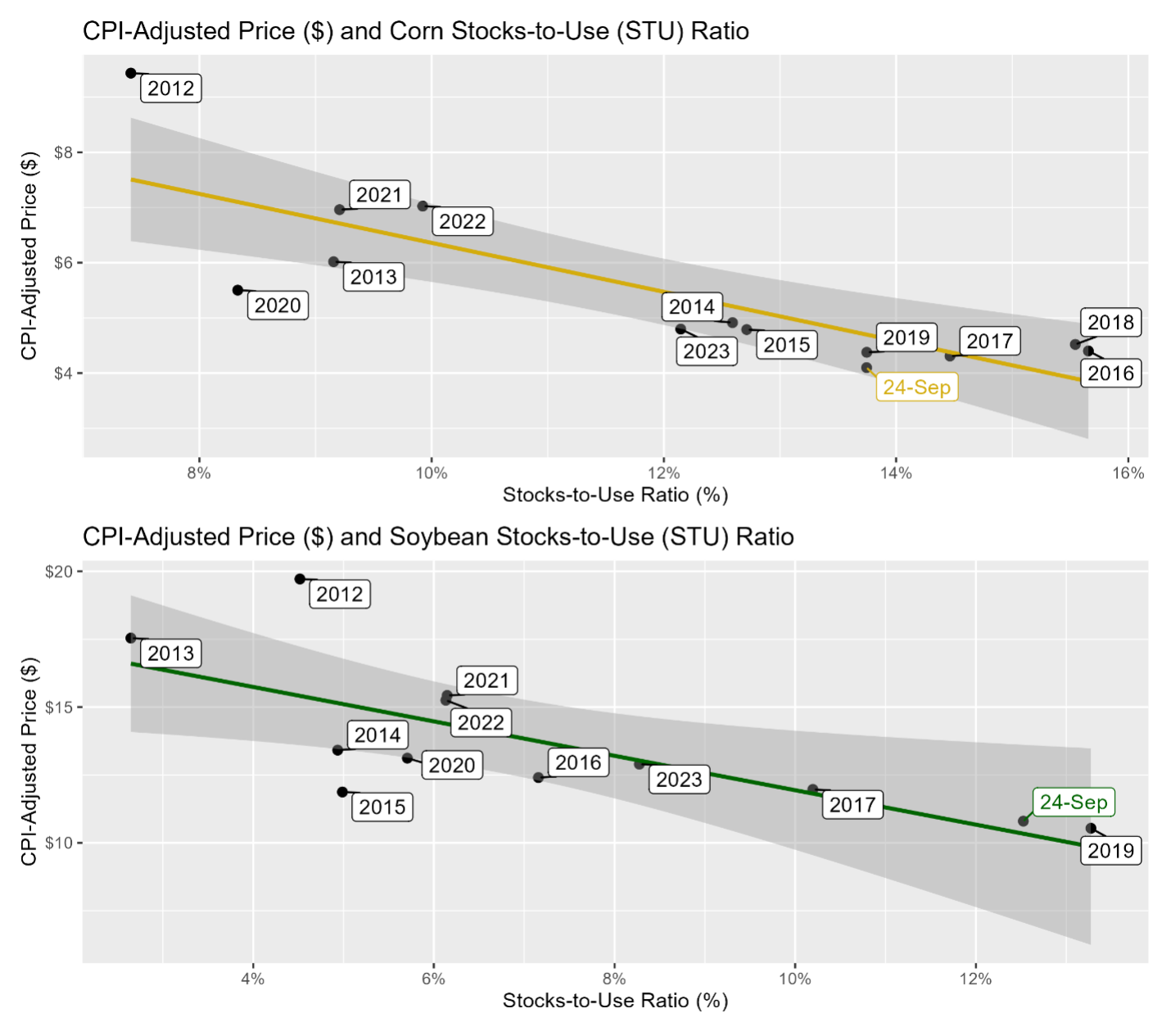
    The remainder of this article focuses on corn and soybeans, which exceed trend yields by 2.6 and 1.2 bushels and represent a national high. Record yield expectations are driving stocks-to-use ratios (a key indicator of surplus) to levels much higher than in recent years. Consequently, the USDA has projected the marketing year average price for corn to be around $4.10 per bushel, while soybeans are expected to average $10.80 per bushel.

    Currently, domestic consumption and exports of corn and soybeans appear to be stable. Crush (processing) and ethanol production are at or near record highs, while export demand is lower, but somewhat steady. Without a significant change in the yield estimate due to drought or overestimation, it is hard to envision a sharp price rise for the 2024/25 marketing year.

    Figure 1 graphs stocks-to-use ratios and CPI- (inflation) adjusted season average prices for corn and soybeans with the September WASDE Estimates and associated trendlines (green and yellow with gray confidence intervals). CPI-adjusted corn prices are at their lowest level since at least 2011, and soybeans are nearing the lows seen in 2019. As a result, 2024 may be one of the toughest years for grain producers in the past decade, given the absence of a major event that could drive substantial price increases.

    Figure 1: CPI Adjusted Price and Stocks to Use Ratio for Corn and Soybeans

    Sources:

    U.S. Department of Agriculture, World Agricultural Outlook Board. (2024, September 13). World Agricultural Supply and Demand Estimates (WASDE). https://www.usda.gov/oce/commodity/wasde


    Gardner, Grant. “Minimal Price Gains Amid Record Yields: A Tough Outlook for Grain Producers in 2024.” Southern Ag Today 4(38.3). September 18, 2024. Permalink

  • Summer Slide

    Summer Slide

    Cattle and calf prices have been sliding lower for more than a month.  For the most part, prices remain higher than last year at this time, even though they are declining.  In the middle of this slide comes the next cattle on feed report which will indicate fed cattle supplies for the next few months.  

    The next cattle on feed report will be released on Friday, September 20th.  Most market analysts’ forecasts are published by now and, generally, indicate that they expect marketings and placements to be below last year.  Feedlot marketings should be down about 3.5 percent lower than last year.  While below last year, one less workday during August means that daily average marketings were slightly higher than last year. 

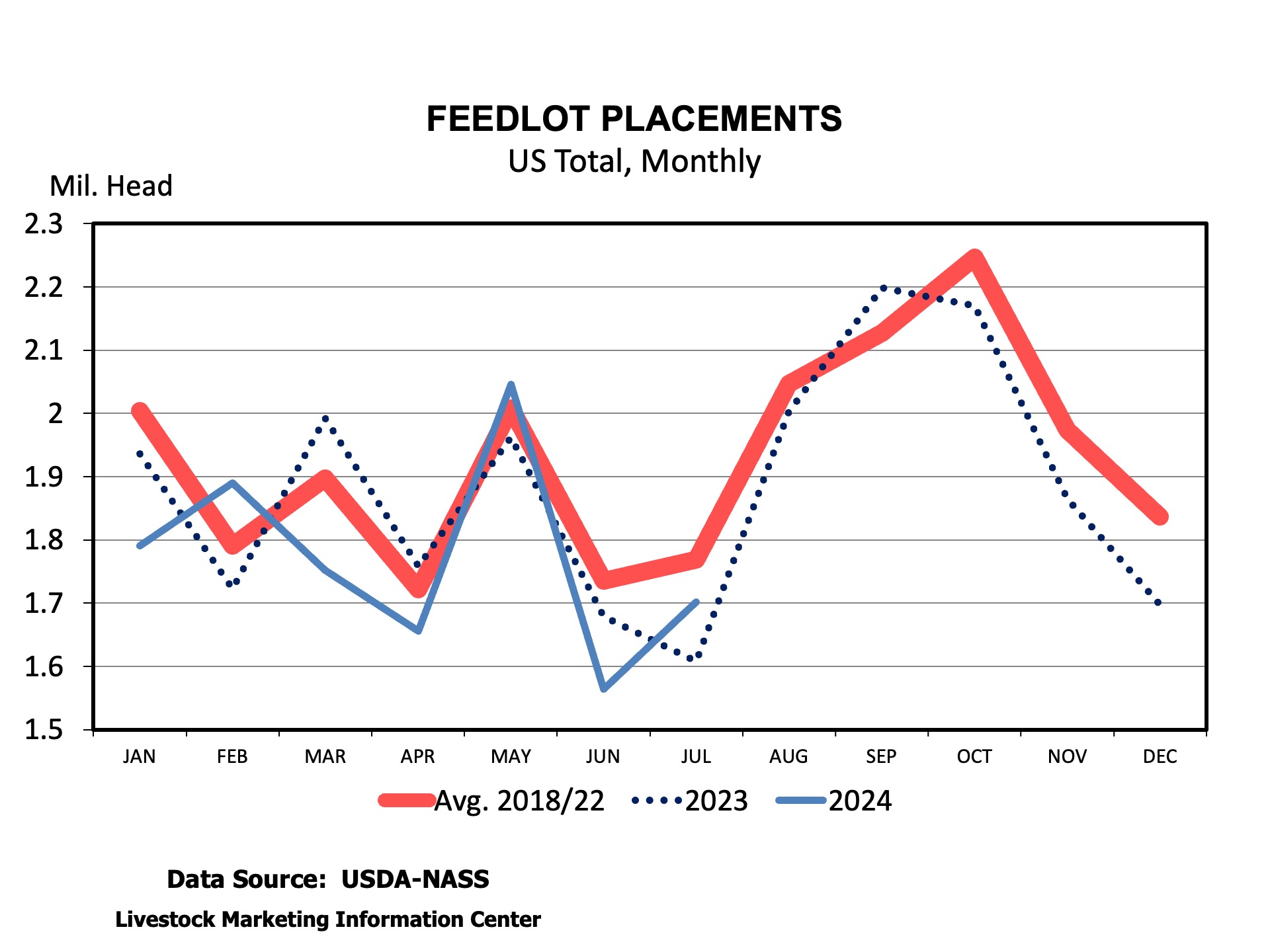
    There is a fairly wide range of market analysts’ estimate of placements, from down 4 percent to up 2 percent.  Seasonally, August placements tend to be large as calves born in the Spring and yearlings coming off summer grazing programs start to be placed.  September and October tend to be the months with the most feedlot placements.  Fewer feeder cattle were sold this August than last year according to available data on feeder cattle sales and feeder cattle reported on the CME feeder cattle index.  But, about 29,000 more feeder cattle were imported from Mexico during August.  August placements also occurred against a backdrop of falling fed cattle futures prices.  Even though corn prices continued to decline lower fed prices forced lower feeder cattle prices throughout the month.

    Typically, more feeder cattle are placed than fed cattle marketed in August.  That is likely the case again this year, which leaves the number of cattle on feed up about 0.3 percent on September 1.  So, compared to last year supplies of cattle in feedlots implying fed beef production should remain close to last year’s level for most of the rest of the year.  

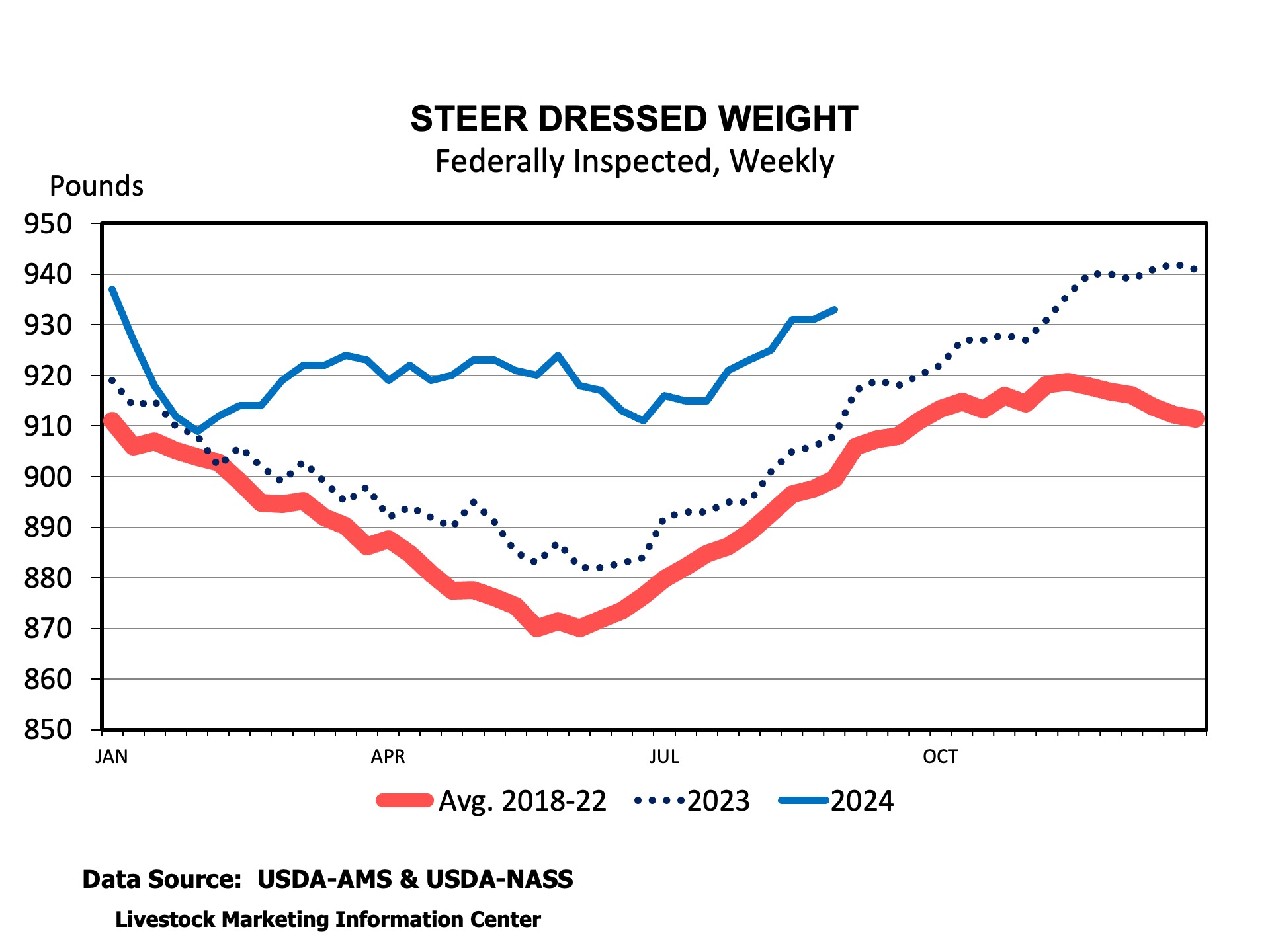
    The report should support the continued trend of more beef production from fed cattle than a year ago.  Both fed steer and heifer weights are headed higher, seasonally, and are at record highs for this time of the year. The percent of beef grading Choice is higher than a year ago indicating that there are larger supplies of Choice beef on the market compared to last year.  From a beef supply perspective, it should not be surprising to see the Choice beef cutout and cattle prices struggling to gain ground compared to last year.

    Watch for placements and the total number of cattle on feed in the report on Friday, September 20th.  Those will provide some good information on beef supplies for the rest of the year.  Placements should be larger in September and October as Fall runs of calves start across the South and the rest of the country.


    Anderson, David. “Summer Slide.Southern Ag Today 4(38.2). September 17, 2024. Permalink

  • Empowering the Next Generation: The Perks of Paying Your Farm Kids

    Empowering the Next Generation: The Perks of Paying Your Farm Kids

    Even in the year 2024, farming tends to be a family affair. The late nights and subsequent long hours can mean the most promising way to spend family time is by spending it together in the field or on the ranch. Predictably, the kids of generational farm parents can morph quickly into farm hands – driving grain carts, loading hay, working cattle, and, in general, proving themselves to be reliable help.

    Farm families and family labor are multi-layered. The roles of manager and parent, employee and child begin to overlap, blend, and mesh over time. The slow, steady drip of ever-increasing labor from the kid often means there’s never a set hire date. Then, suddenly, your brand-new teenager has put in a 40-hour week on her summer break, completely unpaid. The farmer parent may make the valid point that they allow their child to work “for free” on the farm under the guise of building character or as an exchange for a future allowance like a car or college. While I’m never one to argue with character building, this route is not the best approach from a financial and tax perspective. 

    If your farm kid was hard at work in the wheat field or hay field this summer break, consider putting them on the payroll. In 2024, the standard deduction is $14,600. This means one could earn up to $14,600 and not owe any federal tax. Further, if a parent pays their child through a sole proprietorship, and the child is also under the age of 18, the child is also exempt from Social Security and Medicare taxes. The child can also be exempt from Social Security and Medicare taxes when working for a partnership as long as both partners are the child’s parents. 

    The wage paid to an employee who happens to be your child is a fully deductible expense to the payer, and if the amount falls under the threshold mentioned above, the child will not be subject to federal tax. In some instances, state and local taxes may apply, but those amounts are often nominal. This scenario is a win-win for the child and for the parents. 

    There are considerations to be made when adding your children to the payroll. 

    • The wage and the work must be reasonable. One can’t suddenly decide their child is worth $100 per stacked straw bale or $14,000 for a day’s worth of work. 
    • There’s paperwork. It’s important to treat your child like a proper employee. Keep and maintain payroll records and be sure to file the necessary forms throughout the year and at year-end, including issuing them a W2. 
    • Tax allowances are not labor and safety laws. Ensure you are following all laws in regard to children in agricultural settings. 
    • Every farming situation is unique. It’s best to speak with your local tax preparer to discuss your situation and ensure you follow the rules.

    If you want to further set your children up for success, consider helping them invest their wages into a tax-free savings vehicle. A college investment account or a retirement account for those not college bound are a great option. Investing those wages while mom and dad are footing the bill for living expenses will really help to secure a person’s future.

    Paying your kids to work on the family farm is a great way to instill the value of hard work, perseverance, and determination. Done the right way, adding your child to the payroll can be a beneficial situation for all parties involved.  


  • Cell Cultured Meat

    Cell Cultured Meat

    In their most recent legislative sessions, nine states – AlabamaArizonaFloridaKentuckyMichiganNew YorkPennsylvaniaTennessee, and Texas – considered legislation banning the manufacture, sale, or distribution of cell-cultured meat. Florida and Alabama both passed the legislation, and their governors signed it into law. In Kentucky, New York, Tennessee, and Texas the proposed bills did not make it out of committee before the session ended. Arizona’s bill made it further with HB2121 passing in the House of Representatives but failing in the Senate. The Pennsylvania and Michigan bills, whose legislative sessions are ongoing, were introduced following the passage of the Alabama and Florida bills and are each being considered in committee. 

    Florida 

    On May 1, 2024, Florida became the first state in the U.S. to ban cell-cultured meat. SB1084, an appropriations bill with a number of agriculture-related measures, included a provision outlawing the manufacturing for sale, selling, holding or offering for sale, or distribution of “cultivated meat.” The Florida law defines cultivated meat as “any meat or food product produced from cultured animal cells.” The violation of this law is deemed a misdemeanor of the second degree and a food establishment which violates the law will be subject to disciplinary actions. Additionally, a restaurant, store, or other business may have its license suspended if the owner or an employee is convicted of violating this law in connection with that business. The law does not ban research conducted on the production of cultivated meat. The law went into effect on July 1, 2024.

    Alabama 

    Similarly, on May 7, 2024, Alabama Governor Kay Ivey signed SB23 into law. This law prohibits the manufacturing, selling, holding or offering for sale, or distribution of any cultivated food product in Alabama. The law defines a cultivated food product as any food product produced from cultured animal cells. A violation of this law is considered a Class C misdemeanor, and establishments found to be in violation could have its food safety permit suspended. The law does not prohibit research of cultivated food products by a “federal, state, or local governmental entity or institution of higher education, or a person that is partnered with a governmental entity or institution of higher education.” SB23 goes into effect on October 1, 2024. 

    Lawsuit against Florida  

    On August 12, 2024, UPSIDE Foods, Inc. filed a complaint in the U.S. District Court for the Northern District of Florida challenging Florida’s ban on cell-cultured meat. UPSIDE is a California company that produces cultivated meat products grown from animal cells. UPSIDE was the first manufacturer of cell-cultured meat or poultry authorized by the U.S. Department of Agriculture (USDA) and the Food and Drug Administration (FDA), who share the regulatory authority over cell-cultured meat, to sell its product in the U.S. 

    In this complaint, UPSIDE argues that Florida’s cell-cultured meat ban is unconstitutional because it violates both the Supremacy Clause and the Commerce Clause of the U.S. Constitution. The complaint alleges that the Supremacy Clause, which gives priority to the Constitution and federal laws over any conflicting state laws, is violated because Florida’s ban is preempted by federal laws regulating meat and poultry products. Further, UPSIDE argues that the Commerce Clause, which grants Congress the authority to regulate commerce among the states, is violated by Florida’s ban because it discriminates against out-of-state producers of cultivated meat and benefits the interests of Florida’s agricultural industry. So far this is the only legal challenge brought against Florida’s cell-cultured meat ban, and no challenge has been made against Alabama’s. However, that might change when the Alabama law goes into effect on October 1, 2024. 


    Stone, Emily. “Cell Cultured Meat.Southern Ag Today 4(37.5). September 13, 2024. Permalink