Blog

  • Staying Positive While We Wait for a Farm Bill

    Staying Positive While We Wait for a Farm Bill

    During every farm bill cycle, we get asked to provide updates at county, regional, state-wide, and national meetings in the years leading up to the bill, during bill development, and in instances where it appears progress has stalled – like now.  Sometimes the message is not fun to deliver.  But, it’s the job, and it’s better to give an honest assessment than to sugarcoat the situation and have a producer think things are better than they are and make a bad financial decision because we didn’t want to come off as being too negative.  One of us (the old one) has been referred to by just about everyone in Texas as Dr. Doom for most of his 30plus year career in agricultural policy, and he wouldn’t have it any other way.  Why?  Because of the hundreds of producers that have told us we truly helped them by giving them our honest – and most of the times blunt – assessment of the situation.

    A producer recently sent an email with the following questions.  “If Congress doesn’t value what we do enough to provide a meaningful safety net… why should we keep risking hundreds of thousands to millions of dollars per year trying to make a crop?  Should I just quit and do something else?”

    When we get these types of questions, it helps us remember that the approximately 300,000 to 350,000 producers in the United States who rely on agriculture for their living need to hear the positives too.  The rest of the article summarizes the positive response to the producer’s questions.

    First, while not large in number, there are members in both the House of Representatives and Senate who truly understand how dire the situation is and are absolutely trying to help.  It’s all about money and timing, and in our opinion, if this wasn’t an election year, a new farm bill would be signed into law by now.

    Second, we feel strongly that Congress will also see the need and provide financial disaster assistance to help out in the short term since safety net enhancements that will be included in the new farm bill will not trigger payments until October 2026. 

    Third, it has taken a while, but all of the key agricultural stakeholders (general farm organizations, commodity groups, lenders, input suppliers, etc.) are working together and in unison, calling for the farm bill to be completed.   It is important that members of Congress hear a consistent message.

    And finally, agriculture profitability always has been and will continue to be cyclical.  This means the bad times – just like the good times – don’t last for more than a few years before some unforeseen event (e.g., drought, floods, war, or pandemic) around the world causes it to change.  Things will get better.


    Outlaw, Joe, and Bart L. Fischer. “Staying Positive While We Wait for a Farm Bill.Southern Ag Today 4(37.4). September 12, 2024. Permalink
  • Lower Interest Rates Create Opportunities for Managing Debt on the Farm

    Lower Interest Rates Create Opportunities for Managing Debt on the Farm

    A “triple threat” of low commodity prices, high input costs, and high interest rates creates a challenging financial environment for many producers.  This is especially true for producers with little working capital and who rely on operating loans to finance their business activities.  The good news is that one part of this “triple threat” may soon begin to ease.  

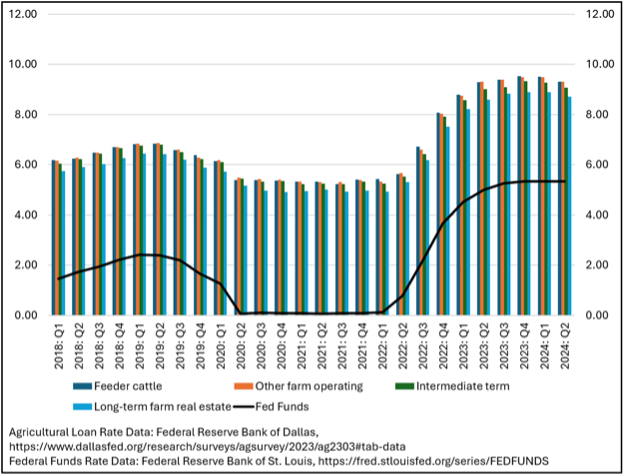
    The Federal Reserve began raising the federal funds rate in the first quarter of 2022 in response to rising inflation (see Figure 1).  This started a series of rate increases that ended in August 2023.  Since, then, the federal funds rate has held steady at 5.33%.  As the federal funds rate increased, interest rates charged on agricultural loans went up from about 5% to around 9% (Figure 1). 

    However, in a speech on August 23, 2024, Federal Reserve Chair Jerome Powell indicated that the Federal Open Market Committee (FOMC) would begin to lower the federal funds rate, perhaps as early as their September meeting.  As the FOMC lowers the federal funds rate, other interest rates will begin to fall as well.  This will be a welcome reprieve for producers as the cost of borrowing to finance operations decreases.  It also provides producers with opportunities to manage the debt they have incurred over the last few years at high interest rates.  Two strategies that producers might use as interest rates fall are debt refinancing and debt consolidation.

    When debt is refinanced, an existing loan is replaced by a new loan with different terms and conditions for repayment.  The new loan pays off the remaining principal plus any accrued interest that is still owed on the old loan.  The amount that is paid off becomes the principal owed on the new loan.  Payments are then made on this new loan, ideally with lower periodic payments.  Debt consolidation is a form of refinancing in which multiple debts are combined into a single loan.  The new loan pays off the remaining principal and any accrued interest on all the old loans, and the amount that is paid off becomes the principal owed on the new loan.

    The primary benefit of refinancing or consolidating debt is smaller monthly or periodic payments, which occurs for two reasons.  First, refinancing or consolidating debt often involves extending the debt’s repayment period.  The amount owed is paid back over a longer period than the original loan(s) terms allowed for, so payments in each month are less.  Second, refinancing or consolidating debt as interest rates decrease means the new loan should charge less in interest monthly than was charged on the old loan(s).  The potential results of this benefit include improved monthly cash flow and an easier time making regular payments on debt.

    Before a producer considers either of these strategies to help manage their debt, it is important to consider the potential pitfalls of refinancing or consolidation.  First, extending the loan payment period may incur higher total interest costs.  Although the amount owed in any single period is less, the fact that the loan principal is paid back over a longer time means interest accrues for longer as well.  Therefore, there may be a tradeoff between lower periodic payments and higher overall costs for the loan.  A second pitfall to consider is the closing costs and fees the producer must pay to initiate the new loan.  Producers should consider whether they can pay these costs, and whether incurring these costs are worth any benefits of refinancing or consolidation, before initiating either process with their lender.  Ultimately, producers will need to consult with their lenders to determine what refinancing or consolidations options are available to them and whether these options will be beneficial in the long run.

    Figure 1.  Changes in the Inflation rate, the Federal Funds Rate, and the Unemployment Rate, January 2018-February 2024 


    References

    Board of Governors of the Federal Reserve System (US), Federal Funds Effective Rate [FEDFUNDS], retrieved from FRED, Federal Reserve Bank of St. Louis; https://fred.stlouisfed.org/series/FEDFUNDS, April 1, 2024.

    Board of Governors of the Federal Reserve System (US), Agricultural Survey, retrieved from the Federal Reserve Bank of Dallas; https://www.dallasfed.org/research/surveys/agsurvey/2024/ag2401#tab-report.


    Wright, Andrew. “Lower Interest Rates Create Opportunities for Managing Debt on the Farm.Southern Ag Today 4(37.3). September 11, 2024. Permalink

  • Inventories, Weather, and Local Hay Markets

    Inventories, Weather, and Local Hay Markets

    It often seems that hay markets and prices are strictly local but, supplies and weather around the country can have far reaching effects.  Understanding inventory in the hay market can be as easy as tagging a new calf with an unhappy mama.  However, there is some data that can help, at least, provide an understanding of regional and national hay production.  Depending on the forage base (cool season perennial, warm season perennial, or warm/cool season annual plantings), rain and fertility can be the primary contributors to yield expectations.  Not to discount the impacts of natural disasters and insects.  Understanding the total inventory on hand entering the production season, consumption of hay stocks, and impact of exporting hay stocks can help in forming some price expectations and suggest some earlier or later purchases.

    Expanding and contracting drought conditions plagued the southern region during production periods for warm season perennials and annuals.  Hay production regions in the south experienced some relief from hurricanes and tropical storms.  Depending on production schedules Figs. 1-3 illustrates the impact of drought conditions on summer forages.  

    Figure 1.

    Figure 2.

    Figure 3.

    May 1 U.S hay stocks and disappearance steadily decreased starting in 2020 (Fig 4).  However, coming out of winter in 2024 hay stocks rebounded to 2020 stocks level.  Hay disappearance is largely driven by hay feeding, winter’s length and severity, and the size of the cow herd. Disappearance started decreasing in 2020 signaling reduced total hay needs.  In 2024, use of hay returned to 2020 use levels.

    Figure 4.

    It often surprises people to learn that the U.S. exports a significant amount of hay, largely alfalfa and other high value specialty hays.  The US hay export market moving three-year average valuation is $1.51 billion.  As of 2023, the export market was valued at $1.34 billion.  Total hay exports have trended downward since 2022, mainly driven by weak demand from China.  The top four countries that import U.S hay stocks are China, Japan, Saudi Arabia, and South Korea.

    So, are we just to expect the market to behave like 2020 due to stock levels?  A notable difference in the southern region will be the potential production impacts from summer droughts.  Hay prices are beginning to decline in parts of Texas due to abundant production from this year’s rains.  Hay markets do represent climate dynamics with a few large weather market issues thrown in.  The storm forecasted for later this week could bring rains for grass growth in drought affected regions of the South.  But it’s very late in the growing season for much hay production.  USDA will report a hay inventory estimate in December which will provide a good stock on hand estimate, so we will wait on that early Christmas present.   


    Fischer, Matthew. “Inventories, Weather, and Local Hay Markets.Southern Ag Today 4(37.2). September 10, 2024. Permalink

  • National Corn Yields and Deviation from Trendline Over Time

    National Corn Yields and Deviation from Trendline Over Time

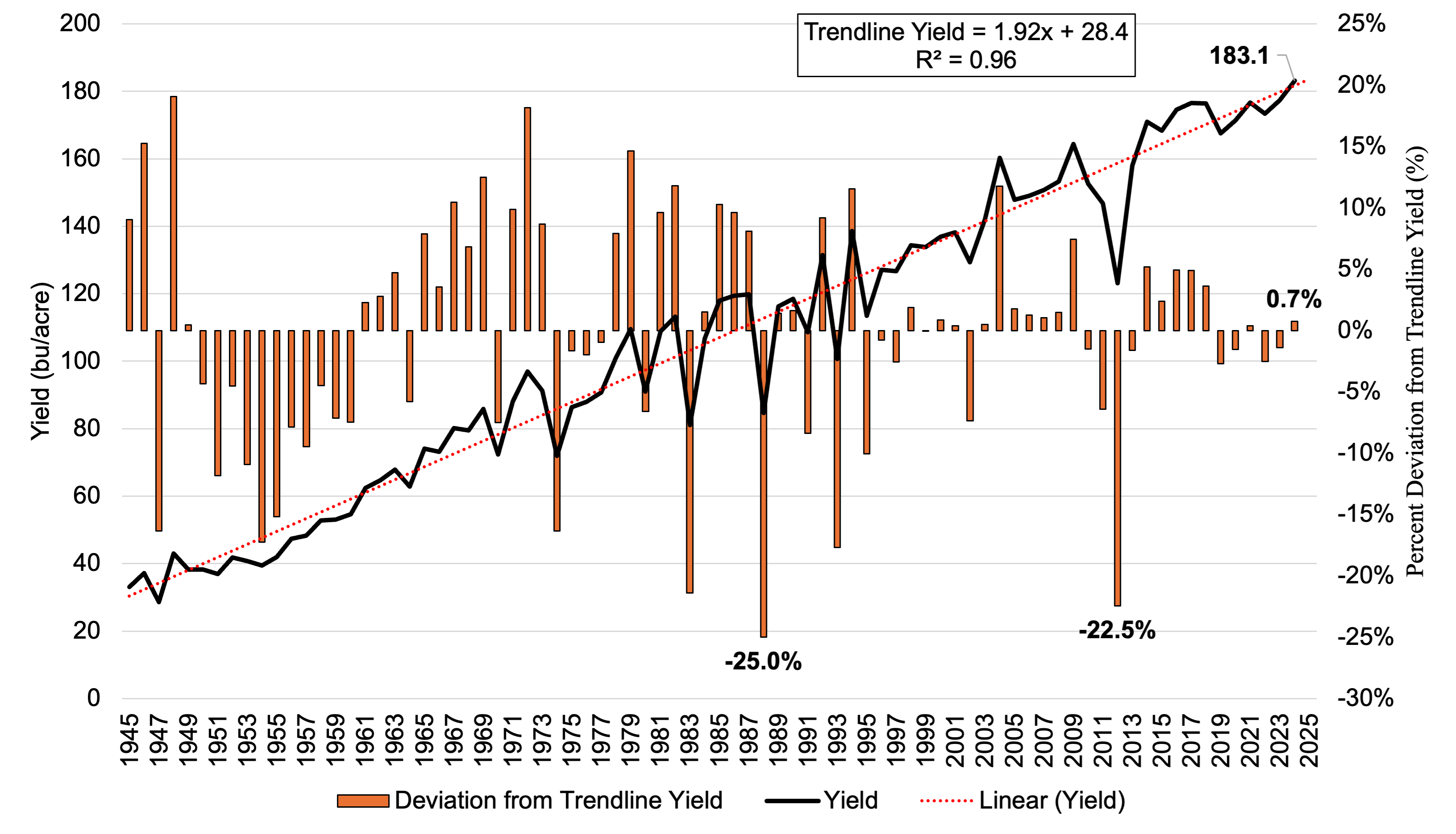
    The USDA is currently forecasting a record national average corn yield of 183.1 bushels per acre for 2024 (Figure 1). Record yield and flat demand have contributed to projected ending stocks of over 2 billion bushels, pushing December corn futures contract prices from $4.80/bu in May to a low of $3.85/bu at the end of August. Additionally, record yields across many regions will provide a weaker than typical basis for many corn producers. USDA will continue to modify yield estimates as additional harvest data are collected this fall and winter. The USDA’s final yield estimate will be provided in January 2025. This article examines national corn yields and changes in percent yield deviation from a trendline over time.

    Figure 1. U.S. corn average yield, linear trendline yield, and percent deviation from trendline, 1945-2024

    * 2025 yield is trendline forecast.

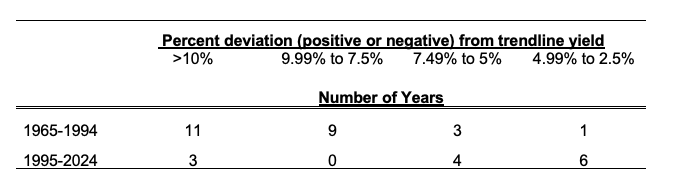
    Since 1945, U.S. national average corn yield has increased an average of 1.9 bushels per acre per year, or 19 bushels every 10 years. Drought is typically responsible for substantial negative deviations from the trendline (-25% in 1988 and -22.5% in 2012; Figure 1). Severe widespread droughts will continue to negatively impact national average corn yields in the future, presenting as large deviations from a long term trendline. However, there are patterns that emerge in the yield deviation from trendline data. There is a tendency to have multiple years of deviation above trend (2003-2009 and 2014-2018) or below trend (1995-1997 and 2010-2013). The number of years differs, and can contain a contradictory year, but there is a pattern. This is not to say that the current yield indicates that for the next few years yields will be above trendline. The second is there is a smaller percent deviation (positive or negative) from trendline in recent decades. From 1965-1994, U.S. corn yields deviated (+ or -) from trendline by more than 10% in 11 years and by more than 7.5% in 20 out of 30 years (Table 1). By contrast, from 1995-2024, yields deviated by greater than 7.5% in only 3 years. The average percent deviation from trendline from 1995-2024 was 3.7% compared to 9.4% from 1965-1994. Thus, with the exception of a few extreme years, yield in the past 30 years has been following a long term trendline. National average yield impacts the prices producers receive. Understanding long term national, state, and regional yield trends and patterns can assist in formulating a risk management and marketing strategy. 

    Table 1. The number of years from 1965-1994 and 1995-2024 with national corn yields 10%, 7.5%, 5%, or 2.5% higher or lower than the linear trendline

    References

    USDA NASS National Corn Yield Data. NASS Quick Stats. https://www.nass.usda.gov/Quick_Stats/

    USDA August WASDE Report. https://www.usda.gov/oce/commodity/wasde


    Smith, Aaron. “National Corn Yields and Deviation from Trendline Over Time.Southern Ag Today 4(37.1). September 9, 2024. Permalink

  • Hunting Leases and Rural Land

    Hunting Leases and Rural Land

    As fall approaches, so does hunting season.  As hunters are scouting for the best locations, landowners may be searching for opportunities to generate additional revenue from agricultural and forested property. Outdoor recreation such as hunting, fishing, camping, and hiking can provide additional opportunities for landowners, depending upon the property and the willingness of the landowner to go down this path. Not all landowners are willing to accept strangers walking around their property so recreational leases are not a perfect fit for everyone.  The leases can also be challenging as they differ significantly from traditional agricultural leases.

    When considering these leases, landowners must make decisions on what types of activities and limitations they are willing to allow.  Some of the issues to decide include: 

    • How do you price your recreational opportunities?
    • How many people have permission to enter the property? 
    • Can the lessees camp and build campfires on the property? 
    • What species are being hunted? 
    • Are there limits on the amount of game that can be taken?
    • How do you allow for recreational use while protecting growing crops and livestock?

    However, there are other issues that may be addressed through the lease as well as other means. For example, what about liability in case someone is injured on your property? Insurance is a readily available and cost-effective means to reduce liability. Based on my conversations with insurance underwriters over the years, many claims submitted for hunting accidents involve tree stands and ATVs. In addition to insurance, simple changes to a lease agreement such as forbidding ATVs and limiting tree stands to only ones that they personally install, may help to mitigate those and other risks.  

    To see a more in-depth list of factors to consider in a hunting lease, as well as a model lease form, you can read the Ranchers’ Agricultural Leasing Handbook: Grazing, Hunting and Livestock Leases handbook which discusses these issues and many more that landowners should consider. 

    Even with this information, I strongly recommend that an attorney draft your recreational lease, specific to your property, your boundaries and your situation.  For tips on finding an attorney, please visit this Southern Ag Today article.


    Rumley, Rusty. “Hunting Leases and Rural Land.Southern Ag Today 4(36.5). September 6, 2024. Permalink