Blog

  • Hiring H-2A Workers through Farm Labor Contracts

    Hiring H-2A Workers through Farm Labor Contracts

    The H-2A Program allows direct farm employers to hire H-2A workers through Farm Labor Contractors (FLCs) (CFR § 655.132).  Current regulations allow an FLC to file a single foreign labor certification application where they declare the need for a batch of workers intended to service multiple farms at several farm work locations.  These work assignments can even extend beyond the FLC’s home state boundaries (Castillo, Martin, and Rutledge, 2022).  

    In 2021 and 2022, FLCs have hired more than 40 percent of all DOL-certified H-2A workers, with California, Florida, and Georgia as the most popular work destinations in recent years (Table 1).  More than 60 percent of FLCs’ H-2A hires are accounted for by companies based in Florida and California. In recent years, Georgia, Texas, and North Carolina are the other Southern States included in the Top 6 home states of FLCs.

    In 2023, most H-2A workers hired by California FLCs were detailed within the state (88 percent), with about 10 percent outsourced to Arizona farms, while the rest worked in four other states (Colorado, Nevada, Texas, and South Carolina).  In contrast, H-2A hires of Florida-based FLCs are more dispersed, with 52 percent ending up employed within the state, while the rest are deployed in 28 states with North Carolina and Michigan (11 percent each), Indiana (6 percent), Georgia (4 percent), and Illinois (3 percent) as the five most popular work destinations. 

    The value of FLCs in the H-2A hiring scheme lies in their greater familiarity with the farm labor supply conditions in countries where most potential H-2A workers come from.  FLCs maintain extensive social and business networks in those countries that allow them to solicit workers even from remote local communities.  In contrast, individual U.S. farm businesses’ worker solicitation outreach networks are usually not as broad and far-reaching.  Thus, the FLCs capitalize on their good connections and extensive outreach, making them viable suppliers of prospective H-2A workers for U.S. farms.  

    However, a cursory review of wage-related violations in agriculture indicates high incidences of infractions associated with the FLC-H-2A hiring scheme. Based on more recent wage violations data compiled by the Department of Labor’s Wage and Hour Division (DOL-WHD), FLCs’ H-2A hires account for 27 percent (2022) to 31 percent (2023) of all H-2A-related cases.  Back wages owed to FLC’s H-2A workers account for 15 percent (2022) to 26 percent (2021) of all H-2A back wages.  These proportions may be less than the FLCs’ H-2A supply proportions of about 33 to 44 percent during these years, but the nature of these violations provides an interesting discussion of the crucial impact of FLCs on the viability of the H-2A program.  In a later issue, a follow-up article will discuss the nature of these FLC-associated labor violations and back wages, as well as shed light on how federal budgetary decisions could influence the varying efficiency, scope, and depth of the DOL-WHD’s policy compliance auditing process over the years.

    Table 1. H-2A Workers Hired by Farm Labor Contracts, Geographical Dispersion, and Wage

    Note:  a Non-farm labor contractors include direct farm employers consisting of individual/joint farm businesses and commodity groups (associations)
    Source:  Department of Labor (DOL) H-2A Disclosure Datasets; DOL -Wage and Hour Division (WHD)

    References:

    Castillo, M., P. Martin, and Z. Rutledge. (2022).  The H-2A Temporary Agricultural Worker Program in 2020.  Economic Information Bulletin #238, Economic Research Service, U.S. Department of Agriculture.  Washington, DC.

    Code of Federal Regulations (CFR). Labor Certification Process for Temporary Agricultural Employment in the United States, Subpart B. National Archives, Government Policy and OFR Procedures, Washington, DC.


    Escalante, Cesar L. “Hiring H-2A Workers through Farm Labor Contracts.Southern Ag Today 4(30.3). July 24, 2024. Permalink
  • Growing On-feed Inventory, Lower Placements, and No Sign of Heifer Retention

    Growing On-feed Inventory, Lower Placements, and No Sign of Heifer Retention

    USDA’s July Cattle on Feed report was released on Friday July 19th. These monthly reports estimate inventory in US feedlots with one-time capacity exceeding 1,000 head, which represent more than 80% of total on-feed inventory in the United States. The July report is also a quarterly report that includes data on the steer-heifer mix in feedlots. This brief article will walk through last week’s report and some of the implications of it.

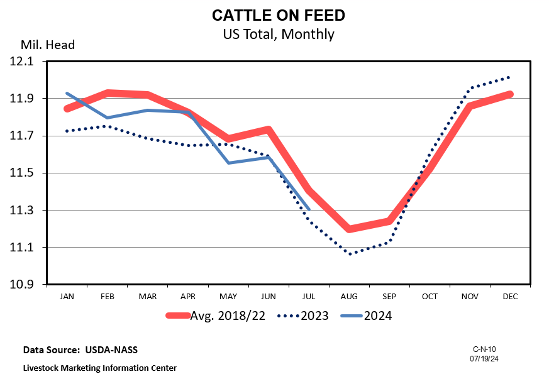
    Total on-feed inventory declined during the month of June with July 1 inventory estimated at just over 11.2 million head. This trend is normal as on-feed numbers tend to decline seasonally from winter to late summer. Compared to 2023, July 2024 inventory was actually about 0.5% higher. On the surface this seems odd given the recent declines in the size of calf crops, but I maintain that cheap feed and higher slaughter weights are largely the reason for this as cattle are being fed longer.

    Feedlot placements have been the most interesting number to watch in recent months. For the month of June, placements were down almost 7% from last year. This contrasts with placements being 4% higher year-over-year for the month of May. These last two months illustrate why it is sometimes hard to look at things purely on a monthly basis. If I instead calculate feedlot placements for the first 6 months of 2024, as compared to the first 6 months of 2023, total placements have been down by 3.2%. This likely tells the feeder cattle supply story a bit better.

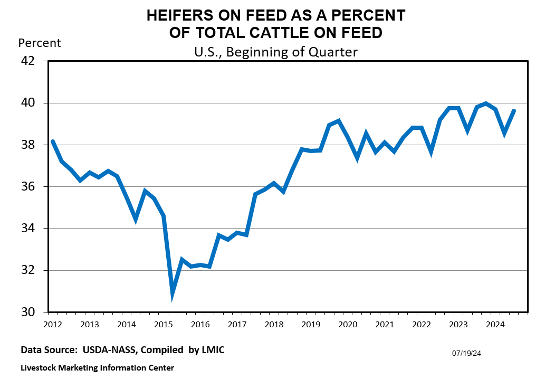
    Since USDA will not be publishing a July Cattle Inventory report this year, the July steer-heifer mix on feed is especially important as it provides some perspective on heifer retention. Heifers accounted for 39.6% of on-feed inventory in July, which was actually higher than the previous estimate from April. If retention were occurring, one would expect the heifer percentage to be in the low-mid 30% range, so this continues to suggest that expansion is not on the near horizon.

    Burdine, Kenny. “Growing On-feed Inventory, Lower Placements, and No Sign of Heifer Retention.Southern Ag Today 4(30.2). July 23, 2024. Permalink

  • Having a Way Out

    Having a Way Out

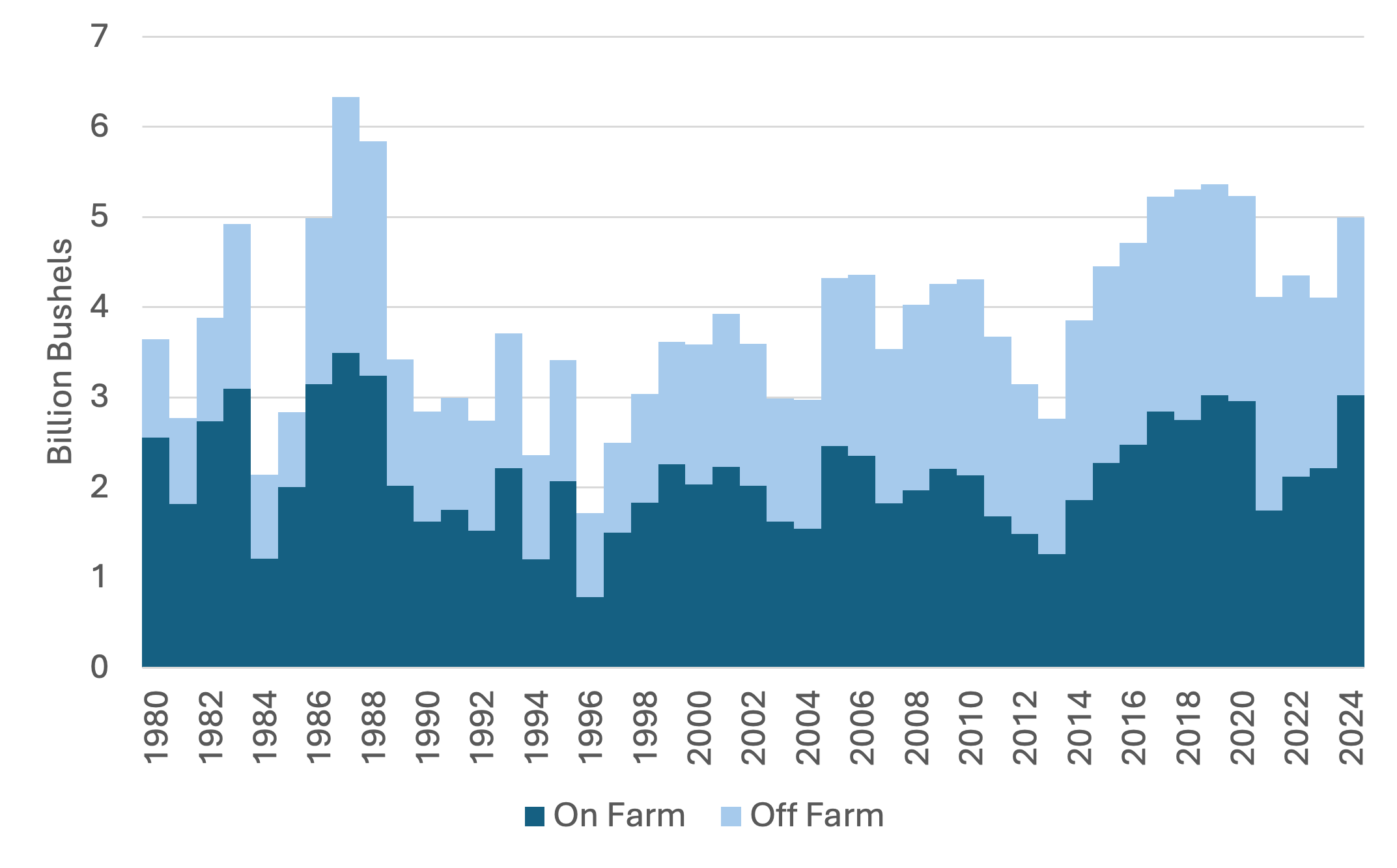
    The USDA Quarterly Stocks Report, representative of stocks held on June 1, indicated that both corn and soybean stocks (Figures 1 and 2) are higher than in recent years. High stocks are a bearish factor for the market as they increase the supply side of the balance sheet going into the new marketing year and have been one of many contributing factors to the price decline experienced this summer in corn and soybean markets. A significant insight from the report is how much stock is still stored on-farm versus off-farm.  On-farm corn stocks are at the highest level since 1988 and up 37 percent from last year. On-farm soybean stocks are up 44 percent from a year ago. Given the high level of stocks still being held by producers, it is appropriate to discuss the importance of having an exit strategy that allows producers to exit old crop positions in preparation for new crops. While the exit strategy ideally should be decided before grain goes into storage, some pieces of the discussion below could still be implemented this late in the marketing year. 

    An exit strategy marks the official end of marketing activities for a particular crop year. No matter what type of marketing tool is used, a basic exit strategy utilizes price-driven or time-driven methods. Specific price targets guide a price-driven exit strategy. An example would be selling stored grain at X cents over the harvest price. In this case, the harvest price would be what the grain could have been sold for at harvest. Ideally, a price-driven exit strategy would divide sales up across a range of prices; an example for corn would be selling 10,000 bushels at $4.25 per bushel, 10,000 bushels at $4.40 per bushel, and the last 10,000 bushels at $4.50 per bushel. As each price level is attained, grain is sold. This strategy diversifies price targets to ensure you are not stuck with mostly unpriced grains when transitioning into the lower price environments we are currently experiencing. Another example would be selling stored grain at X cents under the harvest price. At some point, exit strategies need to be used to cut losses. Price targets serve as bookends that guarantee the producer will not be left holding grain indefinitely, speculating on a marketing situation that never occurs.

    Another exit strategy is to set predetermined sale dates. This could be as simple as “I will sell all stored grain by July 31” or “I will sell 10,000 bushels the first of each month, with my final sale occurring July 31.” Setting a predetermined date forces the producer to take a marketing action. An exit strategy can have both price-driven and time-driven components, for example, selling all stored grain at $4.25 per bushel or higher before July 31st. Being late in the marketing year, a producer can still sell their grain and maintain a position in the market by buying a call option. If it is decided to hold on to the physical grain, producers will likely need to plan to store until after harvest, as harvest pressure will decrease the likelihood of a better pricing environment.     

    While the exit strategies discussed above may seem straightforward, they do a good job of curbing emotional hesitancy in marketing decisions. One of the most challenging emotions for producers to control is regret. A producer might feel regret if they sell right before a rally begins or decide not to sell before a market downturn. Dwelling on regret about past sales can make producers hesitant to book future sales.  A well-developed exit strategy can assist producers in coping with emotional bias in marketing decisions. A successful grain sale is based on sound reasoning, with each component of the exit strategy being grounded in price targets derived from production costs and time targets based on local market seasonality. This exit-strategy approach ensures that each marketing decision is reasonable and not regretted in hindsight. An exit strategy gives producers a way out of the old crop and allows them to focus on new crop positions. 

    Figure 1. On-Farm and Off-Farm June 1 Corn Stocks 

    Figure 2. On-Farm and Off-Farm June 1 Soybean Stocks 


    Maples, William E. “Having a Way Out.Southern Ag Today 4(30.1). July 22, 2024. Permalink

  • Department of Labor Finalizes New H-2A Regulations

    Department of Labor Finalizes New H-2A Regulations

    Labor is in high demand for agriculture in the United States (“U.S.”) and the H-2A visa program is an important component of this critical issue. Over the last few years, there has been a growing interest in amending regulations related to the H-2A program. On September 15, 2023, DOL issued a notice of proposed rulemaking in the Federal Register to amend its regulations governing the H-2A visa program. The proposed rule went through a sixty-day comment period, and now DOL released its final rule.

    The H-2A program is a visa program for temporary and seasonal agricultural workers authorized through the Immigration and Nationality Act. The purpose of this program is to meet the U.S. agricultural labor needs by allowing employers to employ temporary foreign workers. To qualify for the program, an employer must “offer a job that is of a temporary or seasonal nature, demonstrate that there are not enough U.S. workers who are able, willing, qualified, and available to do the temporary work, show that employing H-2A workers will not adversely affect the wages and working conditions of similarly employed U.S. workers, and submit a single valid temporary labor certification from the U.S. Department of Labor with the H-2A petition”. U.S Citizenship and Immigration Services, H-2A Temporary Agricultural Workers.

    On April 26, 2024, DOL announced it had finalized its “Improving Protections for Workers in Temporary Agricultural Employment in the United States” rule. The purpose of the rule, as laid out by DOL, is to promote employer accountability and to “ensure farmworkers employed through the H-2A program are treated fairly, have a voice in their workplace, and are able to perform their work safely.” DOL adopted most of the provisions in the proposed rule as they were proposed and modified or added other provisions. The final rule addresses multiple areas – increasing protections for workers who advocate for better working conditions, creating new or clarifying existing definitions critical to the H-2A program, and measures related to transparency in the H-2A program.

    The final rule adopted the proposed provisions that will add protections for workers who self-organize to change working conditions. Under the final rule, employees will be protected from intimidation, threats, restraint, coercion, or any forms of discrimination for self-organization. Additionally, the final rule adopted the proposed provision preventing employers from restricting employees from granting access to their living quarters, common areas, and outdoor spaces to guests during nonproductive times. Under the final rule, employers would be able to impose reasonable restrictions on access to living quarters, common areas, and outdoor spaces, for worker safety or enjoyment of housing.

    The proposed rule clarified that an H-2A worker may be terminated for cause, for failing to meet productivity standards or failing to comply with employer policies or rules. The final rule adopted this provision and added an additional reason employers may terminate a worker for cause. Under the final rule, an employer may also terminate an H-2A worker for “failing to satisfactorily perform job duties in accordance with reasonable expectations based on criteria listed in the job offer.” The proposed rule outlined six criteria that must be satisfied for an employer to terminate an employee for cause, and the final rule adopted the following five criteria:

    1. “The employee has been informed (in a language understood by the worker) of the policy, rule, or productivity standard, or reasonably should have known of the policy, rule, or productivity standard;
    2. Compliance with the policy, rule, or performance expectation is within the workers’ control;
    3. The policy, rule, or performance expectation is reasonable and applied consistently to the employer’s H-2A workers and workers in corresponding employment; 
    4. The employer undertakes a fair and objective investigation into the job performance or misconduct; and
    5. The employer corrects the worker’s performance or behavior using progressive discipline, which is a system of graduated and reasonable responses to an employee’s failure to satisfactorily perform job duties or comply with employer policies or rules.”

    Lastly, the proposed rule and now the final rule seeks to provide transparency on the wages paid to H-2A employees. First, the proposed rule would require that employers disclose applicable rates in the job order, including any piece rate or the highest applicable hourly rate. This provision was adopted in the final rule. Additionally, the final rule adds a minor change to the proposed provision that requires employers to pay workers daily during a delay. The change adds that employers must pay employees for minor delays, which are identified in the final rule as less than fourteen days. Under the final rule, if the employer does not notify the employee or state workforce agency of a delay within the required timeframe, the employer must pay the highest hourly wage under the offered wage rate regulations. Lastly, the final rule adds provisions amending the job orders and wage rates for herding and range livestock jobs. Under the final rule, all applicable rates of pay must be included in the job order and employers may prorate the wage rate in specified circumstances. 

    The rule went into effect on June 28, 2024. However, only applications for H-2A employer certifications submitted to DOL on or after Aug. 29, 2024, will be processed according to the new rules.

    Capaldo, Samantha. “Department of Labor Finalizes New H-2A Regulations.” Southern Ag Today 4(29.5). July 19, 2024. Permalink

  • Trade Policy Also Important in Next Farm Bill

    Trade Policy Also Important in Next Farm Bill

    The importance of strengthening the commodity provisions in the next farm bill has been discussed on multiple Thursdays in Southern Ag Today.  The steady decline in the U.S. share of exports of major commodities (Figure 1) along with projected prices and the realities of high input costs are expected to exacerbate the current cost-price squeeze producers are enduring.  In addition to meaningful enhancements in commodity programs, many stakeholders are calling for increased funding for trade promotion programs that stimulate the demand for and reduce barriers to imports of U.S. products, specifically, the Foreign Market Development Program (FMD) and the Market Access Program (MAP).  

    Both programs help to develop foreign markets for agricultural commodities.  MAP offers cost-sharing for a variety of consumer-oriented activities designed to increase demand for U.S. agricultural commodities.  The FMD program partners with organizations that represent the broader agricultural industry with projects that aim to reduce trade barriers and expand export opportunities by identifying new markets or uses for a commodity or improving processing capabilities. 

    The last increase in FMD and MAP trade promotion programs was included in the 2002 Farm Bill with MAP at $200 million and FMD at $34.5 million.  Thus far in this farm bill process, the bill passed by the House Agriculture Committee on May 24th (the Farm, Food, and National Security Act of 2024) as well as the Senate Republican-drafted farm bill framework, would double MAP and FMD funding.  While farm bills tend to focus on commodity programs, market development activities are also important because they can stimulate demand for U.S. agricultural products, helping all of U.S. agriculture in the process.


    Outlaw, Joe, and Bart L. Fischer. “Trade Policy Also Important in Next Farm Bill.Southern Ag Today 4(29.4). July 18, 2024. Permalink